Indian ideology mourns at rational debate: The Youth, Political Polarization, and India’s Future
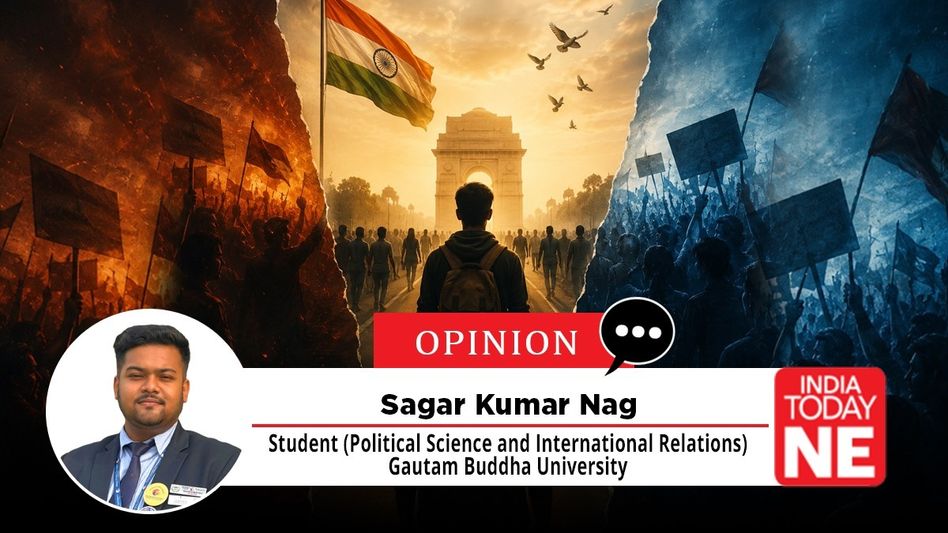
India’s growing political divide is no longer just shaping elections — it is quietly reshaping how an entire generation thinks, argues, and defines patriotism itself. Between blind loyalty, rising intolerance, and fading rational discourse, the piece questions whether the country’s biggest threat is no longer political opposition, but the loss of unity and critical thinking among its own people

- May 24, 2026,
- Updated May 24, 2026, 11:50 AM IST

- Author says partisan hostility is displacing constructive democratic engagement across society
- Young Indians raising systemic concerns are often judged through presumed affiliations
- Piece credits current and past governments, calling development cumulative and shared
India today is not merely witnessing political polarisation; it is witnessing the gradual erosion of rational public discourse. The crisis facing the nation is not simply ideological division between political parties, but the transformation of democratic debate into emotional hostility, partisan absolutism, and intellectual intolerance. In such an atmosphere, the youth — instead of becoming architects of national progress — are increasingly being drawn into camps of blind loyalty and perpetual outrage.
What concerns many observers about this nation is the gradual polarisation of the youth into rigid ideological divisions. Individuals who raise their voices against systemic shortcomings are frequently subjected to controversy and criticism, often on the assumption that they are politically aligned with a particular party or ideology. However, the fundamental issue should not revolve around presumed political affiliations; rather, it should revolve around whether the concerns being raised reflect genuine flaws within the nation that deserve public attention and intellectual scrutiny.
At the same time, there is validity in the argument that political associations can sometimes compromise neutrality. If an individual maintains direct political affiliations, it becomes difficult to claim complete impartiality while selectively criticizing one political entity over another. This ideological contestation is perpetual in any democracy, and perhaps it will never truly cease. Yet the tragedy lies elsewhere: citizens have become so consumed by defending political parties that they have forgotten the larger national interest. Instead of engaging in constructive discourse about employment, empowerment, education, and long-term national progress, society has reduced itself to partisan confrontation.
The unfortunate reality is that ordinary citizens themselves will ultimately bear the consequences of poor governance, social division, and institutional decline. Therefore, this is a moment where unity must prevail over political bias. The youth of India should aspire toward a future where they can look back with pride and say that they contributed meaningfully to the nation’s progress. India is not merely a modern political construct of a few decades; it is a civilization with thousands of years of cultural, intellectual, and historical continuity. Its destiny cannot and should not be determined solely by the fortunes of any single political party.
It is equally important to acknowledge that the present government has undertaken several remarkable initiatives and achieved considerable progress in numerous sectors. Denying such contributions would be intellectually dishonest. However, democratic maturity also requires us to recognise the accomplishments of previous governments. Significant advancements in areas such as the Right to Information (RTI), educational expansion, institutional reforms, and media transparency emerged during earlier administrations. This acknowledgement does not imply that past governments were free from mistakes; clearly, political accountability and electoral outcomes reflect public dissatisfaction where failures existed. Yet national development is cumulative, not exclusive to one administration alone.
Furthermore, many intellectuals and citizens will strongly disagree with the recent characterisation of the youth as “cockroaches.” Such terminology is profoundly inappropriate and dehumanising. When young people are compared to parasites or portrayed as burdens upon society, it diminishes their dignity and undermines their aspirations for the future. The youth of this country are not indifferent to the fate of coming generations; many are deeply concerned about survival, opportunity, and social respect in an increasingly uncertain future.
That being said, there is also an uncomfortable truth that cannot be ignored: dignity must be accompanied by effort and responsibility. Every meaningful achievement in life demands perseverance and hard work. With the exception of a privileged capitalist minority born into inherited wealth and influence, the overwhelming majority of Indians must struggle relentlessly to secure success and stability. Even those born into affluent families cannot sustain a legacy without competence, discipline, and vision. History repeatedly demonstrates that privilege without intellect or determination eventually collapses.
On matters of diplomacy and international representation, many diplomats also believe there is a distinction that must be carefully maintained. Many do not oppose cordial relations or visible friendship between world leaders, including the interactions involving the Prime Minister of India and the leadership of Italy. Friendship between nations is valuable and should indeed be appreciated. However, diplomacy must preserve a sense of institutional dignity and strategic seriousness. A nation such as India, after more than seventy-five years of independence and with its immense civilizational stature, should project itself globally with confidence, maturity, and the assertiveness of a nation prepared to define itself as a developed and influential power.
This is not a criticism directed solely at the present government. Rather, it is an appeal for continuity in foreign policy strength and national interest beyond partisan politics. Every administration must work in a manner that strengthens India’s long-term international credibility so that future governments do not inherit the consequences of short-term political or religious polarisation. Governance rooted excessively in religious symbolism or divisive identity politics may generate temporary emotional appeal, but it risks weakening the broader social harmony and institutional integrity essential for a strong democracy.
Ultimately, India’s future should not be constructed upon ideological hostility, political blind loyalty, or religious division. It should be built upon rational discourse, national unity, institutional accountability, economic opportunity, and the collective determination of its people to leave behind a stronger, more dignified nation for future generations.