Arunachal minister calls for farmer-centric technology to transform Northeast agriculture
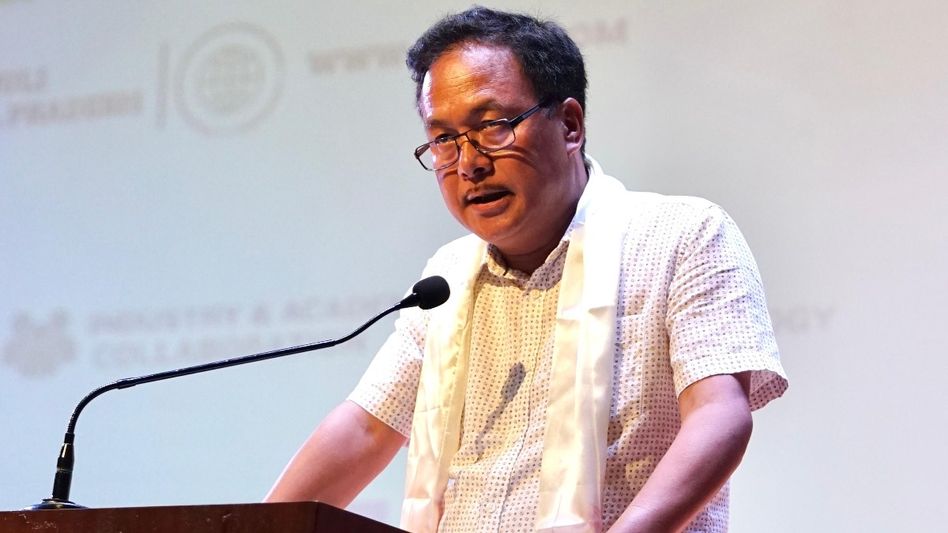
Technology can transform agriculture, but its success will ultimately depend on whether it reaches farmers and works in real-world conditions, Arunachal Pradesh Agriculture and Allied Departments Minister Gabriel D Wangsu said at the valedictory ceremony of EARITA 2026 at NERIST.

- Oct 01, 2026,
- Updated Oct 01, 2026, 8:33 PM IST

Technology can transform agriculture, but its success will ultimately depend on whether it reaches farmers and works in real-world conditions, Arunachal Pradesh Agriculture and Allied Departments Minister Gabriel D Wangsu said at the valedictory ceremony of EARITA 2026 at NERIST.
Speaking at the North Eastern Regional Institute of Science and Technology (NERIST), Wangsu called for a farmer-centric approach to agricultural innovation, particularly in the Northeast, where small landholdings, difficult terrain, diverse agro-climatic conditions and traditional farming practices present distinct challenges.
“Technology in agriculture must ultimately serve the farmer,” Wangsu said, stressing that the true measure of technological progress should be its usefulness, affordability and accessibility to those working in the fields.
The conference, organised by NERIST's Department of Agricultural Engineering, brought together researchers, scientists, academicians, students, innovators and professionals to discuss emerging applications of artificial intelligence, robotics, drones, sensors, remote sensing and digital platforms in agriculture. NERIST identifies EARITA 2026 as an international conference on emerging AI, robotics and IoT technologies in agriculture.
Wangsu said the Northeast could not simply adopt agricultural models developed for large, mechanised farms elsewhere. Technologies for the region, he said, must be adaptable to small farms and difficult terrain while remaining affordable and easy to operate.
He also linked agricultural innovation to the region's growing climate and environmental challenges, saying research on glacier retreat, permafrost, soil erosion, hydrology and changing rainfall patterns had direct implications for water security, soil health, crop productivity and the resilience of farming systems.
The minister highlighted smart irrigation, remote sensing, hydrological modelling and IoT-based water management as areas that could help farmers use water and other resources more efficiently.
On farm mechanisation, Wangsu said the focus should not be limited to automation but should also be on reducing drudgery, improving safety and efficiency, and making farming more dignified.
He said machinery developed for the Northeast must take into account small landholdings, difficult terrain, horticultural crops and local farming practices.
Wangsu also stressed the need to bridge the digital divide in rural areas, cautioning that artificial intelligence should not become a technology available only to farmers with expensive equipment, specialised skills or high-speed internet connectivity.
Welcoming research presented at the conference on edge-AI and low-bandwidth solutions for smallholder farmers, he said technologies such as machine-vision grading, AI-based quality assessment, shelf-life prediction and improved drying systems could help reduce post-harvest losses, improve product quality and create new opportunities for rural entrepreneurship.
“The farmer of the future should not only be a producer. They should also have the opportunity to become a processor, entrepreneur and value creator,” he said.
Wangsu said technology-driven agricultural growth must also remain environmentally sustainable, with climate resilience, soil conservation, efficient water use, renewable energy and protection of natural ecosystems forming an integral part of innovation.
For Arunachal Pradesh, he said the way forward lies in combining traditional knowledge and the state's natural advantages with modern science and technology.
The minister urged researchers to ensure that ideas discussed at EARITA 2026 do not remain confined to conference halls, research papers or prototypes. He called for field testing, demonstrations and wider adoption of promising technologies under actual conditions in the Northeast.
He also encouraged NERIST, research institutions, industry partners and the Agriculture Department to strengthen collaboration, with farmers directly involved in testing technologies and providing feedback.
“Farmers should be able to see the technology, understand it, use it and tell us how it can be improved,” Wangsu said.
Calling on students and young researchers to view agriculture as a major frontier for innovation, the minister highlighted opportunities in AI, robotics, drones, sensors, data, biotechnology, food processing, renewable energy and digital platforms.
He said the Northeast should aim not merely to become a consumer of agricultural technology but to develop solutions tailored to its own agricultural conditions.
Wangsu expressed confidence that NERIST, with its multidisciplinary expertise, could play a larger role in developing and testing technologies specifically suited to the region.
He also assured the organisers of possible support for the programme next year and called for sustained collaboration among academia, government, industry and the farming community.
The valedictory ceremony was attended by NERIST Director Prof Narendranath S, scientists, academicians, researchers and students.