Scientists discover rare leafless 'Ghost Flower' orchid in Arunachal Pradesh
Scientists have identified the rare leafless orchid Gastrodia keyiensis in a remote gorge along the Keyi River in Arunachal Pradesh. The find adds to the state's orchid wealth and has prompted calls for further surveys and conservation.

- Sep 21, 2026,
- Updated Sep 21, 2026, 1:28 PM IST

- Only five flowering plants were recorded during the Keyi River survey
- The leafless orchid survives through fungi instead of photosynthesis or chlorophyll
- Researchers found it in deep shade within bamboo groves and leaf litter
Scientists have identified a rare leafless orchid species, Gastrodia keyiensis, in a remote gorge along the Keyi River in Arunachal Pradesh's Keyi Panyor district, marking a new addition to the state's rich botanical diversity.
The orchid was discovered at an elevation of around 1,000 metres during a botanical survey. Researchers recorded just five flowering individuals at the site, highlighting the species' elusive nature and limited known distribution.
The findings have been formally published in the international taxonomic journal Phytotaxa in a paper authored by Madhusudhan Khanal, Dipankar Borah, Shuvadip Sarkar, Neelam Gap, Santosh Kumar Rai and Devendra Kumar. The paper was published on September 9.
The researchers are affiliated with institutions including the G B Pant National Institute of Himalayan Environment, Sikkim University, Kaliabor College and the Botanical Survey of India.
Gastrodia keyiensis belongs to the genus Gastrodia, a group of orchids known for their unusual dependence on fungi for nutrition.
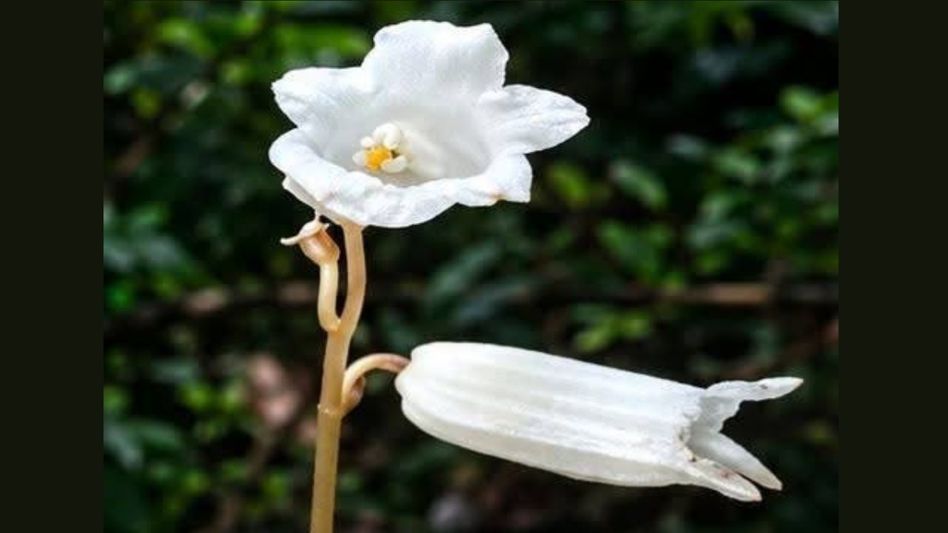
Unlike plants that use photosynthesis to produce food, the newly identified orchid has neither leaves nor chlorophyll. It obtains nutrients through its association with fungi in the soil, a process known as holomycotrophy.
Researchers found the orchid growing in deep shade among thick layers of decaying leaf litter in bamboo groves on the right bank of the Keyi River.
The plants can reach around 35 cm in height and produce between one and three flowers. Their flowers are white to pale bluish, with a distinctive yellow, strongly curved portion of the labellum.
Several morphological features distinguish G. keyiensis from closely related species. These include a broadly obovate basal portion of the labellum with six to seven prominent longitudinally thickened structures and a thick, strongly curved yellow apical portion.
The species is particularly difficult to detect because much of its life cycle takes place beneath the forest floor. Its short flowering period further reduces the chances of encountering it during routine botanical surveys.
The orchid is known as "Oram Opuh" in the Nyishi dialect, meaning "Ghost Flower". The local name refers to the plant's unusual appearance and its tendency to remain hidden for most of its life.
At present, Gastrodia keyiensis is known only from the location where it was discovered. Researchers estimate its area of occupancy at around four square kilometres.
Because its overall population and geographical distribution remain unknown, the species has been placed in the Data Deficient (DD) category. The researchers have recommended further surveys and long-term monitoring to establish its population status and range.
Deputy Chief Minister Chowna Mein described the discovery as another addition to Arunachal Pradesh's natural heritage. He said the finding adds to the understanding of the state's biodiversity and highlighted the need for continued research and conservation of its fragile ecosystems.
Arunachal Pradesh is home to around 600 documented orchid species, according to the state Forest department. Its varied elevations, climate and forest habitats support a wide range of plant and orchid species, contributing to its reputation as an "Orchid Paradise".