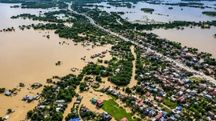
After the flood, can Upper Assam’s silt-covered fields grow again?
Across large stretches of farmland, the floods have left behind thick layers of mud and silt, raising a crucial question: Can these fields be cultivated again, and will the soil still be capable of producing a healthy crop?

- Aug 16, 2026,
- Updated Aug 16, 2026, 1:10 PM IST

Scientists say flood-hit farmland can be brought back under cultivation, but the road to recovery will depend on what the flood has left behind and whether farmers get the right soil tests, drainage support and crop choices in time.
The floodwaters may eventually recede from the agricultural fields of Upper Assam, but for thousands of farmers, the crisis will not end when the water disappears.
Across large stretches of farmland, the floods have left behind thick layers of mud and silt, raising a crucial question: Can these fields be cultivated again, and will the soil still be capable of producing a healthy crop?
Scientists studying Assam's rivers and agriculture say the answer is broadly encouraging. Flood-deposited silt does not automatically mean that farmland has become infertile. In fact, depending on its composition, freshly deposited material can sometimes improve soil.
But the same flood can also leave behind coarse sand, nutrient-poor material or heavy deposits that interfere with drainage and make cultivation difficult.
The difference, experts say, lies in what exactly has been deposited, how thick the layer is, what the original soil was like and what crop farmers intend to grow.
Not all silt is the same
Professor Arup Kumar Sarma, a hydrologist at IIT Guwahati, said the first step in understanding the agricultural impact is to determine the nature of the material deposited by the flood.
"For good agriculture plants need several major and minor nutrients and it gets those from the soil or some time added in irrigation water. Therefore, the measures to be taken for agriculture depends on the type of soil that gets deposited," Sarma said.
The soil carried by floodwaters can come from very different sources.
If the material originates from fertile topsoil rich in biomass, its deposition may not necessarily be harmful. Such material can retain nutrients and organic matter that support crop growth.
But soil washed down from degraded hillsides can be very different.
"Generally the original top soil rich in biomass remain fertile. However, from a hill, degraded due to excavation or toe cutting for various purposes, the soil coming down may not be carbon or nutrient rich," Sarma said.
This distinction is particularly important in a flood landscape where rivers carry material from hills, riverbanks, agricultural land and areas affected by erosion and human activity.
A field covered by fine, nutrient-bearing silt could therefore have a very different recovery trajectory from one buried under coarse sand.
"If the soil type is course silt or sand, then generally nutrient content may be less and thus not fertile. If it is nutrient bearing clay or fine silt, then it may be fertile," Sarma said.
In other words, the presence of silt alone cannot determine whether a field has been damaged permanently.
Soil testing will determine the next step
For farmers standing before fields covered in flood deposits, visual assessment may not be enough.
Sarma said the Agriculture Department can conduct soil tests to determine fertility and pH levels and establish whether the land remains suitable for cultivation.
"Agriculture department can do the soil test for fertility, pH value etc to confirm its suitability for agriculture," he said.
This could become one of the most important steps in the post-flood recovery process.
A field may look ruined because of a thick layer of mud, but testing could show that the deposited material is relatively fertile. Conversely, a field that appears to have received ordinary silt could contain material deficient in nutrients or have drainage problems that make cultivation difficult.
"If the soil is not fertile, then necessary management measures will have to be taken," Sarma said.
But there is no single treatment that can be prescribed for every flood-hit field.
"It is difficult to suggest a measure without knowing the property of deposited soil and the type of crop to be planted there," he added.
The clock is also running for farmers
For farmers, however, recovery is not only about soil quality. It is also about time.
Once floodwaters recede, the condition of individual fields will determine how quickly cultivation can restart. Some areas may dry out relatively quickly, while others could remain waterlogged because of blocked drainage channels or altered soil profiles.
Dr Kalyan Pathak, Head of the Department of Agronomy at the College of Agriculture, said the feasibility of raising another crop would depend largely on when the flood recedes and the condition of the land afterwards.
"The feasibility of raising crop will definitely depend on recession of flood, situation in the area," Pathak said.
That means farmers may need to abandon the idea of immediately returning to the crops they normally grow and instead choose crops according to the remaining agricultural window.
Short-duration crops could offer a way back
If the flood recedes early enough and the fields become workable, farmers could still have options.
Pathak said suitable crops could include rapeseed and mustard, pulses, potato, vegetables and fodder crops, depending on local conditions.
These crops could be particularly useful where the flood has disrupted the normal agricultural calendar and left farmers with a shortened growing season.
"Thus, depending on the time of recession of flood water and condition of land suitable crops such as rapeseed and mustard, pulses, potato, vegetables, fodder crops and other short duration crops can be introduced in rabi and summer crops," he said.
The emphasis, therefore, would be on flexibility rather than simply trying to restore the pre-flood cropping pattern.
A farmer whose paddy cycle has been disrupted may have to look at alternative crops that can mature within the remaining season.
The hidden problem beneath the mud: drainage
The visible layer of silt may be only one part of the problem.
Heavy deposition can change the physical characteristics of agricultural land and interfere with the movement of water through fields. In areas where drainage channels have also been clogged or altered by sediment, water may remain trapped long after the main flood has receded.
Pathak said heavy silt deposition could affect soil fertility and drainage and ultimately reduce crop productivity.
"Heavy deposition of silt will affect soil fertility, drainage and ultimately crop productivity," he said.
This makes post-flood recovery more complicated than simply waiting for the mud to dry.
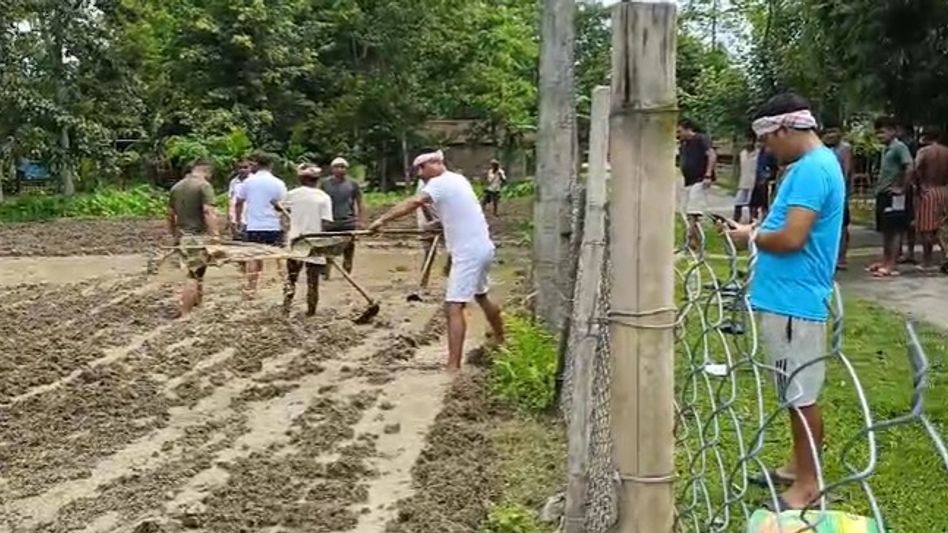
Depending on the location and the depth and nature of the deposits, farmers may need to remove or redistribute accumulated sediment, reopen blocked drainage routes and restore the physical condition of the land before planting.
There is no one-size-fits-all solution
Experts caution against treating every flood-affected field in the same way.
One farmer may be dealing with a thin layer of nutrient-rich fine silt that could eventually benefit the soil. Another may find a thick layer of coarse, nutrient-poor material that needs substantial intervention.
Similarly, one field may have good drainage after the flood recedes, while another may remain waterlogged because sediment has blocked its natural or artificial drainage channels.
Pathak suggested a combination of location-specific desiltation, drainage measures and organic manuring, supported by capacity-building programmes for farmers.
"Depending upon the situation and feasibility, location specific desiltation, drainage, organic manuring coupled with specific capacity building programme may help in restoration of cultivation," he said.
That approach puts local conditions at the centre of recovery rather than prescribing a uniform package for an entire flood-affected region.
The bigger question: why did the flood become so destructive?
The damage to farmland is also part of a much larger story about Assam's rivers.
Scientists have pointed to a combination of factors behind the severity of the recent floods: hills that have lost their ability to retain soil, rivers whose beds have become increasingly shallow because of sedimentation, and embankments that may no longer provide adequate protection against increasingly severe flood events.
The monsoon itself does not necessarily have to be historically extraordinary for the consequences to become catastrophic.
A river system already carrying large amounts of sediment, a landscape vulnerable to erosion and infrastructure unable to withstand rising water levels can turn an intense monsoon into a disaster.
And that raises the more difficult question: if the landscape and river system have changed, can the damage be reversed?
Scientists believe at least some of it can.
But restoration will require more than emergency relief.
From relief to restoration
For farmers, the immediate priority is to get the water out, assess the soil and determine what can still be planted.
The longer-term challenge is rebuilding the productivity of land that may have been physically altered by the flood.
That could mean systematic soil testing across affected agricultural areas, field-specific recommendations on nutrients and organic matter, restoration of drainage systems and selective desiltation where deposits are too heavy or unsuitable for cultivation.
Farmers will also need guidance on crop selection. The agricultural calendar after a major flood cannot simply be assumed to be the same as in a normal year.
For some, the recovery may begin with a short-duration crop. For others, the land may require rehabilitation before anything can be planted.
The answers also point to the need for coordination between scientists, the Agriculture Department, local administrations and farmers.
A difficult recovery, but not a lost land
The flood may have covered fields in mud and silt, but experts do not see that as an automatic death sentence for agriculture.
The material deposited by the flood could be fertile or poor; the fields could recover quickly or remain damaged for a longer period. The deciding factors will be the nature of the sediment, its depth, soil chemistry, drainage and the crop selected.
As Sarma put it, there is no blanket prescription without first understanding the deposited soil and the crop that farmers intend to grow.
That makes soil testing the starting point, not an afterthought.
For Upper Assam's farmers, the challenge now is to move from the immediate trauma of flood loss to a more precise phase of recovery testing what remains, restoring what has been damaged and choosing crops that fit the new reality of the land.
The water may ignore administrative boundaries and political borders, but the response cannot afford to be fragmented. If the flood exposed weaknesses in Assam's landscape and river systems, restoring its agricultural fields will require an equally coordinated effort one that begins in the mud left behind and extends all the way to the hills and rivers that brought it there.