Assam Floods | Nepalikhuti village: Where the river took everything
This is Nepalikhuti, the last village of Assam along the Nagaland border. A village where people spent the night clinging to trees, waiting on rooftops for rescue, and watching their homes disappear before their eyes. Today, one question hangs over the entire village: 'What will we do now? How will we survive?'

- Jul 28, 2026,
- Updated Jul 28, 2026, 11:52 PM IST

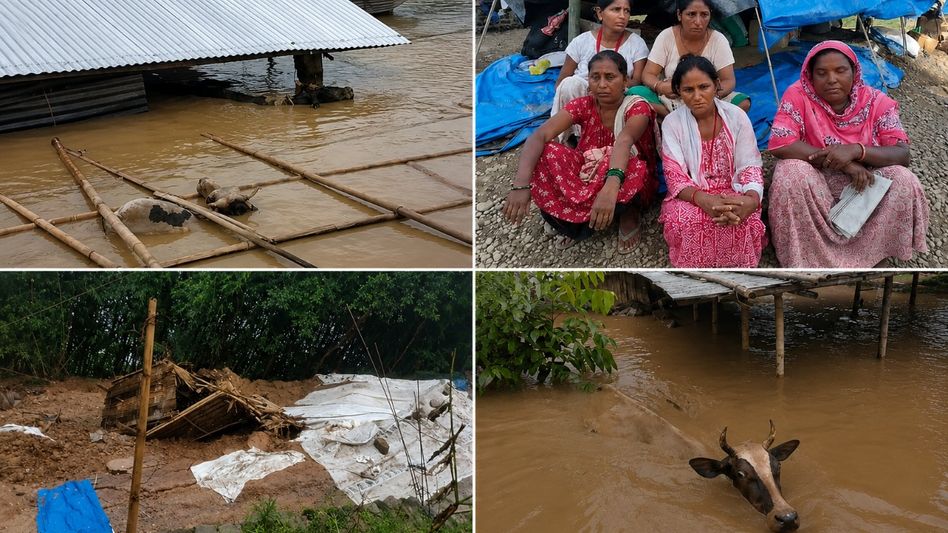
When we entered Nepalikhuti, located about 12 kilometres from Nazira town, there was silence. Not the silence of an ordinary village, but the silence that follows devastation. People turned towards our vehicle. Within seconds, they began running towards us, hoping we had brought relief. For more than seven days, hundreds of families have been living under tarpaulin sheets beside a petrol pump and along the roadside. Their homes remain inaccessible, buried beneath mud and debris left behind by the flood. The air carries the foul smell of decaying livestock. The roads remain blocked, and every direction tells the same story of destruction.
This is Nepalikhuti, the last village of Assam along the Nagaland border. A village where people spent the night clinging to trees, waiting on rooftops for rescue, and watching their homes disappear before their eyes. Today, one question hangs over the entire village:
"What will we do now? How will we survive?"
The first person who came up to us was Rubul Ali.
"Our entire Nepalikhuti has been destroyed. If you go there now, you will only find rotting cattle. We tried to remove them, but we couldn't. There is mud everywhere," he said.
Rubul said boats owned by members of the Bihari community, which were earlier used for stone quarrying, became the villagers' only lifeline during the floods.
"They rescued us. If only dumpers or heavy machines cleared the roads, at least we could go back and see what remains of our homes."
But survival in Nepalikhuti came at a cost.
"One man rescued nearly fifteen people before he lost his life," Rubul recalled.
"Another villager saved seven people. After the rescue, he sat down on a dumper to rest. Moments later, he too died."
"Many risked everything to save others. Some never made it back."
As we travelled further into Bihubor towards Nepalikhuti, the devastation became impossible to ignore. Collapsed houses. Fields buried beneath layers of mud. Dead cattle trapped under silt. Roads washed away. What was once a thriving village now resembles a landscape abandoned by life.
Binod Sharma, a small farmer from Nepalikhuti, remembers the day everything changed.
"On July 19, after breakfast, I went to see the Dikhow River because it had rained heavily the previous day."
"While returning home, floodwater suddenly rushed in. The water level rose so fast that I didn't know what to do. Should I save my mother or should I save my belongings?"
He called his brother, who rescued him by boat.
"When we returned, we thought there would be a relief camp. But there was nothing."
"We slept on the roadside without food." "The next morning, everything had disappeared. Nothing was left."
For generations, coal mining, stone quarrying, farming and dairy sustained families in Nepalikhuti. Today, many villagers allege that years of illegal coal mining and stone quarrying worsened the destruction. "We work in coal mining and stone quarrying. That is how many families here earn their livelihood," Rubul said.
"But we will never allow illegal mining here again. If they bring trucks, JCBs or heavy machines for illegal mining, they will have to drive them over our bodies first."
"The sediment you see everywhere... this is because of mining." Rubul also questioned the relief efforts.
"The Deputy Commissioner says relief has been provided. But it has not reached many people."
"I am not asking for myself. I am asking for those who are extremely poor, who have lost everything and are still waiting for help."
Among them is Jopa Pradhan, a small businesswoman who earned a living through tailoring. The floodwaters swept away her tailoring shop, her sewing machine and everything she had built over the years.
"I could only save my daughter. Everything else was swept away," she said.
With her shop destroyed and her source of income gone, Jopa now lives under a tarpaulin sheet with hundreds of other displaced families, uncertain of how she will rebuild her life.
"There is no place for us to stay. There are young girls and women here. How will we live?"
"My husband rescued seven or eight people. He carried us through the floodwaters. We reached the petrol pump and held on to tyres to survive."
"My sister-in-law survived by holding on to a betel nut tree throughout the night."
"Today we have food only for today. We don't know what tomorrow will bring. Please help us."
As rescue teams slowly clear the roads, families are returning to villages that no longer resemble the places they once called home. They are finding houses reduced to rubble, fields buried beneath mud and livestock lying dead under layers of silt. For many small dairy farmers, the losses are impossible to comprehend.
Several had taken loans to buy Holstein Friesian (HF) cows, relying entirely on milk sales as their only source of income. Today, those cows lie dead, leaving behind debt but no livelihood. The scale of devastation extends far beyond damaged homes.
According to the latest Assam State Disaster Management Authority bulletin, more than 4.45 lakh people remain affected across six districts, while the flood death toll stands at 68.
More than 88,000 livestock have been affected across Assam, and over 26,500 animals have been washed away. In Nepalikhuti alone, villagers estimate that nearly 2,000 cattle have died.
Residents also claim they saw the bodies of seven to eight people being swept away by the floodwaters. Even today, dead cattle remain buried beneath layers of mud, filling the air with an unbearable stench.
The floods have also submerged nearly 49,000 hectares of cropland, wiping out the primary source of income for thousands of farming families.
For Nepalikhuti, the flood did not simply wash away homes. It washed away livelihoods. It washed away years of hard work. And it washed away the certainty of tomorrow. Today, as the floodwaters recede, the people of Nepalikhuti return not to homes, but to ruins. Along the banks of the Dikhow River, farmers sit with their heads buried in their hands, staring silently towards the mountains that have witnessed this tragedy unfold. Their cattle are gone. Their fields lie buried beneath mud. Their homes have disappeared. They are not asking for sympathy. They are searching for a way to begin again.
Across this village, one question still echoes:
"Where do we begin now?"