Assam floods: Ruins and Remains
More than a month after the waters receded, Assam is moving from rescue to rebuilding. But for families who lost people, homes and livelihoods, recovery is proving far more complicated than waiting for the water to go down.

- Sep 06, 2026,
- Updated Sep 06, 2026, 11:50 AM IST

- State report recorded 108 deaths and nearly 25,000 people still affected
- More than 12 lakh residents across 25 districts faced flooding this season
- Raihana Ara Ahmeda died saving her parents, leaving behind two daughters
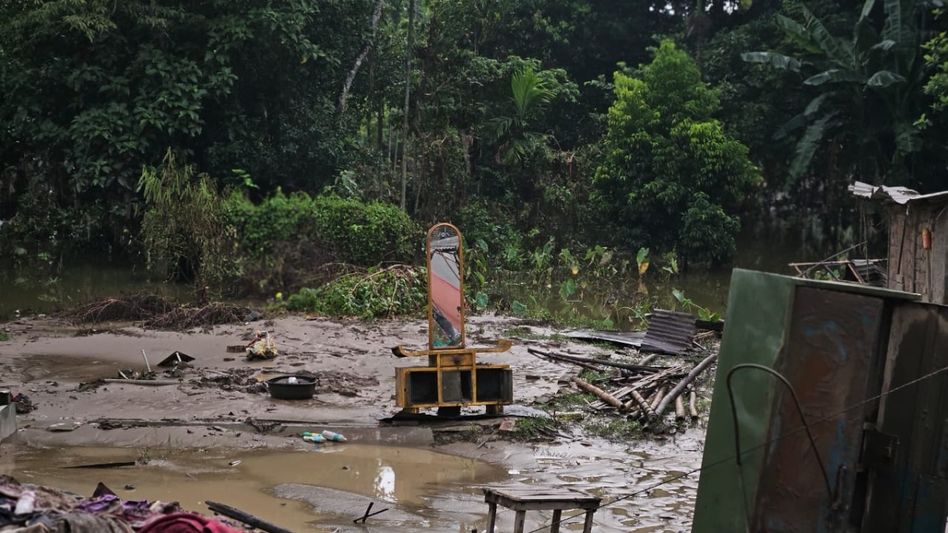
The mirror is still standing.
Around it, there is little left of what was once a home. Mud has settled across the floor, broken bamboo lies scattered where a wall used to be, and belongings that once had their place inside the house have been pushed together, discarded, or left where the floodwater put them down. The mirror remains upright, reflecting a small patch of the world outside. More than a month after the floods swept through Assam, the water has largely gone, but in many homes its presence remains — in the mud still on the walls, the furniture left out to dry, the things that could not be salvaged, and the spaces left empty by those who did not survive.
The scale has settled into numbers by now. As of September 3, Assam’s flood death toll had risen to 108, with 25,083 people affected across seven districts and 6,477.31 hectares of crop area affected. The latest spell of flooding has hit Goalpara, Sivasagar, Biswanath, Nagaon, Morigaon, West Karbi Anglong and Cachar, with 155 villages currently affected. During the worst days, the questions were immediate — who needs a boat, who is trapped, where can people find food. More than a month later, the questions have changed. Where will the family live. Who will replace the income that was lost. What does a person do with a grief that has no repair plan.
For Raihana Ara Ahmeda's family, there is no rebuilding that restores what the flood took. Raihana, 30, a mother of two, died trying to save her parents. Her father, Rafique Uddin Ahmed, survived. "My daughter died saving my wife and me," he said. She left behind Mehnaz, 12, and Atika Shehnaz, 9, along with her husband. Her younger daughter still asks where her mother is, the family said. It is a child's question, but it carries the part of the flood no official count captures — there is no equivalent point at which this loss recedes.
Nobojyoti Gogoi, 53, died trying to save his livestock, leaving his wife, Rupa Gogoi, 41, and daughters Principriya, 12, and Ayushree, 10. In the days after his death, Principriya spoke of what she and her sister had decided. "Now we both will. We won't let her worry alone anymore," she said. The girls are too young to carry a household, but grief does not wait for adulthood. They are living with their mother, and that promise has become one way of making sense of a life that changed without warning.
For Shravan Prasad, 26, the aftermath is tied to a decision made while the water was still rising. His younger brother, Samir Prasad, 23, was trapped and calling him, while a larger group waited to be rescued elsewhere. "If I come for you, those two hundred people will die. I have to go to them first," he told Samir. Samir survived. Shravan and others eventually helped rescue more than a thousand people. What remains, more than a month on, is not a second tragedy but the memory of having to choose. He hopes such a disaster never happens again. The work around him has shifted from pulling people out of water to learning how to build — his own home, and other people's.
That shift is the story of where Assam is now: from rescue, to food and shelter, to the slower work of rebuilding. Dr Rajib Panging, psychiatrist at Sivasagar Civil Hospital, said people who lived through the disaster will have developed post-traumatic stress. The end of danger does not mean the end of the experience — fear can attach itself to something as ordinary as heavy rain. Much of the support survivors receive, though, is coming from within their own families, from people who are themselves recovering from the same event.
Photographs of children from the affected areas show a simpler version of the same aftermath — routines interrupted, homes that no longer look familiar, school disrupted. For a child, a flood can quietly change what ordinary rain means. That is part of why "home" is more complicated than a repaired roof. A house is a structure; a home is made by the people in it. When someone dies, rebuilding the house does not restore the home that existed before it. When a family stays in a shelter, the shelter becomes home for a while.
The Sivasagar Gurudwara showed that shift directly. During the floods, it sheltered around 500 people at a time, and its kitchen served an estimated 1,000 to 1,500 people a day. Some families have since moved out after finding stability; others remain. Ashok Sharma, 66, a sevadar there, said the volunteers understood what people were going through because their own homes had also gone underwater. "We can understand everyone's pain because our own homes were also underwater," he said.
Axom Relief, started by young technology professionals during the flood to connect people needing help with people offering it, is still active — its focus has moved toward linking flood-affected families with house-construction assistance. The problem has changed, and so has the response: the question is no longer how to get someone out of a flooded house, but how to help them have a house again.
ALSO WATCH:
For many families, that remains distant. A household that lost its home may also have lost livestock, crops, documents, tools, and its income. Compensation, when it arrives, does not by itself put a roof back up.
While Assam works through that slower phase, another Himalayan disaster is still unfolding. On August 26, a collapse high in the mountains sent a surge of water, mud and rock through the Lhende Khola valley along the Nepal-Tibet border, destroying homes and infrastructure. At last count, at least 1,341 bodies had been recovered across Nepal and Tibet combined, with more than 4,500 people still missing and over 13,000 injured or rescued in Nepal. The Red Cross estimated roughly 90,000 people affected. The numbers are still moving daily.
The scale is different from Assam's. But the images that follow are familiar — mud where a road used to be, families looking for the missing, rescue giving way to the long work of clearing debris. Assam is a month into that second phase. Nepal is only beginning it.
The physical ruins can be cleared. Mud can be washed from floors, walls rebuilt, belongings replaced. What cannot be restored is a mother returning to her daughters, or a father to his family, or the particular ease with which a person once heard rain falling.
The mirror remains in the damaged room, still reflecting a small piece of the world outside. Around it, the work of putting the house back together continues. Whether it becomes a home again will depend on far more than whether the walls can be repaired.