Assam Government urged to rebuild century-old namghar in Meghalaya, 270 Rabha families seek help
A century-old Namghar in Meghalaya's Ri-Bhoi district, which has served as a centre for preserving Assamese religious traditions and cultural heritage for more than 100 years, is in urgent need of reconstruction, prompting residents of two neighbouring villages to appeal to the Assam government for financial assistance.

- Oct 31, 2026,
- Updated Oct 31, 2026, 4:32 PM IST

A century-old Namghar in Meghalaya's Ri-Bhoi district, which has served as a centre for preserving Assamese religious traditions and cultural heritage for more than 100 years, is in urgent need of reconstruction, prompting residents of two neighbouring villages to appeal to the Assam government for financial assistance.
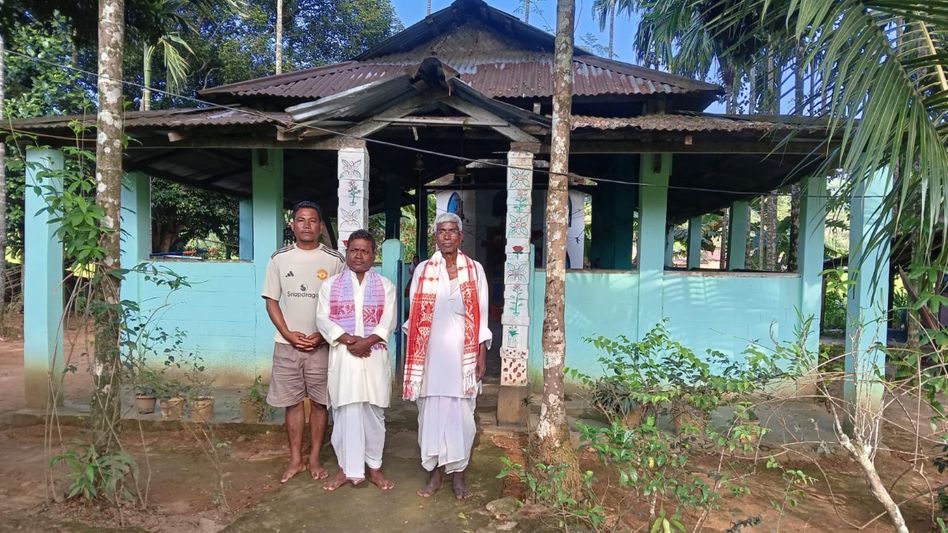
Residents of Umsaw and Baregaon villages have urged the Assam government to extend financial support for the reconstruction of the Sri Sri Kalia Thakur Namghar, also known as the Gosain Ghar, citing the deteriorating condition of the historic institution.
The Namghar, established in Baregaon in 1910, has remained a significant religious and cultural centre for nearly 270 Rabha families living in the two villages. Despite being located outside Assam, the community has continued to preserve Assamese customs, Vaishnavite traditions and cultural practices across generations.
Of the approximately 270 Rabha families, around 160 reside in Baregaon and 110 in Umsaw. The villages, located near Patharkhmah in Meghalaya's Ri-Bhoi district, are situated about 35 kilometres from Rani on the western outskirts of Guwahati.
The community has also maintained peaceful relations with the Khasi and other communities in the region, setting an example of communal harmony.
Spread across approximately three bighas of land between Baregaon and Umsaw, the Sri Sri Kalia Thakur Namghar remains the focal point of religious gatherings and community activities. However, the main prayer hall, granary and other associated structures have gradually deteriorated due to years of neglect and a lack of financial resources.
Most families in the villages depend on agriculture, daily wage labour and small businesses for their livelihoods, leaving them with limited means to undertake large-scale reconstruction.
Members of the Namghar management committee, including president Suren Sinal, vice-president Prasanna Mego, secretary Kumar Diya and treasurer Hari Pathak, along with young social worker Rano Chambai, said the institution continues to play a crucial role in keeping Assamese religious and cultural traditions alive in the area.
Religious activities are held regularly at the Namghar. Every Monday, women from the community assemble between 7 pm and 10 pm for naam-prasanga, while similar devotional gatherings take place on full moon and new moon evenings.
The institution also hosts annual worship of Sri Sri Kalia Thakur Gosain, Janmashtami celebrations, and programmes commemorating the birth anniversaries of Srimanta Sankardeva and Madhavdeva, the two prominent Vaishnavite saints of Assam.
The community also observes the annual Suweri festival on the eighth day of the Assamese month of Bohag. Uruka, the eve of Magh Bihu, is celebrated through a community feast, followed by the traditional lighting of the Meji bonfire the next morning.
In 2018, the then MLA of Jirang facilitated the construction of a boundary wall around the Namghar under a government scheme following demands from local residents. However, the main building and other structures have continued to deteriorate.
The tin roofs of the prayer hall and associated buildings have rusted over the years, raising concerns among residents about the long-term survival of the institution.
The villagers have now appealed to Assam Chief Minister Himanta Biswa Sarma to take special note of their demand and facilitate the complete reconstruction of the Namghar.
Local social worker Oral Chinkle, along with several other residents, welcomed the Assam government's initiatives to support Namghars and Satras outside the state, particularly in metropolitan cities where Assamese communities have established religious and cultural institutions.
They pointed out that the state government has extended support for the construction, renovation and infrastructure development of such institutions in cities including New Delhi, Kolkata, Mumbai, Chennai and Bengaluru.
According to the villagers, the Assam government earmarked Rs 325.55 crore in the 2025-26 financial year for the development, construction and infrastructure improvement of Namghars and Satras in Assam and other parts of the country.
They argued that similar assistance should be considered for the Sri Sri Kalia Thakur Namghar, given its historical significance and the role it continues to play in preserving Assamese cultural identity beyond the state's geographical boundaries.
The villages are approximately 60 kilometres from Guwahati city, while the Lokpriya Gopinath Bordoloi International Airport at Borjhar is around 40 kilometres away.
Surrounded by natural landscapes, Umsaw and Baregaon have retained their distinct cultural identity despite being located in Meghalaya. Residents said the Namghar has been central to this continuity, bringing generations together through religious observances, festivals and community activities.
The villagers expressed hope that the Assam government would consider their appeal and extend financial assistance before further deterioration damages the century-old structure.
They said rebuilding the Namghar would not only address the long-standing demand of the Rabha community but also help preserve an important part of Assam's religious and cultural heritage in a neighbouring state.