
Assam hosts North East workshop to push district-level SDG action plans
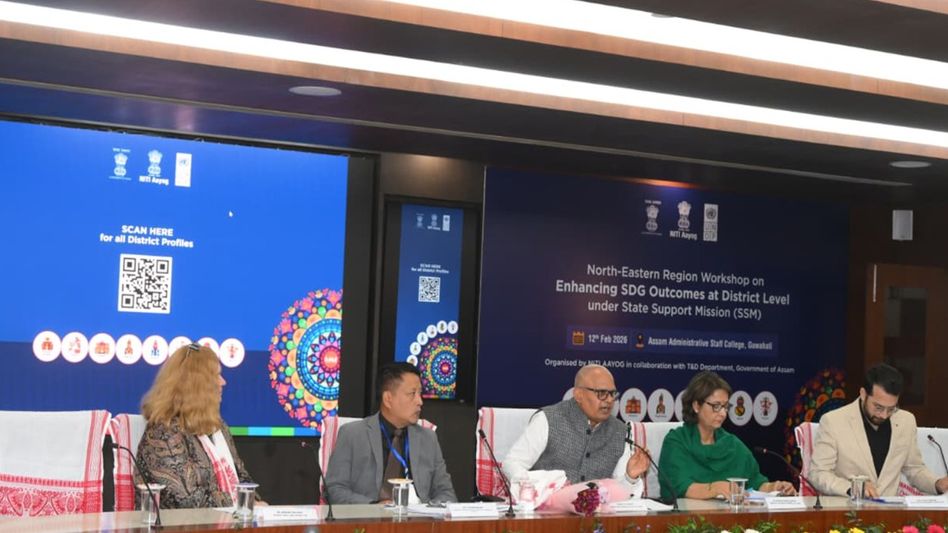
NITI Aayog, in collaboration with the Transformation and Development Department of Assam, held a regional workshop on strengthening Sustainable Development Goal (SDG) outcomes at the district level in Guwahati on February 12. The programme was organised under the State Support Mission (SSM) at the Assam Administrative Staff College.

- Feb 12, 2026,
- Updated Feb 12, 2026, 10:07 PM IST

NITI Aayog, in collaboration with the Transformation and Development Department of Assam, held a regional workshop on strengthening Sustainable Development Goal (SDG) outcomes at the district level in Guwahati on February 12. The programme was organised under the State Support Mission (SSM) at the Assam Administrative Staff College.
The workshop brought together senior officials from across the North East, including Chief Secretaries, Planning Secretaries and District Collectors, along with representatives from central ministries and development partners.
Among those present at the inaugural session were Charan Boro, Assam’s Minister of Transport and Bodoland Welfare; VK Paul, Member (Health) of NITI Aayog; Narayan Chandra Borkataky, Vice-Chairman of SITA; Ravi Kota, Chief Secretary of Assam; Satinder Bhalla, Secretary of the North Eastern Council; Rajib Sen, Programme Director (SDGs), NITI Aayog; Angela Lusigi, Resident Representative of UNDP; Dilip Kumar Bora, Secretary of the Transformation and Development Department; and P Vijaya Bhaskar Reddy, CEO of SITA.
Addressing the gathering, Charan Boro said the impact of global SDG targets must ultimately be visible at the grassroots level. He noted that progress would be meaningful only when outcomes are reflected in villages, schools and households. Referring to Assam’s recent performance in the SDG India Index, he said the state had improved its standing through coordinated planning and monitoring.
VK Paul underlined the importance of identifying gaps through reliable data and preparing time-bound action plans. He acknowledged the support of development partners and stressed that sustained focus on SDGs remains essential for national progress.
Chief Secretary Ravi Kota highlighted initiatives undertaken since 2016 that aligned state finances and departmental strategies with SDG targets. He called on the North Eastern states to assess their current performance, identify shortfalls and pursue coordinated interventions.
The workshop focused on translating district-level data into targeted administrative action. Officials discussed the “Zoom-In Effect”, a data convergence approach that uses the North East Region Index to flag district-level gaps and the Panchayat Advancement Index to pinpoint specific blocks or gram panchayats requiring intervention. The aim is to enable district administrations to design precise, time-bound action plans.
Another key component of the programme was the introduction of a step-by-step guide for SDG budget tagging, developed in collaboration with UNDP. The framework seeks to align state and district budgets more directly with SDG priorities, strengthening financial accountability and outcome tracking.
Technical sessions followed the inaugural event, with discussions centred on institutionalising coordination mechanisms through the State Support Mission and SDG Coordination and Action Centres.
Officials said the workshop is intended to move beyond review exercises and ensure that district administrations convert data insights into measurable, localised outcomes across the North East.
MORE NEWS











Copyright©2026 Living Media India Limited. For reprint rights: Syndications Today
