Assam scientist part of the collaboration which won 2026 Breakthrough Prize in Fundamental Physics
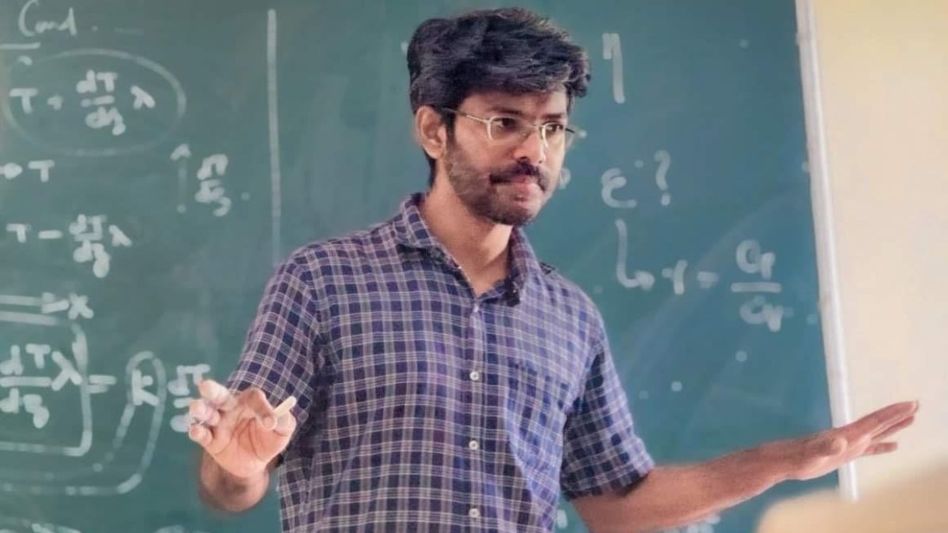
Atanu Nath, assistant professor of physics at Tihu College and a native of Hailakandi in Assam, is part of the Fermilab Muon g-2 collaboration, one of three laboratories that together won the $3 million prize announced in Los Angeles this month.

- Apr 24, 2026,
- Updated Apr 24, 2026, 4:26 PM IST

An Assam-born physicist, Atanu Nath, is part of one of the laboratories honoured with the 2026 Breakthrough Prize in Fundamental Physics, popularly known as the “Oscars of Science.”
Nath, who hails from Hailakandi district in Assam’s Barak Valley, is currently an assistant professor of physics at Tihu College in Nalbari district. He is a member of the Fermilab Muon g-2 collaboration, one of the three laboratories sharing the honour.
Nath is among 376 scientists worldwide, including around 11 Indians, who are part of this collaboration.
The prize itself has not gone to any individual scientist. It has been awarded to the Muon g-2 collaborations at CERN, Brookhaven National Laboratory, and Fermilab for multi-decade, groundbreaking contributions to the measurement of the muon’s anomalous magnetic moment, pushing the boundaries of experimental precision and igniting a new era in the quest for physics beyond the Standard Model.
The Breakthrough Prize Foundation announced the 2026 laureates on April 18 in Los Angeles. Co-founded by Sergey Brin, Priscilla Chan and Mark Zuckerberg, Julia and Yuri Milner, and Anne Wojcicki, the prizes are now in their 14th year, with each of the six main prizes carrying a $3 million purse. This year’s total prize money amounts to $18.75 million, bringing the total conferred over the 15 years of the Breakthrough Prize to more than $340 million.
At the heart of the recognition is a single, elusive number — the anomalous magnetic moment of the muon. The muon is a heavy, unstable cousin of the electron, and like the electron it can behave like a tiny magnet. Physicists have been trying to capture how the muon’s magnetic strength is subtly affected by the “foam” of virtual particles constantly popping in and out of empty space around it. Measuring the muon’s magnetism and comparing it to theoretical predictions allows physicists to test whether any unknown particles or forces are hidden in this foam — in other words, to probe for new physics beyond the Standard Model, our most successful theory of particles and forces.
The story of the experiment spans more than six decades and three continents. The CERN collaboration’s pioneering storage ring experiments of the 1960s and 1970s first measured the anomalous magnetic moment with meaningful precision. Then in the 1990s, Brookhaven National Laboratory’s reimagining of the experiment achieved a major improvement. And after the audacious transportation of Brookhaven’s 50-ton, 15-metre-diameter storage ring 3,200 miles by road and barge to Fermilab in 2013, the experiment was systematically refined to achieve a final precision of 127 parts per billion — a mind-boggling 30,000 times more precise than the first g-2 experiment in 1965.
The findings have kept physicists on edge. The results had shown a tantalising discrepancy with the value predicted by theory, and in 2023 Fermilab’s new results pushed that discrepancy close to the threshold considered evidence for new physics. Since then, the final, even more precise results, compared to newly evolved theoretical calculations, narrowed the gap — but considerable uncertainty remains for the moment.
That Nath — a Hailakandi boy who now teaches at Tihu College — is part of this global scientific enterprise adds a significant dimension to the announcement. The Fermilab-led experiment has drawn in hundreds of researchers from dozens of institutions worldwide, and Indian physicists, including one from the Northeast, are among those whose work underpins the collaboration’s decades-long pursuit of precision.
Whatever the final verdict on the muon anomaly, the 2026 Breakthrough Prize has placed the experiment — and by extension every physicist associated with it — in the front rank of modern science.