Assam shifts focus from bandhs to industries, says Himanta Biswa Sarma
Himanta Biswa Sarma has set out Assam’s industrial push, citing projects in chips, food processing and power. He said the aim is to turn investment pledges into jobs and keep young people working in the state.

- Oct 12, 2026,
- Updated Oct 12, 2026, 3:44 PM IST

- PepsiCo’s Nalbari plant has created 700 jobs, mostly for women
- Farmer engagement linked to the facility is expected to rise sharply
- Jagiroad’s first clean room is ready and pilot chip production began
Assam Chief Minister Himanta Biswa Sarma has outlined the state government’s industrial development agenda, highlighting investments in semiconductor manufacturing, food processing, power generation and traditional industries as key drivers of the state’s economic transformation.
In an article shared on Substack titled “From Bandhs to Blueprints: The Making of an Industrial Assam,” Sarma said Assam was moving away from a past marked by frequent shutdowns and uncertainty towards an industrial future centred on manufacturing, investment and employment generation.
The Chief Minister highlighted several recent industrial developments, including PepsiCo India’s ₹778-crore food manufacturing plant in Nalbari, the ₹27,000-crore Tata Electronics semiconductor assembly and test facility at Jagiroad, and a proposed 3,200 MW thermal power plant at Chapar in Dhubri district.
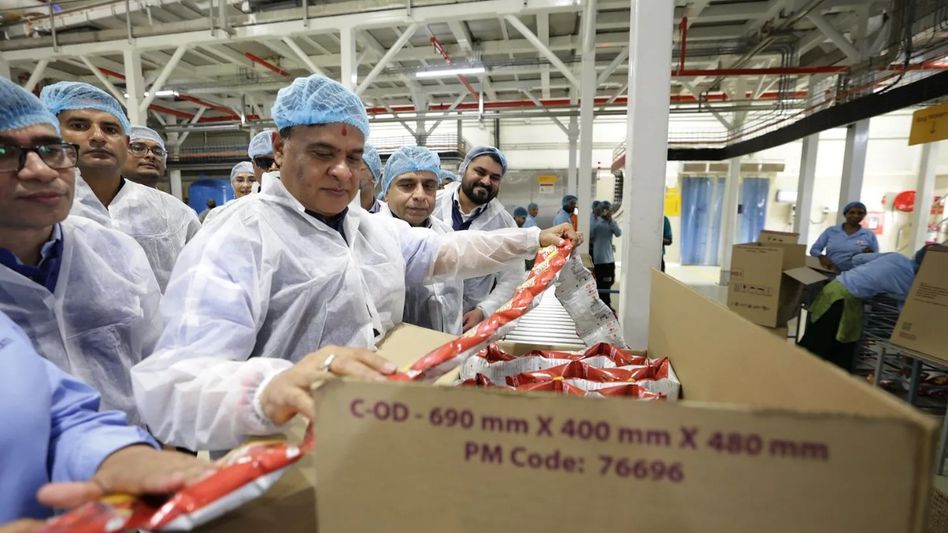
According to Sarma, the PepsiCo facility, inaugurated on September 10, is the company’s first food manufacturing plant in Assam and its fifth in India. Spread across 44.2 acres, the plant has created around 700 direct and indirect jobs, with women accounting for more than 75 per cent of its workforce. The company’s engagement with farmers in Assam is also expected to expand from more than 600 to 5,000, he said.
On semiconductor manufacturing, Sarma said the first clean room at Tata Electronics’ facility at Jagiroad had been completed and pilot chip production had begun. The project, involving an investment of ₹27,000 crore, is expected to position Assam within the global semiconductor supply chain.
The Chief Minister also referred to a tiles manufacturing facility in Sonitpur district, which he said would be the first in the Northeast to manufacture tiles using raw materials sourced from Assam. He said smaller industrial units in sectors such as food processing, packaging and construction materials were also emerging across districts.
Power infrastructure featured prominently in the article. Sarma said the foundation stone for a 3,200 MW ultra-supercritical thermal power plant at Chapar was laid on September 20. The project, involving an investment of ₹48,000 crore, will comprise four 800 MW units, with commissioning scheduled to begin in December 2030. Two pumped storage projects with a combined capacity of 2,700 MW are also planned, he said.
Sarma said these projects were intended to help Assam move from a power-deficit state to a power-surplus state, improving the availability of electricity for industrial and commercial activities.
The article also highlighted the proposed ₹10,601-crore ammonia-urea plant at Namrup, whose foundation stone was laid by Prime Minister Narendra Modi in December last year. Once completed, the facility is expected to produce more than 12 lakh tonnes of fertiliser annually. At Numaligarh, meanwhile, the refinery is being expanded from three million tonnes to nine million tonnes per year, supported by a new 1,635-km crude oil pipeline from Paradip.
Explaining the factors behind the state’s industrial push, Sarma cited improved security, faster approval processes and investments in roads, bridges, airports and waterways. He also referred to commitments worth approximately ₹5 lakh crore made at the Advantage Assam 2.0 investment summit, saying the focus was now on translating those commitments into operational projects.
Looking ahead, the Chief Minister outlined four priorities for the next phase of industrialisation: developing industrial parks with ready infrastructure, ensuring reliable and surplus power, providing industry-specific skills training, and promoting entrepreneurship at the grassroots level.
He said initiatives such as the Chief Minister’s Atmanirbhar Asom Abhijan and the Mukhyamantri Mahila Udyamita Abhiyan were intended to support young entrepreneurs and women-led businesses, enabling local suppliers and service providers to benefit from larger industrial projects.
Acknowledging that scepticism remained over earlier investment announcements, Sarma argued that the projects underway in Nalbari, Jagiroad and Chapar represented tangible progress rather than promises on paper.
He concluded that the government’s broader objective was to create opportunities for young people within Assam, allowing them to build their careers and businesses without having to leave the state.