Assam: Student bodies object to Guwahati city expansion into RHAC villages, demand rollback of acquisition notices
The Kamrup District Committee of the All Rabha Students' Union (ARSU) and the South Kamrup District Committee of the All Bodo Students' Union (ABSU) on Tuesday, July 14, jointly opposed the Guwahati Metropolitan Development Authority's (GMDA) proposed land acquisition in areas under the Rabha Hasong Autonomous Council (RHAC) for the Guwahati City Extension project.

- Jul 14, 2026,
- Updated Jul 14, 2026, 8:19 PM IST

The Kamrup District Committee of the All Rabha Students' Union (ARSU) and the South Kamrup District Committee of the All Bodo Students' Union (ABSU) on Tuesday, July 14, jointly opposed the Guwahati Metropolitan Development Authority's (GMDA) proposed land acquisition in areas under the Rabha Hasong Autonomous Council (RHAC) for the Guwahati City Extension project.
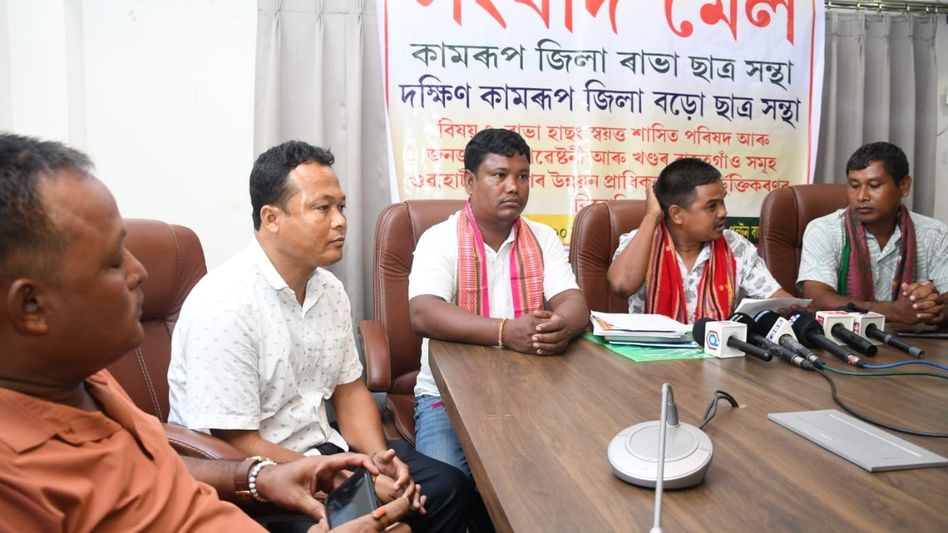
Addressing a joint press conference at the Tribal Rest House on Solapara Road in Guwahati, leaders of the two organisations alleged that the proposed acquisition would violate the provisions of the Rabha Hasong Autonomous Council Act and adversely affect tribal land rights. The press conference was attended by ARSU President Ananda Rabha, General Secretary Ashok Nongbag, ABSU South Kamrup District President Sangswarang Basumatary and other leaders.
Explaining the organisations' objections, ARSU General Secretary Ashok Nongbag said that following discussions between Chief Minister Himanta Biswa Sarma and the GMDA Chief Executive Officer on May 24, 2026, the authority issued a communication on June 3 proposing land acquisition for the Housing and Urbanisation Department in villages falling under the Rabha Hasong Autonomous Council and notified Tribal Belts and Blocks within the Azara and Palashbari Revenue Circles.
According to the organisations, land acquisition notices have already been issued for several villages in the greater Rani area, including 203 bighas in Jawe village, 676 bighas in Deorali village and 280 bighas in Janghliapara village. They further alleged that GMDA plans to include villages such as Jawe, Patgaon, Sajjanpara, Rajapanichanda, Andherijuli, Rangapara, Kachari Alibari and Batabari under the proposed New Town III project, despite these villages being part of the 779 revenue villages notified under the Rabha Hasong Autonomous Council (Amendment) Act, 2005 and located within Tribal Belts and Blocks.
ARSU President Ananda Rabha said the union has been opposing the inclusion of villages under the Rabha Hasong Autonomous Council and Tribal Belts and Blocks within the jurisdiction of the GMDA since 2009. He alleged that repeated attempts were being made to bring these revenue villages under the metropolitan development authority and asserted that ARSU and ABSU would continue to oppose any move to include their land under the Guwahati city expansion project.
Nongbag further alleged that the state government was attempting to undermine the Rabha Hasong Autonomous Council by bringing RHAC land under the city expansion project, in violation of the Rabha Hasong Autonomous Council (Amendment) Act, 2005. He claimed the move would weaken the Tribal Belts and Blocks framework and deprive Raiti farmers, who have depended on agriculture for generations, of their land ownership rights.
The two student organisations jointly demanded that none of the 779 revenue villages under the Rabha Hasong Autonomous Council be brought within the jurisdiction of the GMDA. They also urged the government to halt what they described as attempts to fragment Tribal Belts and Blocks and sought the grant of land ownership rights to Raiti farmers in the greater Rani area under the Azara and Palashbari Revenue Circles.
Calling for a review of the proposed land acquisition, the organisations also referred to the provisions of the Guwahati Satellite City Development Authority (GSCDA) Bill, 2026. They said the proposed legislation stipulates that development within the State Capital Region must comply with existing laws governing Tribal Belts, Blocks and Autonomous Council areas, while ensuring the protection of tribal traditions and cultural practices. They further noted that the Bill requires prior consent from the concerned authorities before finalising any regional development plan and mandates coordination with the Assam Land and Revenue Regulation, 1886, and other applicable laws to ensure lawful and inclusive planning.