
Assamese ‘marginalised in our own land’: Himanta Biswa Sarma warns of severe demographic challenge
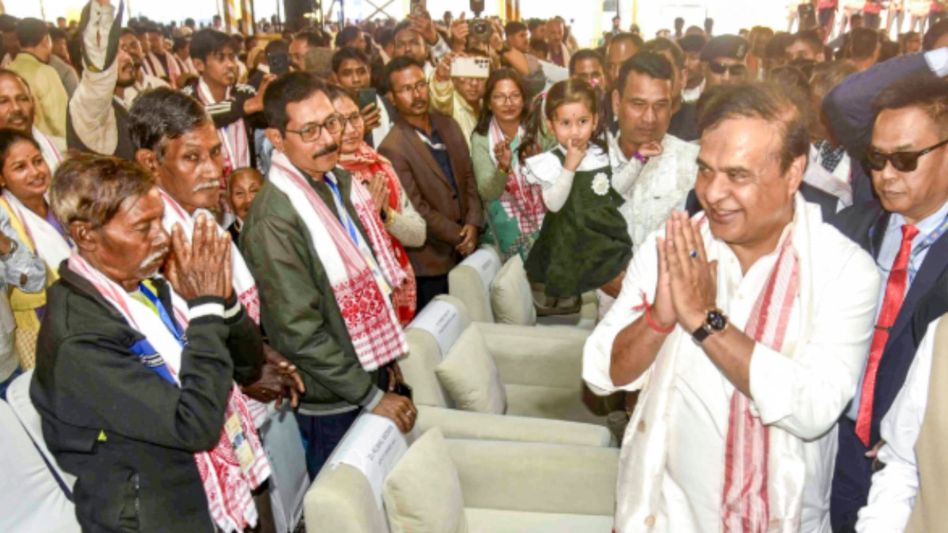
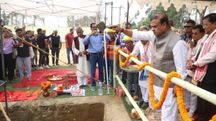
"Legalities apart, the Assamese are today marginalised in our own land; our culture is marginalised and the economy is fast shifting to those people who were never associated with our culture and history," Sarma said whilst inaugurating the Rs 170-crore Swahid Smarak (Martyrs Column) in Boragaon, Guwahati.

- Dec 10, 2025,
- Updated Dec 10, 2025, 10:37 PM IST

Assam is confronting a severe demographic challenge, with 40 per cent of the state's population having origins in Bangladesh, Chief Minister Himanta Biswa Sarma warned on December 10. Speaking on the occasion of Swahid Divas (Martyrs' Day), he painted a stark picture of the marginalisation facing indigenous communities in their own land.
"Legalities apart, the Assamese are today marginalised in our own land; our culture is marginalised and the economy is fast shifting to those people who were never associated with our culture and history," Sarma said whilst inaugurating the Rs 170-crore Swahid Smarak (Martyrs Column) in Boragaon, Guwahati.
The chief minister acknowledged that whilst the challenge continues, "one good thing is that there is a collective spirit to face it and I am sure that our new generation will keep on fighting. God will bless us and we will survive."
The memorial commemorates more than 860 people who died during the Assam Movement, a violent six-year agitation against illegal immigration that began on this day in 1979. The movement demanded the removal of foreigners from electoral rolls and sought to prevent further infiltration into the state.
Sarma traced the roots of illegal migration to the pre-independence era, when people from East Bengal and later East Pakistan entered Assam in large numbers, drawn by land and better opportunities. He alleged that successive Congress governments encouraged infiltration for vote-bank politics whilst offering only "token homage" to the movement's martyrs—describing this as "a grave insult to the memory of the martyrs."
The agitation claimed its first victim on 10 December 1979, when Khargeswar Talukdar, a first-year student at Howly College and secretary of the Bhabanipur Regional Students' Union, was killed during protests. Police were clearing demonstrators to allow Begum Abida Ahmed, wife of then-President Fakhruddin Ali Ahmed, to travel from Guwahati to Barpeta to file nomination papers.
"At that time, I was a student of class five; I remember that picketers were beaten with sticks and removed by the police so that she could go to Barpeta to file her papers, but she faced resistance along the way," Sarma recalled. He said Talukdar was dragged by police and thrown into a ditch, becoming the movement's first martyr.
The Assam Movement erupted after protesters from Sadiya to Dhubri demanded clean voter lists without foreign nationals. They appealed to political parties and candidates to boycott elections until their demands were met, but the government at the time refused to listen, according to the chief minister.
"Following the path shown by Khargeswar Talukdar, 860 martyrs sacrificed their lives to protect their 'Aai Asomi', to ensure its security and build a self-respecting and developed state. Today, we honour the courage and sacrifice of 860 brave hearts of the Assam Movement who laid down their lives to protect the identity of our beloved motherland," he said.
Sarma alleged these individuals were "mercilessly killed by illegal infiltrators and the then Congress government for raising their voice in favour of the fundamental issue of identity."
The chief minister outlined measures taken under Prime Minister Narendra Modi's leadership to address infiltration concerns. "Under the leadership of Prime Minister Narendra Modi, the BJP-led government took firm steps to end this menace. We have worked to seal the borders, identify and plug gaps, and deploy advanced technology to prevent infiltration," he said.
He listed initiatives including implementation of the Assam Accord and its Clause 6, creation of tribal belts and blocks to safeguard indigenous lands, establishment of a commission to protect Satras (Vaishnavite monasteries), extensive eviction drives, promotion of indigenous languages, and granting classical language status to Assamese.
"All these initiatives are our solemn tributes to the 860 martyrs and expressions of our unwavering commitment to our 'Jati, Mati, and Bheti' (identity, land and roots). The inauguration of the Martyrs Column is a timeless reminder of their courage and Assam's resilience," Sarma said.
The chief minister expressed his commitment to "realising the dreams of a 'Viksit and Surakshit' (Developed and Secure) Assam, as envisioned by our brave hearts." He described it as an "honour of a lifetime" to dedicate the memorial to those who fought for the pride of "Aai (mother) Asomi."
"Every moment, every action, every step is dedicated to uphold the honour of Assam and the sacrifices of our brave hearts," he said.
The Boragaon memorial, whose foundation stone was laid in 2019, includes water bodies, an auditorium, a prayer hall, a cycle track and facilities for a sound and light show highlighting different aspects of the Assam agitation and state history. Built at a cost of Rs 170 crore, the memorial represents the enduring resolve of the Assamese people to live with dignity and will serve as a source of inspiration for generations, Sarma said.
The central programme of Swahid Divas was held at the Swahid Smarak Kshetra, whilst similar programmes were organised in all district and sub-divisional headquarters across the state.
MORE NEWS








Copyright©2026 Living Media India Limited. For reprint rights: Syndications Today
