
Assam's Dhubri electoral roll row: Retired, transferred officials still listed in 2026 voter list
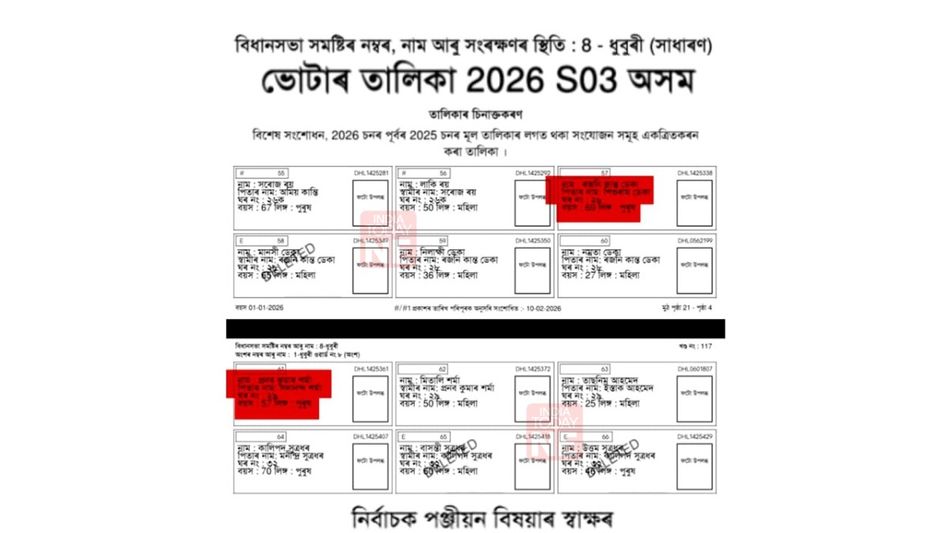
A serious administrative lapse has surfaced in Dhubri town after the newly published 2026 Electoral Roll (S03 Assam) reportedly continued to carry the names of senior officials who either retired or were transferred out of the district nearly a decade ago.

- Feb 13, 2026,
- Updated Feb 13, 2026, 5:42 PM IST

A serious administrative lapse has surfaced in Dhubri town after the newly published 2026 Electoral Roll (S03 Assam) reportedly continued to carry the names of senior officials who either retired or were transferred out of the district nearly a decade ago.
The discrepancy relates to house numbers 28 and 29, as per the electoral rolls— government residences traditionally allotted to district administration officers. Although these quarters are presently occupied by serving officials, the final electoral roll still reflects the names of former bureaucrats long posted elsewhere, raising questions about the integrity of the recently concluded Special Summary Revision (SSR) with January 1, 2026 as the qualifying date.
Among the most striking entries is Rajani Kanta Deka, a former Senior Planning Officer who served in the Dhubri administration for several years and reportedly retired around 2014–15. Despite being away from the district for nearly ten years, his name continues to appear against the official quarter address.
Another prominent name on the list is Pranab Kumar Sarmah (ACS, 1992 batch), who served as SDO (Sadar) from 2010 to 2013 and later as Additional Deputy Commissioner until March 2014. Since leaving Dhubri, Sarmah has held key assignments, including Deputy Commissioner in other districts, and is currently serving as Secretary to the Government of Assam in Dispur.
The retention of these names is being viewed as particularly concerning given that the Election Commission of India recently completed the Special Summary Revision process. The exercise involves Booth Level Officers conducting house-to-house verification to remove “shifted” or deceased voters and ensure accuracy of the roll.
The final electoral roll carries the digital signature of the Electoral Registration Officer (ERO), certifying due verification. Local residents are now questioning how multiple revision cycles failed to detect that occupants of these government quarters have changed several times over the past decade.
Under established procedure, the ERO and the district administration are responsible for supervising revisions and ensuring that government-allotted quarters reflect updated occupancy details. Observers argue that when quarters are re-allotted, corresponding updates in voter records should follow as a matter of routine administrative coordination.
“If the administration cannot accurately track who resides in its own official bungalows in the centre of town, what assurance is there about the accuracy of rolls in remote interior areas?” a concerned resident asked.
With the 2026 Assembly elections approaching, the presence of what critics describe as “legacy” or “ghost” entries has cast doubt over official claims of an error-free revision. Several citizens have termed the issue not merely a clerical oversight but indicative of systemic complacency.
The district administration has yet to issue a formal clarification on how these names remained in the electoral roll despite repeated revision exercises.
MORE NEWS









Copyright©2026 Living Media India Limited. For reprint rights: Syndications Today
