
Assam's locally produced fish powder aims to tackle nutritional deficiencies in school meals
A Kamrup district initiative to tackle malnutrition through nutrient-rich small fish powder has received the Assam government's Karmashree award. School Inspector and District Elementary Education Officer (Kamrup) Tapan Kumar Kalita and his team were recognised for the initiative, known as Matsya Paripusti.
Advertisement
 IS and DEEO (Kamrup) Tapan Kumar Kalita
Priyanka Saharia
- Aug 12, 2026,
- Updated Aug 12, 2026, 7:30 PM IST
In a state like Assam, where 33 per cent of children under the age of five are underweight, according to National Family Health Survey-5 (NFHS-5) statistics, and 68 per cent of children aged between six and 59 months are anaemic, according to the Assam Agribusiness and Rural Transformation Project (APART), a Kamrup district initiative to tackle malnutrition through nutrient-rich small fish powder has received the Assam government's Karmashree award. School Inspector and District Elementary Education Officer (Kamrup) Tapan Kumar Kalita and his team were recognised for the initiative, known as Matsya Paripusti, which incorporates scientifically processed small fish powder into meals served at Anganwadi centres and lower primary schools.
The recognition comes as the initiative prepares for a wider rollout. The small fish powder intervention is planned to be scaled up under PM-POSHAN and the Pradhan Mantri Matsya Sampada Yojana in Kamrup, Darrang and Morigaon districts.
The initiative has also attracted interest from the B Barooah Cancer Institute, which is considering incorporating small fish powder into meals for cancer patients as an additional nutritional supplement.
Why fish powder?
The project, known as Matsya Paripusti, was launched by the Kamrup district administration to improve dietary diversity and micronutrient intake among children aged three to six years at Anganwadi centres and children aged six to 10 years studying in lower primary schools.
Speaking to India Today NE, Kalita, who is from Tihu, and is an Assam Education Service inspector of schools, District Elementary Education Officer and District Mission Coordinator of Samagra Shiksha Abhiyan, said the idea was to make use of a locally available and culturally accepted source of nutrition.
“According to the government nutrition scheme, children are provided eggs once a week as a source of protein. We thought that since Assam has abundant fish resources, fish powder could provide an additional source of protein and other nutrients,” Kalita said.
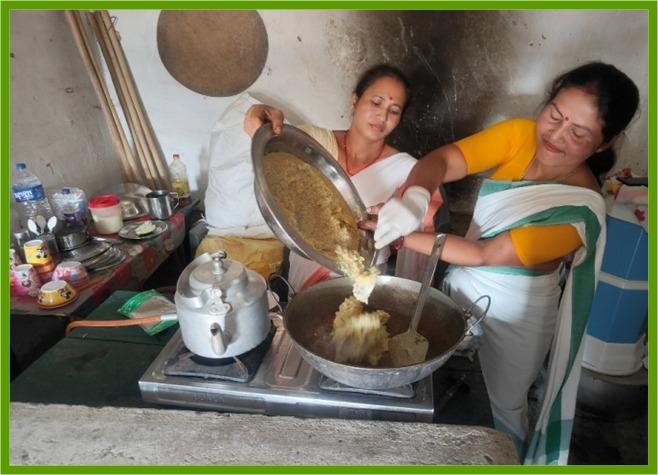
The initiative uses small indigenous fish, including locally available mua fish such as dorikona, which are scientifically processed and machine-dried into powder. The powder is then mixed with the curry served as part of the Hot Cooked Meal at Anganwadi centres and the Mid-Day Meal at lower primary schools.
Fish powder provides protein, calcium, iron, essential vitamins, omega-3 fatty acids and other micronutrients. Since small indigenous fish are processed whole, nutrients present in the bones and edible tissues are also retained.
How the pilot was conducted?
The project was implemented through convergence among the Departments of Fisheries, Education, Social Welfare and Health, with assistance from the College of Fisheries, Raha, WorldFish, Farmers Producer Companies and a local NGO. It was sponsored under the World Bank-aided Assam Agribusiness and Rural Transformation Project (APART).
The pilot project began with demonstration and awareness programmes across Kamrup district in 2023. In September that year, dried small fish powder was introduced for three months among 7,000 children in 293 Anganwadi centres during Nutrition Month.
The pilot recorded around 95 per cent acceptability among the children through the plate-counting method.
The programme was expanded in 2024 to 55 Anganwadi centres covering 1,000 children and 43 lower primary schools covering 2,300 children, taking the total beneficiaries under the six-month intervention to 3,300 children.
The fish powder was provided in prescribed quantities. Pre-school children aged three to six years, including children identified as moderately or severely malnourished, received 7 grams per child per day, three times a week, while lower primary school children received 8 grams per child per day, also three times a week.
What did the study find?
Kalita said the pilot was designed as a controlled experimental study, with baseline, midline and endline assessments conducted to determine whether the intervention produced measurable nutritional benefits.
“Baseline, midline and endline assessments were conducted. Blood tests and other health parameters were monitored. We looked at anaemia, height, nutritional status and mineral deficiencies,” he said.
The project documents say the assessment showed improvement in haemoglobin levels, reduction in anaemia, better nutritional status and improvement in growth parameters, including height, along with positive changes in several blood parameters.
The results were analysed by WorldFish, an international organisation under CGIAR.
The intervention also focused on whether children would accept fish powder in their regular meals. Instead of traditional sun-drying, the fish was machine-dried, helping remove the characteristic fishy smell while retaining its nutritional value.
The project found that less than five per cent of children were unwilling to consume meals mixed with fish powder, indicating an acceptability rate of more than 95 per cent.
Dietary preferences were also taken into account. Food meant for vegetarian students, estimated at around five per cent of beneficiaries, is separated before the fish powder is mixed into the remaining food.
The pilot was completed by the end of 2024. Its findings were published in 2025, after which the results were submitted to the National Fisheries Development Board (NFDB) in January 2025. The findings were subsequently appreciated and accepted by the concerned government departments in March 2025.
From Kamrup to three districts
The encouraging results have now paved the way for the initiative to move beyond the pilot stage.
The scaling-up plan includes introducing small fish powder under PM-POSHAN and the Pradhan Mantri Matsya Sampada Yojana in Kamrup, Darrang and Morigaon districts.
The project team is also looking at applications beyond school and Anganwadi nutrition. The B Barooah Cancer Institute is considering using small fish powder as an additional nutritional supplement in meals for cancer patients.
The model has also attracted interest outside Assam. Telangana is scheduled to introduce small fish powder in ICDS and lower primary schools from September 2026, under the guidance of the Kamrup district Fisheries Department.
A nutrition intervention with a livelihood angle
The project is being viewed not only as a nutrition intervention but also as a potential livelihood model.
By creating sustained demand for locally produced fish powder, the initiative could support fish farmers, fish processors and rural entrepreneurs, while promoting pisciculture and generating employment in fish processing.
The initiative therefore seeks to create a link between child nutrition and local livelihoods, using Assam's abundant small indigenous fish resources to address nutritional deficiencies while supporting the rural economy.
'Hard work never goes unnoticed'
For Kalita and his team, the Karmashree award has provided fresh motivation to take the initiative forward.
“This award inspired us to do more good work for the community and also made us believe that if you do your work honestly and diligently, somewhere or the other people observe it. Hard work never goes unnoticed. This will help many children and people, and that motivates us to serve society even more,” Kalita said.
The long-term plan is to expand the initiative across more schools and Anganwadi centres in Assam and eventually develop it as a replicable model for other fish-producing states.
POST A COMMENT