Between liberty and social anxiety: The real debate behind Assam’s UCC and live-in registration
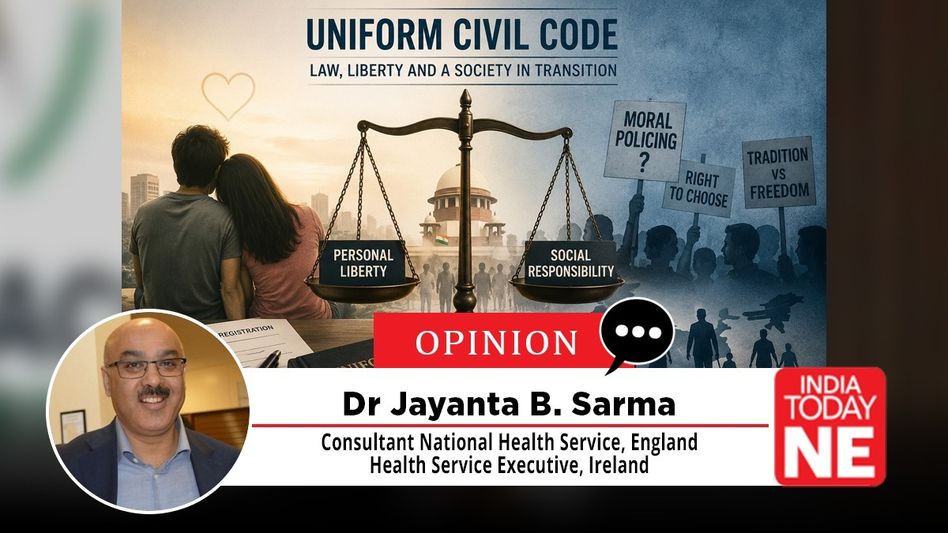
To some, the provision represents overdue social responsibility in an age of rapidly shifting values. To others, it is moral policing disguised as legal reform. Both reactions, interestingly, arise from real anxieties within a society changing faster than its institutions, culture, and emotional frameworks can comfortably absorb.

- May 26, 2026,
- Updated May 26, 2026, 5:24 PM IST

The debate surrounding the proposed Uniform Civil Code provisions in Assam, particularly the requirement that live-in or cohabiting couples formally register their relationship, has quickly moved beyond legal technicalities. It has become a mirror reflecting a larger civilisational transition underway in India itself.
To some, the provision represents overdue social responsibility in an age of rapidly shifting values. To others, it is moral policing disguised as legal reform. Both reactions, interestingly, arise from real anxieties within a society changing faster than its institutions, culture, and emotional frameworks can comfortably absorb.
At the centre of the controversy lies an important distinction often lost in political shouting matches. The question is no longer whether consenting adults have the right to live together outside marriage. That principle has already been substantially settled by the Supreme Court of India through repeated affirmations of personal liberty and dignity under Article 21. Urban India, in practice, crossed that social threshold years ago, even if awkwardly and unevenly.
The real question now is something subtler and more uncomfortable: can the state require such relationships to be formally declared and documented, and should failure to do so attract legal consequences?
Supporters of the provision are often caricatured as cultural conservatives trying to discipline youth. That explanation is partially true, but incomplete. Beneath the politics lies a more defensible concern rooted in Indian social reality itself.
Unlike many Western societies, India still remains deeply structured around marriage as a social, economic, and legal institution. Property rights, inheritance patterns, social legitimacy, family negotiations, and even female security continue to revolve around formal marital recognition in large sections of society. In such an environment, informal unions can create real vulnerabilities, especially for women who may find themselves abandoned without documentary proof of relationship, financial entitlement, or social support.
From that perspective, registration is presented not merely as surveillance, but as legal recognition and evidentiary protection. The state’s argument, at least theoretically, is that formal documentation may reduce exploitation, denial of responsibility, or abandonment hidden behind the ambiguity of informal relationships.
Viewed in isolation, that logic is not entirely unreasonable.
Indeed, Western societies themselves gradually moved toward frameworks recognising non-marital unions once cohabitation became socially widespread. In the United Kingdom, for instance, decades of social change eventually led to expanding legal protections around domestic partnerships, tenancy rights, inheritance disputes, child custody, and domestic violence protections. France introduced the PACS civil partnership system precisely because many couples sought legal recognition without conventional marriage. Scandinavian countries similarly evolved extensive cohabitation protections long before modern debates on marriage equality matured.
Yet even Western societies that normalised cohabitation never fully dissolved the special institutional status of marriage itself. Cohabitation became tolerated, protected, and legally recognised, but not entirely elevated to the same symbolic, religious, or civilisational sanctity associated with marriage. Churches across Europe and North America generally continued to privilege marriage as the preferred moral arrangement even while broader society became increasingly accepting of alternative domestic arrangements.
Even secular legal systems preserved subtle hierarchies. Marriage still typically carries clearer legal privileges, inheritance simplicity, immigration advantages, stronger presumptions around kinship, and deeper ceremonial legitimacy. If cohabitation were considered fully identical in institutional terms, marriage itself would gradually become legally redundant — yet no major Western society has entirely erased that distinction.
In other words, even liberal societies retained a soft but visible preference for marriage as the more stable social institution around family continuity and long-term commitment. India’s policymakers, operating within a far more family-centric society still in rapid transition, appear to be responding to the same underlying civilisational instinct, though through a more interventionist and state-driven framework.
The important difference, however, is how that preference is expressed.
Western democracies generally evolved toward optional legal recognition and indirect encouragement of marriage through incentives, privileges, and cultural signalling. The Indian debate, by contrast, centres around compulsory registration backed by criminal provisions. That distinction changes the emotional character of the law entirely.
A liberal democracy grows uneasy when the state appears to move from protecting rights to supervising private behaviour. Once intimate relationships require formal disclosure to authorities, critics begin to see not social protection but state intrusion. This is why opponents describe such provisions as moral policing. Their discomfort is not necessarily with legal recognition itself, but with the criminalisation of non-registration and the symbolic message that the state reserves the right to monitor acceptable lifestyles.
Yet dismissing the entire debate as mere conservatism also misses the deeper social churn underway in India.
Indian society today is experiencing a compressed version of social transformations that unfolded over many decades in Europe. Urbanisation, migration, delayed marriage, digital dating culture, weakening of traditional kinship structures, expanding female education, and exposure to global media have radically altered social behaviour within a single generation.
But emotionally and institutionally, much of society remains semi-traditional.
This creates what may be called a transitional morality gap, modern individual behaviour operating within older civilisational expectations.
In such periods of rapid transition, states often respond defensively. They attempt to preserve social stability while cautiously accommodating change. India’s evolving UCC debates appear to reflect precisely such a balancing instinct: accepting cohabitation as legal reality, while refusing to treat it as entirely private or socially neutral.
There is also an uncomfortable political truth underlying the conversation. Many supporters are not simply arguing for women’s protection. They are expressing broader anxieties about social fragmentation, weakening family structures, declining restraint, and the perception of an increasingly hyper-individualistic youth culture detached from older moral anchors.
Opponents, meanwhile, see selective state activism. They ask why intimate adult relationships suddenly become urgent legislative priorities when unemployment, education quality, healthcare access, policing reform, and judicial delays remain far more pressing governance failures. To them, such provisions represent symbolic politics aimed at cultural signalling rather than structural reform.
Both positions contain elements of truth.
What India is witnessing may therefore not be a straightforward battle between liberty and authoritarianism, but a deeper negotiation between social continuity and accelerating modernity.
Western societies normalised cohabitation only after building relatively strong institutional cushions — social security systems, better legal accessibility, higher female economic autonomy, comprehensive documentation structures, and more individualised social cultures. India is attempting to navigate similar behavioural shifts without those stabilising supports being equally mature across regions and classes.
That partly explains why Indian policymakers instinctively gravitate toward registration frameworks. The state seeks administrative certainty in a society where informal arrangements can still carry severe social and economic consequences.
Whether such laws ultimately become instruments of protection or tools of unnecessary intrusion will depend less on political rhetoric and more on how they are enforced in practice. A narrowly applied administrative safeguard is one thing. Aggressive criminalisation and selective enforcement are another.
History will likely judge these experiments not by ideological claims from either side, but by a simpler question: did they genuinely protect vulnerable individuals without disproportionately shrinking personal liberty?
Modern societies survive not merely by preserving freedom, nor merely by preserving order, but by continuously renegotiating the uneasy balance between the two.
(Author’s Note: Dr Jayanta Biswa Sarma writes on politics, institutions, and society through the lenses of history, philosophy, and systems thinking, drawing on both Indian and Western intellectual traditions. Artificial intelligence tools may be used in preparing this article as research and editorial aids. All arguments, interpretations, and final editorial judgement remain the author’s responsibility)