Bohag Is Not Just a Season
From memory to momentum, Assam’s spring festival must become a fresh leaf in the manuscript of new thought
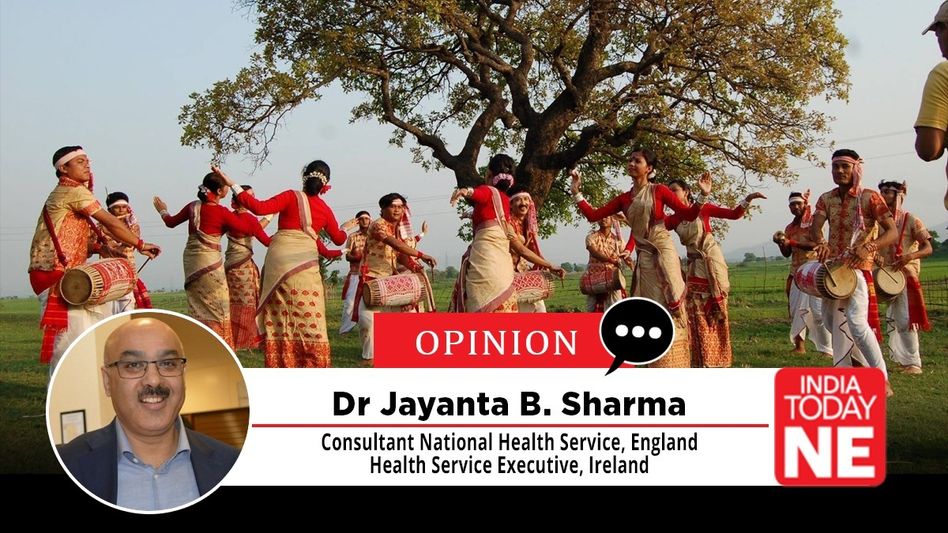

- Apr 13, 2026,
- Updated Apr 13, 2026, 6:40 PM IST

Bohag is not merely a season; it is the pulse of a people. It is a fresh leaf in the manuscript of new thought.
For many in Assam, childhood and youth are inseparable from the songs of Bhupen Hazarika. In the 1980s, his Bihu compositions did more than entertain, they stirred something elemental, sending a quiet shiver through body and spirit. There was a time when evenings in Guwahati meant moving restlessly from one Bihu stage to another, Chandmari to Latasil to Bharalumukh drawn not by spectacle alone, but by a shared cultural rhythm.
That immediacy has faded for many who now live away. Since leaving for England in the mid-1990s, and then settling into life abroad, the lived experience of stage Bihu has been replaced by memory. Yet Bohag has a way of returning each year, unannounced but insistent bringing with it a familiar ache. Through Hazarika’s songs, that ache becomes reflection.
Bohag, then, is not simply a marker of time. It is a reminder of continuity, of renewal, and of an unfinished conversation between memory and possibility.
And yet, a question persists. If Bohag is indeed a fresh leaf in the manuscript of new thought, where is that new thought today? Which ideas, which institutions, which acts of creation are emerging with enough clarity to dispel the anxieties of the present? Have we truly shed the worn-out habits of thinking that weigh us down?
There is no easy answer. But there is reason for cautious optimism. Bohag continues to carry within it the energy of renewal. The rhythms of Bihu, the call of the kuli, the gathering of communities these are not empty rituals. They are signals of a society that has not lost its capacity to regenerate.
But renewal is not automatic. It requires intent.
A society is not static; it is a flowing current. Its vitality depends on whether it continues to evolve or allows itself to harden into familiar patterns. Terms such as “indigenous” and “sons of the soil” carry deep emotional resonance, but they cannot become substitutes for growth. Identity, like a river, must gather new tributaries if it is to remain alive.
A wider historical lens offers both perspective and confidence. The civilisation of Kamarupa was neither marginal nor insular. At its height, its influence stretched from the eastern Himalayan foothills across the Brahmaputra valley to the Karatoya River in the west, and southwards towards the Bay of Bengal. It was a polity of considerable depth, politically organised, culturally vibrant, and intellectually connected to the wider currents of the subcontinent.
Its most celebrated ruler, Bhaskaravarman (7th century CE), stood not at the periphery but at the centre of early medieval Indian statecraft. A contemporary and ally of Harsha, Bhaskaravarman’s court moved within the same civilisational orbit that sustained centres such as Nalanda, where scholarship, diplomacy, and cultural exchange intersected at a subcontinental scale. The Chinese pilgrim Xuanzang, who visited Kamarupa, recorded it as a land of learning, refinement, and distinctive cultural identity neither derivative nor isolated.
That legacy left a mark not only in chronicles but in time itself. The Bhaskarabda, an era named after Bhaskaravarman continues to be observed, a rare honour that reflects both memory and stature. It is a reminder that Assam once generated its own temporal and intellectual reference points, confident enough to define its place in history rather than inherit it.
The lesson is clear: vitality comes from engagement, not enclosure.
Bohag, therefore, is more than a cultural marker. It is an opportunity to reimagine scope, not in territorial terms, but in intellectual, professional, and institutional ambition. The challenge is not to draft anxious blueprints for “saving” a people. Societies do not survive through fear. They evolve unevenly, often unpredictably, but continuously.
What remains within our control is more modest, yet more powerful: to move beyond inertia, dependency, and habitual criticism, and to invest instead in ideas, skills, and environments that enable growth.
This is easier said than done. Building institutions and shaping social environments require sustained effort over decades. But every long effort begins with a decision. There is no reason why that decision cannot begin with Bohag.
The public energy of Bihu—its stages, its gatherings, its visibility offers more than celebration. It can serve as a platform for nurturing leadership across sectors: education, healthcare, enterprise, arts, sports, and civic life.
If that current fails to emerge, the consequences may not be immediately dramatic. Societies will continue to change regardless. But something less visible may be lost the awareness that change could have been shaped, not merely endured.
A Systems View, A Deeper Reflection
Seen through the lens of systems thinking, the present moment resembles a metastable state appearing stable, yet poised for transition.
In complex systems, small, well-placed interventions can trigger disproportionate effects. If inputs remain unchanged, the system settles into stagnation. If new patterns emerge, the system can shift.
Vedanta offers a parallel insight: when consciousness contracts, identity becomes defensive; when it expands, identity becomes creative.
The question is not how to protect what exists, but how to evolve without losing essence.
Bohag stands at that threshold.
In systems terms, the tipping point is never far away.
In philosophical terms, the potential is always present.
The rest is action.
This essay draws on an earlier reflection first published in Assamese in 2018.