Centre pushes water governance reforms at Brahmaputra board meet in Guwahati
Union Minister for Jal Shakti CR Patil on May 19 chaired the 14th meeting of the High-Powered Review Board (HPRB) of the Brahmaputra Board in Guwahati, where key discussions were held on river basin management, flood control, erosion mitigation and long-term water governance reforms in the Northeast.

- May 19, 2026,
- Updated May 19, 2026, 4:42 PM IST

Union Minister for Jal Shakti CR Patil on May 19 chaired the 14th meeting of the High-Powered Review Board (HPRB) of the Brahmaputra Board in Guwahati, where key discussions were held on river basin management, flood control, erosion mitigation and long-term water governance reforms in the Northeast.
The meeting was attended by Union Minister Sarbananda Sonowal, Minister of State for Jal Shakti Raj Bhushan Choudhary, senior officials from the Centre and Northeastern states, technical experts and stakeholders.
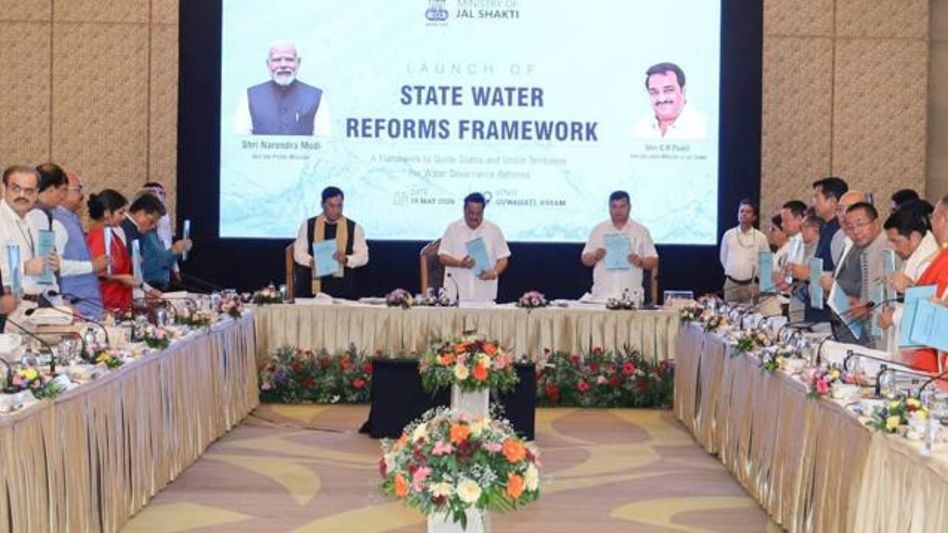
During the programme, Patil launched the State Water Reforms Framework (SWRF), a national governance initiative aimed at strengthening water sector reforms across states and Union Territories through a system of benchmarking and cooperative federalism.
Addressing the gathering, the Union Minister said water security remains central to India’s development goals and the vision of Viksit Bharat @2047. He stressed that sustainable water management requires strong institutions, policy reforms, technological innovation and community participation alongside infrastructure development.
The review meeting assessed the progress made by the Brahmaputra Board in areas including river basin masterplans, flood and erosion management, springshed rejuvenation, digital transformation and institutional reforms. Officials informed the board that 76 river basins and sub-basins under the Brahmaputra and Barak systems have been identified for preparation and updation of masterplans using technologies such as GIS, LiDAR, remote sensing and hydrological modelling.
Discussions were also held on ongoing and proposed flood management, drainage and water conservation projects in Assam, Meghalaya, Mizoram, Manipur, Nagaland and Tripura in coordination with respective state governments.
The HPRB further deliberated on transforming the Brahmaputra Board into a technology-driven River Basin Organization (RBO), with emphasis on restructuring technical units, digital governance and institutional efficiency.
The proposed revitalisation of the North Eastern Hydraulic and Allied Research Institute (NEHARI) was also reviewed to enhance hydraulic research, consultancy and capacity-building activities in the region. Plans for redevelopment of the Brahmaputra Board office complex at Basistha in Guwahati into a modern institutional campus were also discussed.
As part of the event, several books and documentaries showcasing indigenous water conservation practices from Northeast India were released, including documentaries on the Dong irrigation system of Assam, bamboo drip irrigation in Meghalaya, rainwater harvesting in Mizoram and paddy-cum-fishery systems in Arunachal Pradesh.
The newly launched SWRF comprises 75 indicators across five major dimensions — policy and regulation, project monitoring, digitalisation and research, infrastructure, and community engagement. The framework aims to encourage states to undertake measurable reforms in areas such as groundwater regulation, floodplain zoning, wastewater reuse, dam safety and river basin planning.
States and Union Territories have been given time till December 31, 2026, to implement reforms and submit responses under the framework by January 31, 2027.
The meeting concluded with a renewed commitment towards sustainable river basin management and stronger inter-state coordination for the Northeast and West Bengal.