Experts deliberate on agroforestry challenges and opportunities on World Environment Day
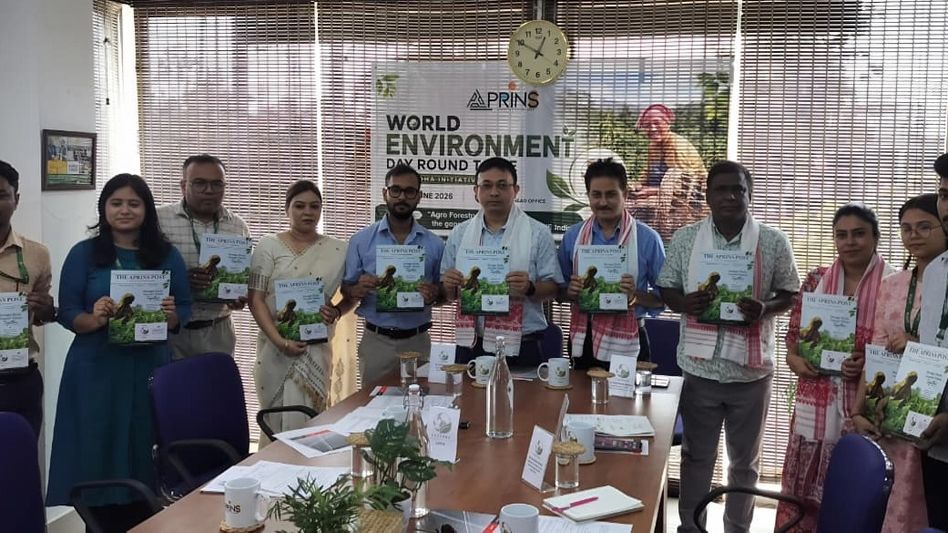
As part of its Vasudha Initiative aimed at advancing climate change interventions in Northeast India, APRINS organised a high-level Round Table Discussion on June 6, 2026, on the theme “Agro Forestry Road Map – The Gaps and the Way Ahead for NE India.”

- Jun 06, 2026,
- Updated Jun 06, 2026, 10:52 PM IST

As part of its Vasudha Initiative aimed at advancing climate change interventions in Northeast India, APRINS organised a high-level Round Table Discussion on June 6, 2026, on the theme “Agro Forestry Road Map – The Gaps and the Way Ahead for NE India.”
The half-day policy-focused event brought together leading experts from The Energy and Resources Institute (TERI), GIZ India, the National Rural Livelihoods Mission–National Institute of Rural Development and Panchayati Raj (NRLM–NIRDPR), and the United Nations Development Programme–Global Environment Facility Small Grants Programme (UNDP–GEF SGP). Farmers and management representatives of Farmer Producer Companies (FPCs) from across Northeast India also participated actively through online mode.
Welcoming the distinguished guests and participants, APRINS Secretary Urmi Mala Mahanta underscored the importance of collaborative efforts in addressing climate and livelihood challenges through sustainable land-use practices.
The discussion was moderated by APRINS Director T. E. Rassull, while APRINS Managing Director Chandan Borthakur delivered the opening remarks, highlighting the organisation’s commitment to ecological restoration, climate resilience, and sustainable livelihood generation across the region.
During the deliberations, Dr. Naba Kumar Goswami, Associate Director of TERI’s North East and Himalayan Centre, shared extensive field experiences from agroforestry interventions implemented across Northeast India and the Himalayan region. He highlighted critical ecosystem components, identified prevailing gaps, and outlined strategies for strengthening the integration of scientific knowledge with farmer-led practices.
Dr. Jeherul Islam, State Coordinator for Northeast States at GIZ India, presented insights into GIZ-supported initiatives, with particular emphasis on the aquaculture sector. He also showcased international examples demonstrating the integration of sustainable aquaculture systems within agroforestry landscapes.
Drawing on his experience in Bihar, Jharkhand and other states, A. Mannan Choudhury, National Resource Person at NRLM–NIRDPR, shared lessons from a successful agroforestry pilot project that delivered measurable outcomes over several years. He stressed the importance of community institution-building and sustained stakeholder engagement in ensuring long-term impact.
Sounika Karmakar, Regional Coordinator for the Northeast Region under the SGP India (TERI) and UNDP–GEF programme, highlighted the significance of community-driven intervention models. She emphasised that farmer participation and local ownership must remain central to the development and implementation of any agroforestry roadmap for the region.
The Round Table focused on key ecosystem linkages within Northeast India’s agroforestry landscapes, major barriers to adoption, practical farmer-centric solutions, and opportunities for convergence among government schemes, development programmes, and international initiatives.
In addition to the policy dialogue, APRINS marked World Environment Day with a large-scale plantation drive across its Farmer Producer Company network throughout Northeast India on June 5, 2026. The initiative was aimed at translating policy discussions into immediate ecological action and reinforcing the organisation’s commitment to environmental sustainability and climate resilience.