
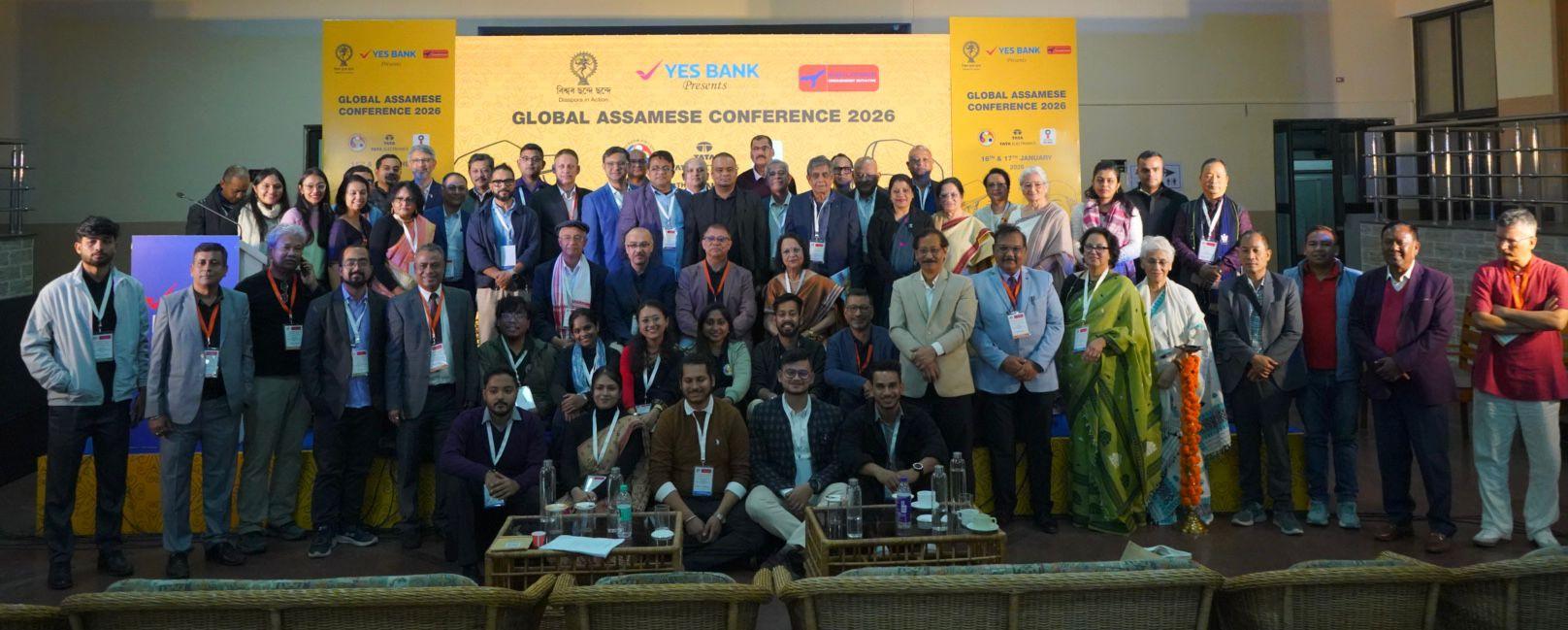

First Assamese Global Conference concludes in Guwahati, marks milestone in diaspora engagement
The First Assamese Global Conference (AGC) concluded successfully in Guwahati on January 18, marking a significant step towards structured and sustained engagement between the global Assamese diaspora and institutions in Assam. Held from January 16 to 18, the three-day conference brought together scholars, professionals, policymakers, and members of the diaspora from across the world.
Advertisement
 First Assamese Global Conference concludes in Guwahati
Priyanka Saharia
- Jan 21, 2026,
- Updated Jan 21, 2026, 4:53 PM IST
Story highlights
- The AGC aimed to connect Assam's institutions with its global diaspora.
- Dr. Choudhary urged the diaspora to move beyond cultural nostalgia.
- Sessions covered space tech, healthcare, and AI in disaster prediction.
The First Assamese Global Conference (AGC) concluded successfully in Guwahati on January 18, marking a significant step towards structured and sustained engagement between the global Assamese diaspora and institutions in Assam. Held from January 16 to 18, the three-day conference brought together scholars, professionals, policymakers, and members of the diaspora from across the world.
Conceived under the Global Assamese Engagement Initiative, the conference was the result of nearly a year-long effort by a small group of organisers seeking to move diaspora engagement beyond cultural symbolism towards meaningful collaboration.
Reflecting on the diaspora’s responsibility
In a reflective note published in the conference souvenir Biswar Chande Chande, Dr. Jayanta Choudhary of Lewiston, New York, posed a fundamental question: What is the duty of the Assamese diaspora?
“Is it enough to gather occasionally, celebrate Bihu abroad, teach our children a few words of Assamese, and feel content?” he wrote, urging the community to introspect on whether such engagements have translated into tangible impact for Assam.
While acknowledging the value of global Assamese conventions in fostering cultural connection and community spirit, Choudhary noted that many such efforts have remained limited to nostalgia and celebration. “These alone cannot sustain the Assamese language, culture, or socio-economic development,” he wrote, calling for diaspora platforms to evolve into engines of concrete action.
He emphasised that the global Assamese community, comprising scientists, doctors, academics, artists, engineers, entrepreneurs, and technology professionals, has the potential to become a robust support system for Assam if knowledge and resources are pooled effectively. The need, he argued, is for honest introspection, acknowledgement of past shortcomings, and a commitment to purposeful engagement.
The inaugural session on January 16 was attended by Union Minister of State for External Affairs Pabitra Margherita, Assam Chief Secretary Ravi Kota, and IIT Guwahati Director Devendra Jalihal. Addressing the gathering, the dignitaries highlighted the role of the diaspora in Assam’s development and cultural preservation.
Over 60 international delegates from 16 countries, including the United States, the United Kingdom, Germany, Japan, Denmark, Sweden, Australia, New Zealand, Oman, and the UAE, participated in the conference.
Keynote addresses were delivered by Pitambara Deva Goswami, Satradhikar of Auniati Satra, and eminent academic Amarjyoti Choudhury, who reflected on Assam’s spiritual, cultural, and intellectual traditions.
The inaugural programme also featured the screening of a specially commissioned mini-documentary, Assam through the Ages, conceptualised and produced by Jayanta Biswa Sarma, tracing Assam’s civilisational journey. The conference souvenir Biswar Chande Chande was formally released during the session.
The plenary session included a presentation on bird tourism in Assam by environmentalist Feroz Ahmed, who noted that nearly 900 of India’s 1,300 bird species are found in the state. The plenary and parallel sessions drew around 200 local delegates, including students and faculty from educational institutions across Assam.
Sessions on January 17 addressed themes such as space technology, healthcare, artificial intelligence applications in flood and earthquake prediction, groundwater arsenic contamination, women’s issues, and marketing. A special session on the legacy of Lakshminath Bezbaruah reaffirmed the conference’s grounding in Assam’s intellectual heritage.
The conference also highlighted the Assamese Digital Living Museum (ADLM), a proposed digital platform aimed at preserving and promoting the history, culture, and global contributions of the Assamese diaspora. The initiative is led by US-based technology entrepreneur Pradip Das.
A blood donation camp was organised during the conference by the Assam Healthcare Cooperative Society in collaboration with Guwahati Medical College Hospital and the National Service Scheme (IIT Guwahati), with participation from students and diaspora members. The camp was held in memory of singer Zubeen Garg.
On the final day, delegates visited Pobitora Wildlife Sanctuary and later participated in an academic interaction at Assam Down Town University, engaging with faculty members.
Evenings throughout the conference enabled informal dialogue and cultural exchange through shared meals and performances, strengthening bonds between diaspora delegates and local scholars.
Way forward
The conference concluded with a valedictory dinner in Guwahati, where delegates resolved to establish a formal foundation to carry forward the objectives of the Global Assamese Engagement Initiative.
Organisers said the successful conclusion of the First Assamese Global Conference underscored the demand for a credible, action-oriented platform for global Assamese engagement, one that moves beyond celebration towards sustained contribution and responsibility.
POST A COMMENT
MORE NEWS








Copyright©2026 Living Media India Limited. For reprint rights: Syndications Today
