From Assam’s Hargila Army to Cornell University: Purnima Devi Barman takes conservation story global
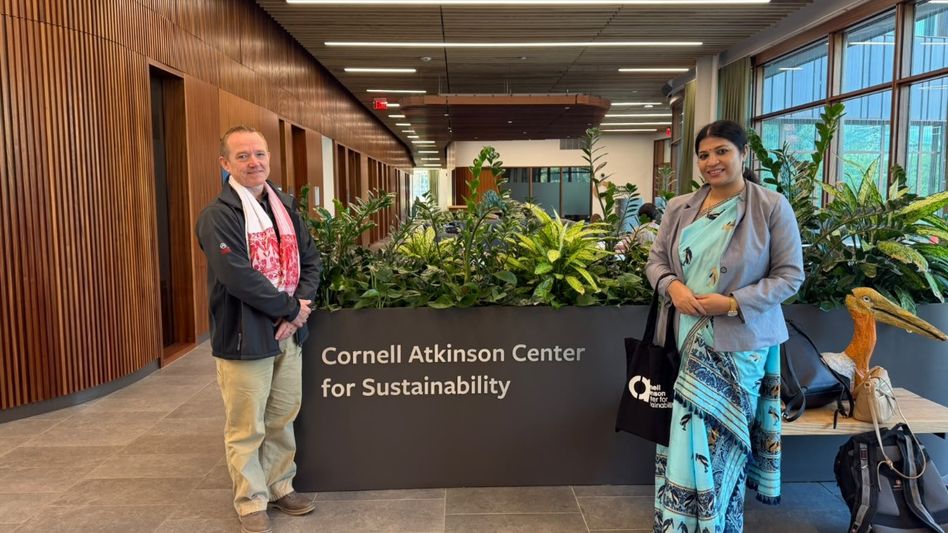
Assam’s renowned wildlife biologist and conservationist Dr Purnima Devi Barman is currently at Cornell University in Ithaca, New York, where she is taking part in a series of academic sessions, classes and scientific engagements as part of Cornell’s collaboration with conservation partners in India.

- Oct 07, 2026,
- Updated Oct 07, 2026, 9:48 PM IST

Assam’s renowned wildlife biologist and conservationist Dr Purnima Devi Barman is currently at Cornell University in Ithaca, New York, where she is taking part in a series of academic sessions, classes and scientific engagements as part of Cornell’s collaboration with conservation partners in India.
Barman, best known for her pioneering work with the Hargila Army and the conservation of the Greater Adjutant Stork in Assam, said she had been invited by Cornell University to conduct sessions across different departments and interact with students and researchers.
During her ongoing visit, Barman has already addressed a session with around 60 MBA students and participated in discussions with different schools and academic programmes at Cornell.
She has also held engagements at the Cornell Lab of Ornithology, where she exchanged knowledge and experiences relating to threatened birds, conservation and the natural history of the Greater Adjutant.
A major highlight of her visit comes on October 7, when Barman will deliver a public lecture at Cornell University’s College of Veterinary Medicine as part of the K. Lisa Yang Center for Wildlife Health Distinguished Speaker Series.
The lecture, titled “A Global Conservation Leader Coming to Cornell: Dr. Purnima Devi Barman,” will focus on her work to conserve the Greater Adjutant Stork and the development of the Hargila Army as a community-led conservation model.
Barman’s visit is part of a wider collaboration between Cornell University and conservation partners in Assam and Bangladesh. The collaboration, supported by the Cornell K. Lisa Yang Center for Wildlife Health, aims to combine wildlife-health expertise with community-based conservation, livelihoods and capacity building.
The programme includes work on wildlife medicine, diagnostic techniques and mortality investigations, while researchers are also looking at risks from environmental toxins and high-consequence diseases affecting threatened avian scavengers.
For Barman, the Cornell engagements have also provided an opportunity to take the Hargila Army model beyond Assam and discuss how conservation, women's empowerment, livelihoods and community participation can work together to protect threatened species.
The Hargila Army, led by Barman, has become widely recognised for involving rural women in the conservation of the Greater Adjutant, transforming community attitudes towards a bird that was once often viewed as a nuisance.
At Cornell, Barman is also sharing the natural history of the Hargila and discussing the conservation challenges facing the species with students, scientists and researchers.
The broader collaboration seeks to create opportunities for training and capacity building for young wildlife researchers, veterinarians, conservationists and students in India and the wider region.
Barman’s presence at Cornell thus puts Assam’s community-led conservation experience at the centre of an international exchange involving wildlife health, ornithology, veterinary science, sustainability and conservation research.