
Gauhati University forum warns leadership choices now decisive for third pole climate stability
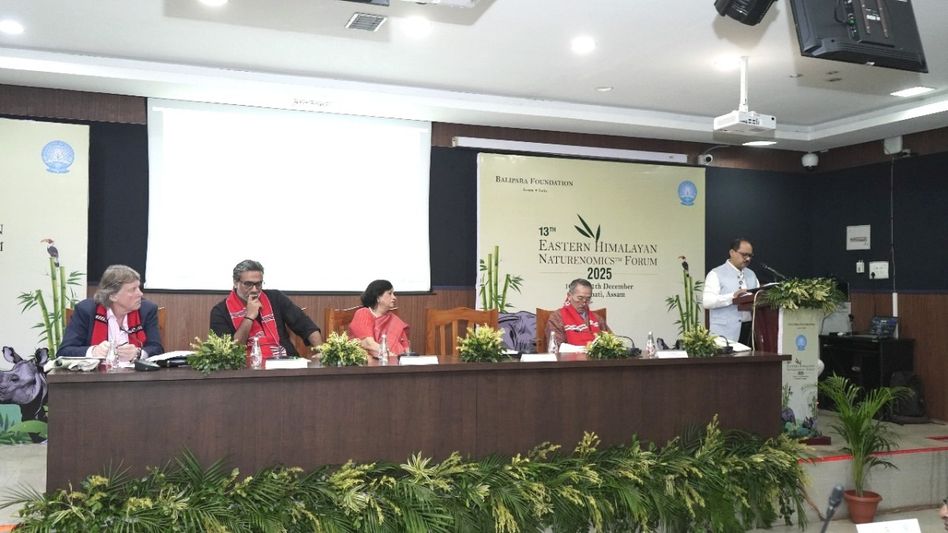
Experts at the Eastern Himalayan Naturenomics Forum 2025 warned that political decision-making, rather than technology or finance, is now the strongest predictor of climate outcomes in the Eastern Himalaya — a region often described as the world’s “Third Pole” due to its vast water reserves.

- Dec 11, 2025,
- Updated Dec 11, 2025, 6:32 PM IST

Experts at the Eastern Himalayan Naturenomics Forum 2025 warned that political decision-making, rather than technology or finance, is now the strongest predictor of climate outcomes in the Eastern Himalaya — a region often described as the world’s “Third Pole” due to its vast water reserves.
At the forum’s closing session at Gauhati University, Vice-Chancellor Nani Gopal Mahanta said global data shows how leadership directions can accelerate or restrain emissions. He pointed to projections that greenhouse gases would have risen far more sharply under a Trump administration than under Joe Biden, arguing that similar leadership choices will determine whether the Eastern Himalaya can avoid irreversible ecological losses.
Mahanta said countries in the Global South — including India, Brazil and South Africa — now carry greater responsibility in shaping climate action. He questioned the relevance of GDP-led development, noting that automation and AI are driving growth without jobs while masking climate-linked economic losses. With studies estimating that India could lose up to 6% of its GDP at 2°C warming, he called for a “post-growth” model centred on equity and ecological limits. Brazil’s attempt to balance development and conservation ahead of COP30, he said, demonstrates an alternative path.
This year’s event took an unusual multi-campus format, with parallel sessions at IIT Guwahati, Cotton University and Royal Global University — effectively turning the city into a shared sustainability hub.
Tata Steel Foundation CEO Sourav Roy cautioned that global environmental debates risk becoming mere “repair conversations”. He said meaningful progress requires breaking down institutional and social hierarchies and treating communities as equal actors in ecological decision-making.
Panels across both days examined regenerative land systems, restoration of degraded and waste landscapes, wetland protection, circular economy models and the pressures linking forests, elephants and expanding human settlements. Day 2 further focused on climate justice, regenerative livelihoods and the integration of indigenous knowledge with modern tools.
A major announcement on the opening day was the launch of the Asian Elephant Secretariat, intended to strengthen long-term conservation coordination across the Brahmaputra and Eastern Himalayan region.
The forum closed with participants stressing that the Eastern Himalaya’s stability will depend on leadership willing to prioritise ecological security over short-term growth.
MORE NEWS











Copyright©2026 Living Media India Limited. For reprint rights: Syndications Today
