How an Assam activist turned millet entrepreneurship into a mission for social change?
For Assam-based activist Abhishek Singha, Pustimaan is more than a millet brand. 5% of every profit goes towards The White Revolution Campaign, an initiative working to break menstrual stigma, improve hygiene awareness, and fight anaemia and malnutrition among women and girls in rural Assam.

- May 13, 2026,
- Updated May 13, 2026, 6:55 PM IST

There comes a moment in life when a person stops asking, “Why is this happening?” and begins asking, “What can I do about it?”
For social activist Abhishek Singha, that moment came after years of witnessing silent struggles in villages, unheard voices in marginalised communities, and dreams fading, not because people lacked potential, but because no one stood beside them.
Today, that question has shaped not just his life’s work, but an unusual model of social entrepreneurship in Assam, one where business directly funds humanitarian work.
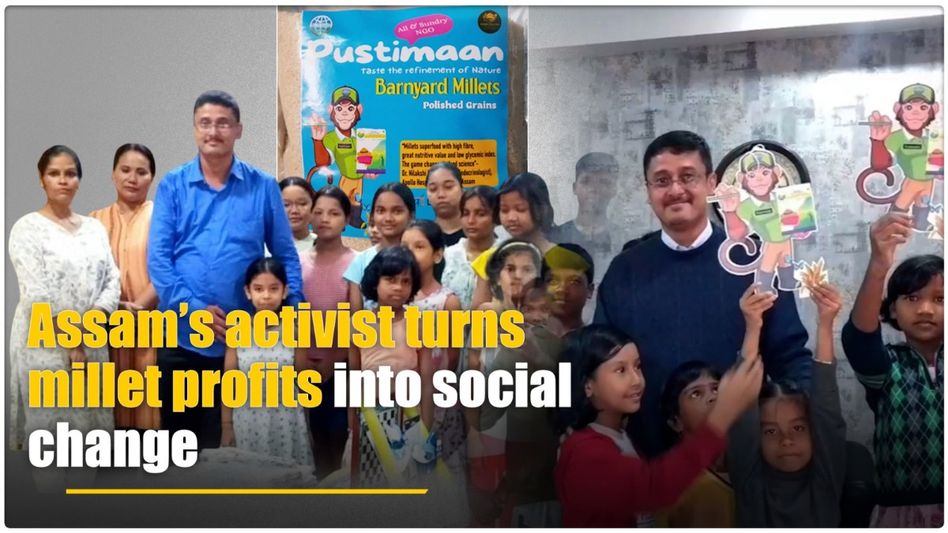
On store shelves, ‘Pustimaan’ looks like a health-focused brand, neatly packed millet grain packets designed for everyday nutrition. But behind the brand lies a mission that goes far beyond commerce. Five per cent of every profit generated through Pustimaan is channelled into social initiatives through Singha’s NGO, All & Sundry.
Launched on July 14, 2024, Pustimaan Millets is an agri-themed initiative of All & Sundry and, according to Singha, Assam’s only agri-focused startup that dedicates five per cent of its profits from every millet grain packet sold towards tackling anaemia and malnutrition among women and children in vulnerable communities.
From menstrual hygiene awareness in remote villages to supporting underprivileged children, Singha has built a model where enterprise fuels impact.
Turning farmers’ struggles into a startup
Before becoming an entrepreneur, Singha spent years travelling through Assam’s rural landscape, working closely with farming communities. The repeated stories of small and marginal farmers, crop losses, uncertain incomes, and lack of market access left a lasting impression on him.
“I always knew that someday I wanted to do something in agriculture,” he says.
That vision eventually took shape in 2024 with the launch of ‘Pustimaan’. The startup focuses on climate-friendly, gluten-free millets made from grains such as barnyard millet, finger millet, and sorghum. Packed as raw millet grains for daily meals like khichdi and upma, the brand encourages people to bring traditional, nutrient-rich grains back into their kitchens.
But Singha didn’t launch the brand overnight. Before the products entered the market, he spent months organising awareness sessions, workshops, and tasting events in colleges and public spaces, introducing people to the health benefits of millets.
His products have now reached customers in Assam as well as places such as Delhi and Haryana. Yet, he says his biggest satisfaction lies not in sales figures, but in knowing that every packet sold contributes to a larger purpose.
“Pustimaan Millets was created to revive a lost connection, between health and tradition, and between enterprise and social responsibility. It is about promoting healthier food choices while simultaneously creating sustainable livelihoods at the grassroots level.
“When it comes to profit and loss, I see it a little differently. Yes, like any startup, we maintain financial discipline and aim for sustainability. But the real ‘profit’ for us goes beyond numbers. It is measured in the number of people we are able to support, the farmers we are able to empower, and the awareness we create about healthier living.
“Five per cent of the profit generated from every millet packet sold is channelled through All & Sundry and used for humanitarian initiatives. A major part of that goes towards tackling anaemia and malnutrition among women and children from vulnerable communities, while also supporting our menstrual health campaigns in rural areas.
“So, while there may be financial ups and downs, the purpose has always remained steady, to build something that nourishes both people and society”.
Tap the Youtube link to watch his journey
The White Revolution
Long before Pustimaan, Singha had already begun another mission, one that would become deeply personal.
In 2017, through All & Sundry, he launched ‘The White Revolution Campaign’, a menstrual health and hygiene initiative aimed at breaking stigma and bringing dignity to women and girls in rural Assam.
The idea came while working in villages, tea garden communities, and remote areas, including parts of Karbi Anglong. What he saw disturbed him, girls skipping school during menstruation, women silently dealing with infections, and entire communities treating periods as something shameful.
“While working closely with rural communities, I saw a reality that was deeply uncomfortable yet widely ignored. Menstruation, something completely natural, was surrounded by stigma and shame. Some girls even skipped classes during their periods. I realised that if we truly talk about empowerment, we cannot ignore something so fundamental,” he says.
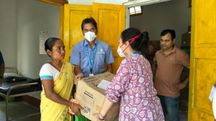
Unlike large-scale awareness drives that focus on numbers, Singha takes a smaller, more personal approach. Instead of handing out one sanitary pad packet to hundreds of women, he works with smaller groups, often around 20 to 30 women at a time, ensuring each receives a three-month hygiene kit containing sanitary pads, soap, detergent, shampoo, and towels.
The sessions are practical, rooted in local realities. Women are taught not only how to use sanitary products, but also about hygiene, affordable period-friendly diets, and safe disposal practices.
“If we tell them to eat expensive foods, it becomes impractical. So, we suggest things they can actually afford, like sesame seed laddoos, which cost around Rs 10 to Rs 20. Sesame seeds are also easily available in most Assamese households,” he says.
In many villages, he found women disposing of used pads in open spaces simply because no one had taught them otherwise. His team now educates women about safer disposal methods, including burial with lime.
Today, as part of The White Revolution Campaign, Singha and his team also distribute Pustimaan millet packets to women and girl students during awareness sessions.
The idea, he says, is not just to talk about menstrual hygiene, but also to address nutritional deficiencies linked to anaemia and poor health.
“Menstrual health cannot be discussed in isolation. Nutrition plays a huge role in a woman’s health. Through Pustimaan, we are trying to ensure that women not only receive hygiene support, but also access to healthier food choices,” he says.
But for Singha, distributing products is only one part of the mission.
“The deeper goal is education, creating safe spaces where girls can ask questions without fear, where myths are challenged, and where confidence is built,” he says. “This is about more than hygiene. It is about dignity.”
Childhood and inspiration
Singha traces his journey in social service back to his childhood in Golaghat. Growing up as an only child, he spent evenings watching television and listening to BBC broadcasts with his uncles.
One memory never left him, the news of the death of Princess Diana in 1997.
“I was probably in second or third standard. I still remember the news flashing on television and my family talking about her. Later, I started reading about her humanitarian work. That stayed with me,” he recalls.
Building with almost nothing
In 2012, at just 23, Singha founded All & Sundry, without funding, sponsorship, or institutional support.
For the first few years, he financed projects from his own pocket, sometimes spending as little as Rs 500 or Rs 1,000 to organise community programmes.
“People don’t support an unknown initiative easily. But my parents always supported me because they knew that once I decide something, I will do it,” he says.
Recognition came slowly. Candlelight rallies in Guwahati, humanitarian contributions during the 2015 Nepal earthquake relief efforts, and later an appreciation note from Sanjeev Kapoor all became milestones in a journey built on persistence rather than resources.
Yet, for Singha, success has never been about scale.
“I’m not in competition with anyone. Even if I spend Rs 1,000 on a project, it should create real change,” he says.
For him, even the smallest recognition carries weight.
“For people like us, even small recognition means a lot because we work for people and for the betterment of society. Whenever I am able to do something for our community, for our people, it gives me strength from within,” he says.
Pausing for a moment, he adds with quiet gratitude:
“I am thankful to everyone who has supported me and held my hand during this journey. In today’s world, even a little encouragement gives me greater strength to continue working for humanity.”