‘Hulao Mara Festival’ celebrated with traditional community fishing in Meghalaya’s Marngar
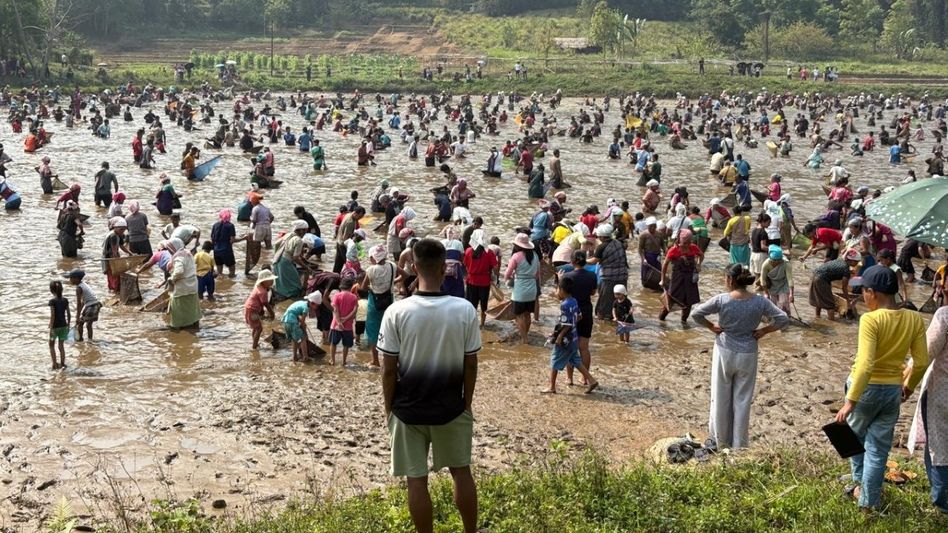
Residents of a cluster of Assamese-speaking villages near Nongpoh in Meghalaya’s Ri-Bhoi district organised their annual community fishing festival at the Marngar wetland, reaffirming longstanding cultural traditions despite geographical and administrative distance from Assam.

- Apr 16, 2026,
- Updated Apr 16, 2026, 3:02 PM IST

Residents of a cluster of Assamese-speaking villages near Nongpoh in Meghalaya’s Ri-Bhoi district organised their annual community fishing festival at the Marngar wetland, reaffirming longstanding cultural traditions despite geographical and administrative distance from Assam.
Located about six kilometres from Nongpoh and approximately 50 kilometres from Guwahati, the Marngar region comprises ten villages—Borgang, Nalapara, Nongaon, Puran Gaon, Lalumpam, Joygaon, Barkuchi, Barkhat Chai, Charikuchi, and Athgaon. The area, though surrounded by natural landscapes, has remained relatively underdeveloped and lacks significant representation.
The residents, primarily belonging to the Karbi and Tiwa communities, are locally referred to as “Marngali.” Despite residing outside Assam, they have maintained Assamese language, literature, and cultural practices over generations.
A key cultural event in the region is the annual community fishing festival, locally known as the “Hulao Mara Festival,” held at Kucho Khua Beel. The festival coincides with the eve of Bohag Bihu, marking the Assamese New Year.
This year’s celebrations saw large participation from across the villages. From early morning, villagers gathered along the wetland to engage in traditional fishing practices using indigenous tools such as jakoi, khaloi, pol, chepa, khokha, and fishing nets.
The event witnessed participation from all sections of the community, including men, women, youth, and children, reflecting a shared cultural engagement and collective identity. The wetland area transformed into a focal point for social interaction and cultural expression.
However, participants noted a decline in fish availability compared to previous years, with some villagers unable to secure a catch. Despite this, the festival continued with traditional music and dance performances along the banks, maintaining the celebratory spirit associated with Bihu.
Local residents said the festival remains an important platform for preserving cultural continuity and community cohesion in the region.