
iRAD 2026 opens at Gauhati University, bringing global focus to Weather Science in the northeast
In a significant boost to meteorological research in India’s North-East, the Eighth Conference on India Radar Meteorology (iRAD 2026)—an international academic conclave—was inaugurated at Gauhati University, marking the first time the prestigious conference is being hosted in the region.

- Jan 07, 2026,
- Updated Jan 07, 2026, 8:58 PM IST

- iRAD 2026 is the first radar meteorology conference in India's North-East.
- The RADAR School aims to enhance capacity in radar-based weather science.
- Dr Aggarwal noted shifts in weather patterns and risks to agriculture in Assam.
In a significant boost to meteorological research in India’s North-East, the Eighth Conference on India Radar Meteorology (iRAD 2026)—an international academic conclave—was inaugurated at Gauhati University, marking the first time the prestigious conference is being hosted in the region. With a sharp focus on the application of radar meteorology in understanding weather systems over mountainous and complex terrain, the conference brings global scientific attention to the region’s unique climatic challenges.
The multi-day event formally began with the inauguration of the RADAR School on January 6, an academic initiative aimed at strengthening capacity-building and advanced learning in radar-based weather science. The opening session was attended by M. Ravichandran, Secretary, Ministry of Earth Sciences, Government of India, and Dr Soma Sen Roy, Head of the RADAR Division, India Meteorological Department (IMD).
The conference was officially inaugurated on January 7 at the university’s PD Hall with the ceremonial lighting of the lamp, followed by a welcome address by eminent atmospheric scientist B. N. Goswami. Addressing the gathering, Vice-Chancellor Prof. Nani Gopal Mahanta underscored the growing role of technology-driven research in addressing environmental uncertainties and mitigating weather-related risks. He emphasised the responsibility of universities in fostering innovation, interdisciplinary research and institutional collaboration to tackle climate challenges.
The inaugural session featured addresses by S. P. Aggarwal, Director of the North Eastern Space Applications Centre (NESAC), and S. S. Kakatkar, Programme Director of the Society for Applied Microwave Electronics Engineering and Research (SAMEER), who were present as Guests of Honour. Dr Aggarwal highlighted noticeable shifts in weather patterns across Assam and the wider North-East, including changing winter conditions, rising humidity levels and increasing temperatures. He pointed out that the region’s heavy reliance on the monsoon, coupled with erratic rainfall and recurrent flooding, continues to pose serious risks to its agriculture-driven economy.
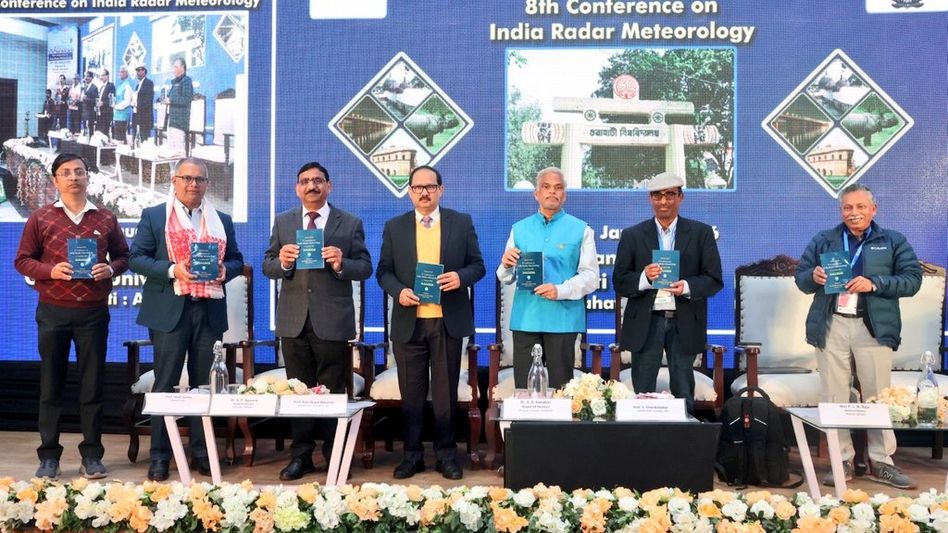
As part of the inaugural proceedings, the Book of Abstracts of iRAD 2026 was formally released, documenting the diverse research themes and scientific contributions to be presented during the conference. The programme concluded with a vote of thanks delivered by Utpal Sarma, Registrar of Gauhati University.
The iRAD 2026 conference will continue over the coming days with keynote addresses, technical sessions and expert discussions, bringing together scientists and researchers from India and abroad. Deliberations will centre on advances in radar meteorology, real-time weather monitoring and disaster preparedness, with special emphasis on forecasting and risk management in mountainous and complex terrains.
MORE NEWS










Copyright©2026 Living Media India Limited. For reprint rights: Syndications Today
