
‘LoP was interrupted 20 times’: Gaurav Gogoi attacks Speaker while moving removal resolution
Explaining the reasons behind the move, the Jorhat MP said the Leader of the Opposition had been repeatedly prevented from speaking during the motion of thanks to the President’s address.

- Mar 10, 2026,
- Updated Mar 10, 2026, 2:51 PM IST

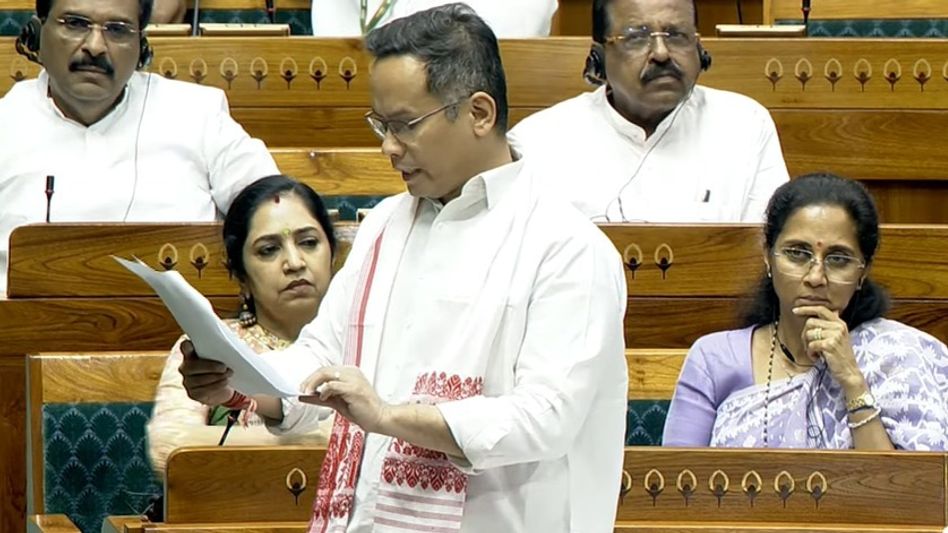
Congress MP Gaurav Gogoi on March 10 defended the opposition’s move to bring a resolution seeking the removal of Lok Sabha Speaker Om Birla, saying the step was necessary to “protect the dignity of the House and save the Constitution”.
Initiating the debate on the resolution, Gogoi accused the Speaker of showing partisan behaviour and allowing repeated interruptions of the Leader of the Opposition during a key parliamentary debate in February.
Explaining the reasons behind the move, the Jorhat MP said the Leader of the Opposition had been repeatedly prevented from speaking during the motion of thanks to the President’s address.
“We stated that in February, when the LoP wanted to speak on the motion of thanks to the President’s address, he was interrupted 20 times by the Speaker, members of the chairpersons’ panel and senior members of the treasury benches,” Gogoi said. According to him, the interruptions happened “in a premeditated manner”.
“The Speaker did not allow the LoP to speak,” he added, claiming that attempts to raise issues of public importance were repeatedly obstructed.
Gogoi said the Leader of the Opposition had intended to raise remarks made by former army chief MM Naravane in his unreleased book, where the former officer reportedly wrote that the country’s leadership told him “Jo uchit samjho wahi karo”.
At this point, Jagdambika Pal, who was presiding over the proceedings, asked Gogoi to confine his remarks to the reasons for bringing the resolution against the Speaker.
Parliamentary Affairs Minister Kiren Rijiju intervened, stating that the discussion was about the Speaker and the opposition should not introduce unrelated issues. Gogoi responded that a review of parliamentary transcripts would show Rijiju interrupting opposition members most frequently.
Home Minister Amit Shah then remarked that while Rijiju might have interrupted the most, “there has never been an opposition like the current one”.
Resuming his speech after several interruptions, Gogoi said the Leader of the Opposition had also sought to raise the issue of an investigation underway in the United States involving a businessman and mentioning an Indian minister.
He further said questions were to be raised about trade negotiations involving India and the United States. “He asked what made India rush into a deal and make concessions to the US that would be detrimental to our farmers,” Gogoi said.
According to the Congress MP, the Speaker had demanded authentication of the claims being raised, which the Leader of the Opposition agreed to provide. However, Gogoi alleged that members from the treasury benches objected repeatedly and prevented the speech from continuing.
Gogoi also cited the Supreme Court’s observations in the Nabam Rebia case, which state that the Speaker must display “a sense of elevated independence, impeccable objectivity, irreproachable fairness and above all absolute impartiality”.
Raising questions about the procedure followed for the debate, Gogoi asked who decided that Jagdambika Pal would preside over proceedings related to the resolution against the Speaker.
Despite the criticism, Gogoi said opposition members maintained cordial personal relations with Birla. “But it is our responsibility to protect the dignity of the House and save the Constitution,” he said.
The resolution was moved by Congress MPs K Suresh, Mallu Ravi and Mohammad Jawed. More than 50 members stood up in support, leading to its admission in the House.
Under parliamentary rules, a Speaker can be removed if the House passes a resolution with a simple majority. Article 96 of the Constitution allows the Speaker to defend himself or herself during such proceedings.
The opposition resolution accuses Birla of acting in a “blatantly partisan” manner and “abusing” the constitutional office while conducting the business of the House.
Historically, three Lok Sabha Speakers — G V Mavlankar in 1954, Hukam Singh in 1966 and Balram Jakhar in 1987 — faced similar no-confidence motions, all of which were defeated.
MORE NEWS











Copyright©2026 Living Media India Limited. For reprint rights: Syndications Today
