
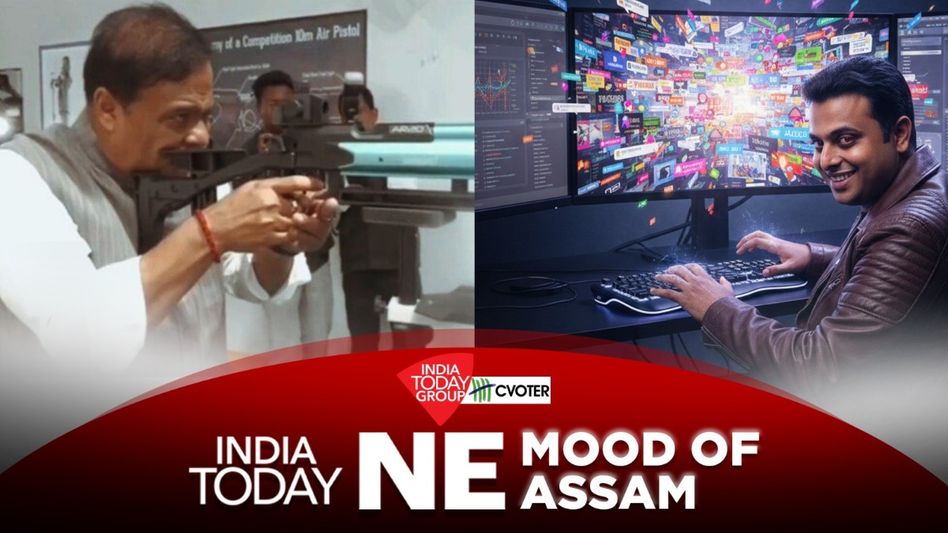
Mood of Assam: 38 per cent Muslims blame Himanta for gun video, 23 per cent Hindus point to uploader
A gun video in Assam has sparked controversy with Muslims largely blaming Himanta Biswa Sarma, while Hindus blame the uploader. The incident highlights differing community perspectives in the state

- Feb 18, 2026,
- Updated Feb 18, 2026, 10:50 AM IST

An AI-generated video uploaded to the official social media handle of the Assam BJP has exposed deep communal divisions in the state, with the India Today–CVoter Mood of the Nation poll conducted on February 13-14, 2026, revealing a sharp 11-percentage point gap separating Muslim and Hindu beliefs about who should be held responsible.
The video depicted Chief Minister Himanta Biswa Sarma pointing a gun at a Muslim man standing beside opposition leader Gaurav Gogoi—content that ignited fierce debate about acceptable political discourse just weeks before the state's March-April 2026 assembly elections.
The poll, conducted across 1,864 respondents, asked who should be held responsible for uploading the video. Overall, 31 per cent held Chief Minister Sarma directly responsible, 12 per cent blamed Assam BJP president Dilip Saikia, 21 per cent pointed to the person who uploaded the video, 7 per cent saw nothing wrong with it, and 29 per cent said they didn't know or couldn't say.
The communal divide is stark. Among Muslim respondents, 38 per cent held Sarma directly responsible and another 17 per cent blamed BJP president Dilip Saikia—meaning a combined 55 per cent assigned responsibility to party leadership. Among Hindu respondents, only 27 per cent held Sarma responsible, while 23 per cent blamed the individual uploader—a near-equal split that reveals a fundamentally different framework for assigning accountability. Where Muslim voters see institutional sanction from the top, Hindu voters are far more willing to treat it as the action of a rogue individual.
The divide over whether the video was even problematic tells its own story. Nine per cent of Hindu respondents saw nothing wrong with an AI-generated depiction of the Chief Minister pointing a gun at a Muslim man, compared to only 5 per cent of Muslims—a gap that, while seemingly small, represents communities perceiving the same content through entirely different lenses of threat and normalcy.
For Muslim voters, who see themselves in the unnamed target, the imagery registers as an institutionally sanctioned threat. For a significant slice of Hindu voters, it registers as acceptable political communication.
The "Don't Know/Can't Say" responses also diverge meaningfully—32 per cent among Hindus versus 25 per cent among Muslims. The higher uncertainty among Hindu respondents just weeks before elections suggests strategic ambiguity: avoiding uncomfortable questions about a leader they may support electorally while stopping short of explicit endorsement. Muslim respondents, confronting content that directly targets their community, show far less room for ambiguity.
The video's appearance on the BJP's official social media handle—not a fringe account or anonymous page—makes the question of institutional responsibility impossible to sidestep. Official party platforms do not publish content accidentally, which is precisely why 31 per cent overall and 55 per cent of Muslim respondents trace responsibility upward to party leadership rather than downward to an individual uploader.
The BJP's apparent calculation—that 7 per cent seeing nothing wrong combined with 29 per cent uncertain creates sufficient political cover—reflects the cold logic of base mobilisation over broad consensus.
The India Today–CVoter Mood of the Nation poll ultimately reveals a state where the same piece of content generates two entirely different political realities depending on which community you belong to. Muslim voters assign clear institutional responsibility; Hindu voters diffuse it.
Muslim voters see a threat; a slice of Hindu voters see nothing wrong. As Assam heads toward elections, the poll suggests that for Chief Minister Sarma, a controversy that energises his base while producing only fragmented opposition may be less a crisis than a strategy—and that in a polarised state, that calculation may be exactly right.
MORE NEWS






Copyright©2026 Living Media India Limited. For reprint rights: Syndications Today
