
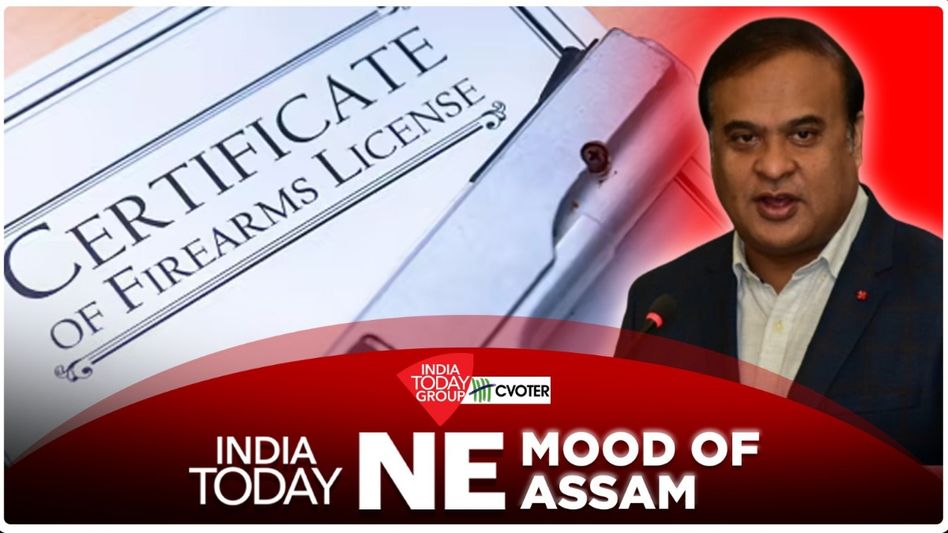
Mood of Assam | 58 per cent back government arming indigenous villagers for self-defence
The Assam government’s decision to grant arms licences to indigenous villagers in select border and remote areas as a self-defence measure amid security threats has triggered a sharply divided public response, according to the latest India Today–CVoter Mood of the Nation (MOTN) survey conducted in January 2026.

- Feb 02, 2026,
- Updated Feb 02, 2026, 6:11 PM IST

The Assam government’s decision to grant arms licences to indigenous villagers in select border and remote areas as a self-defence measure amid security threats has triggered a sharply divided public response, according to the latest India Today–CVoter Mood of the Nation (MOTN) survey conducted in January 2026.
Unlike other recent governance measures that have drawn clearer majorities, this policy appears to be more contested, reflecting competing concerns over personal security and the risks of weapon proliferation.
Statewide, 41.8 per cent of respondents support the move, saying people in vulnerable areas need to protect themselves. This reflects a significant section of the population aligning with the government’s security rationale, particularly in regions facing cross-border threats, insurgency risks, or weak policing presence.
Among Hindu respondents, support stands at 47.0 per cent, indicating a near-majority endorsement within this group. Support is overwhelming among respondents categorised as “Others”, where 90.0 per cent back the move — though this unusually high figure also suggests the category may represent a smaller or more region-specific sample.
Among Muslim respondents, however, support is markedly lower at just 24.5 per cent, pointing to substantial community-level scepticism about the policy.
An additional 16.2 per cent of respondents say they may support the policy, but only with proper training and strict safeguards. This group reflects a cautious middle, acknowledging security concerns but wary of the risks associated with wider civilian access to firearms.
This view is more prevalent among Hindus (21.5 per cent) than among Muslims (11.0 per cent), and is absent among the 'Others' category (0.0 per cent), according to the data.
Taken together, unconditional and conditional support amounts to 58.0 per cent, suggesting that a majority could potentially be aligned with the policy if strong regulatory and training frameworks are clearly demonstrated.
Opposition is substantial. 29.0 per cent of respondents believe the policy could lead to misuse and escalate violence. This concern is particularly pronounced among Muslim respondents, where nearly half — 49.1 per cent — oppose the move on these grounds.
By contrast, 19.8 per cent of Hindu respondents and just 3.3 per cent of respondents in the “Others” category share this fear, highlighting another sharp community-wise divide.
A further 12.9 per cent of respondents said they don’t know or can’t say. The undecided share is higher among Muslims (15.4 per cent) compared to Hindus (11.7 per cent) and Others (6.7 per cent*), indicating lingering uncertainty and information gaps around how the policy will be implemented.
The findings suggest that while the government’s security-based justification resonates with a sizeable section of the electorate, the policy also carries significant social and political risks. Concerns about weapon misuse, vigilantism, and the potential for escalation of local conflicts remain prominent, particularly among minority communities.
For the Himanta Biswa Sarma government, the data points to a delicate balancing act. Framing the policy as a tightly regulated, last-resort self-defence mechanism with robust training and oversight could help consolidate broader support. Failure to do so, however, risks reinforcing fears of militarisation of civilian spaces and deepening community mistrust.
The January 2026 India Today–CVoter MOTN survey shows that Assam voters are divided on the decision to arm indigenous villagers for self-defence. While a plurality — and potentially a conditional majority — supports the move on security grounds, a significant minority fears misuse and escalation of violence.|
MORE NEWS












Copyright©2026 Living Media India Limited. For reprint rights: Syndications Today
