Northeast’s divided anaemia map: The best and the worst states
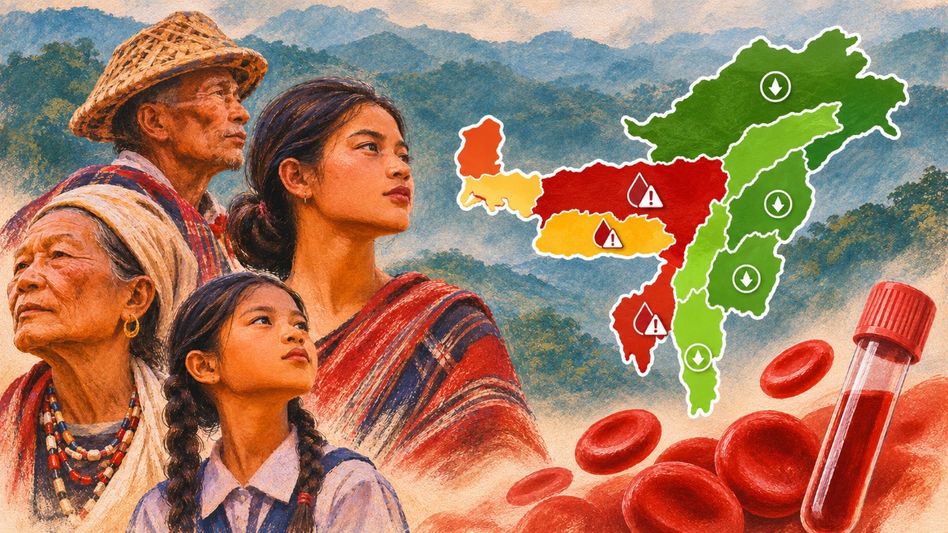
While Assam, Tripura and Meghalaya report a disproportionately high burden of anaemia, Mizoram, Nagaland, Sikkim and Arunachal Pradesh fare better than the national average across every population category assessed.

- Nov 26, 2026,
- Updated Nov 26, 2026, 12:06 PM IST

- Assam records India's highest prevalence among adult and elderly men
- Nearly four in five elderly women in Tripura suffer from anaemia
- All seven surveyed states beat the national average for younger children
India’s Northeast presents a strikingly divergent picture of nutritional and public health outcomes, with neighbouring states reporting vastly different levels of anaemia prevalence. While Assam and Tripura figure among the country’s worst-performing states in several population categories, Mizoram, Nagaland, Sikkim and Arunachal Pradesh have recorded prevalence estimates below the national average across all nine demographic categories assessed in a new nationwide nutrition survey.
The Survey for Assessment of Markers of Population Health, Activity, Diet and Anthropometry (SAMPADA), conducted by the ICMR-National Institute of Nutrition between 2023 and 2025 and released on November 23, also reveals that anaemia among adult and elderly men is a particularly serious concern in Assam, Meghalaya and Tripura.
The geographical disparities are most pronounced among women. Tripura has recorded an anaemia prevalence of 73.3 per cent among non-pregnant, non-lactating women aged 20 to 59 years, the highest estimate among Indian states, followed by Assam at 72.8 per cent. Meghalaya stands at 60.9 per cent, also above the national average of 54.8 per cent.
In contrast, the corresponding figures for Nagaland, Mizoram, Sikkim and Arunachal Pradesh are 35.7 per cent, 36.6 per cent, 37.2 per cent and 43.6 per cent, respectively.
The prevalence among adult women in Tripura is more than twice that in Nagaland, illustrating the enormous disparities in health outcomes within the region.
The three states of concern
Assam has the highest estimated anaemia prevalence among adult men and elderly men in the country, at 46.8 per cent and 74 per cent, respectively. Meghalaya has the second-highest prevalence estimate nationally among adult men, at 38.9 per cent, while Tripura reports 31.8 per cent. The national average is 22 per cent.
Among elderly men, the prevalence in Tripura and Meghalaya stands at 64.8 per cent and 58.6 per cent, respectively, against the national figure of 44.7 per cent.
Tripura’s elderly women are particularly vulnerable, with nearly four in five, or 79.6 per cent, suffering from anaemia. The corresponding figure is 76.9 per cent in Assam.
The burden extends to younger generations. Nearly 60 per cent of adolescent girls in Tripura and Assam are anaemic, while Meghalaya reports a prevalence of 47.1 per cent against the national average of 46.3 per cent. Among children aged five to nine years, Assam, Meghalaya and Tripura all exceed the national average.
Four states buck the trend
Mizoram, Nagaland, Sikkim and Arunachal Pradesh offer a contrasting picture. All four states have recorded lower estimated anaemia prevalence than the national average across every population category for which state-level data have been published.
Mizoram has the lowest prevalence among children aged 12 to 59 months in the Northeast, at 14.8 per cent, compared with the national average of 41.8 per cent. This places it close to Kerala, which recorded 14.5 per cent.
Nagaland has the region’s lowest estimated prevalence among adolescent girls, at 22.8 per cent, less than half the national average of 46.3 per cent. Sikkim has the lowest prevalence in the region among adolescent boys and adult men, at 7.1 per cent and 11.8 per cent, respectively.
Arunachal Pradesh, meanwhile, reports a prevalence of 35.2 per cent among adolescent girls, 43.8 per cent among women of reproductive age and 39.6 per cent among elderly women, all considerably below the corresponding national averages.
Interestingly, all seven northeastern states for which SAMPADA has published data report lower anaemia prevalence among children aged 12 to 59 months than the national average.
A historical pattern
The regional disparities are not entirely new. The National Family Health Survey (NFHS-5), conducted between 2019 and 2021, also identified Assam and Tripura as states with a particularly high prevalence of anaemia among women and men.
According to NFHS-5, 67.2 per cent of women aged 15 to 49 years in Tripura and 65.9 per cent in Assam were anaemic. In comparison, the prevalence was 28.9 per cent in Nagaland, 29.4 per cent in Manipur and 34.8 per cent in Mizoram.
These variations warrant further investigation into differences in dietary diversity, food security, socioeconomic conditions, inherited blood disorders, infectious diseases and access to healthcare across the region. The SAMPADA fact sheets do not establish the specific reasons behind these interstate disparities.
The two surveys are also not directly comparable because of differences in blood sampling methods, diagnostic thresholds and demographic classifications. SAMPADA used venous blood samples and automated analysers, considered a more reliable approach to measuring haemoglobin levels.
Beyond iron deficiency
One of the most significant findings of SAMPADA is that iron deficiency alone cannot explain India’s anaemia burden. Nationally, while 55.9 per cent of women of reproductive age were anaemic, 26.7 per cent had both anaemia and iron deficiency. Among adult men and elderly populations, the prevalence of iron deficiency was substantially lower than that of anaemia.
The findings have important implications for the Northeast, where previous research has documented inherited blood disorders in certain communities. They point towards the need for more comprehensive diagnostic interventions rather than an approach dominated by iron and folic acid supplementation.
India’s Anaemia Mukt Bharat programme, launched in 2018, already recognises the importance of addressing infections, inherited blood disorders and other non-nutritional causes. The new findings underline the need for more geographically targeted interventions, particularly in Assam, Tripura and Meghalaya.