Over 11,000 people benefit from Small Grants Programme in Assam, Meghalaya
More than 11,000 people, mostly farmers, have benefited from the GEF-Small Grants Programme (SGP) in Assam and Meghalaya during the first two years of its five-year project, with over 17,000 hectares of land brought under improved management, officials said.


- Sep 14, 2026,
- Updated Sep 14, 2026, 4:15 PM IST

More than 11,000 people, mostly farmers, have benefited from the GEF-Small Grants Programme (SGP) in Assam and Meghalaya during the first two years of its five-year project, with over 17,000 hectares of land brought under improved management, officials said.
The programme aims to empower communities to take collective action for conservation and sustainable development, particularly in vulnerable and least-developed areas.
As the seventh Operational Phase (OP7) of the GEF-SGP concluded on Monday, implementing partners in the Northeast said efforts are underway to expand the programme's reach and bridge the gap between grassroots practices and formal policy.
The Environment, Forest and Climate Change Ministry, in collaboration with the UNDP, is implementing GEF OP7 of the SGP in India. The Energy and Resources Institute (TERI) is the National Host Institution, while the Tata Institute of Social Sciences (TISS), Guwahati, is the knowledge partner for the Northeast.
The Northeast is one of three focus regions under OP7, alongside central semi-arid areas and coastal regions.
“The OP7 aimed to enable communities and organisations in some of the most vulnerable and least developed areas to take collective action through a participatory landscape planning and management approach aimed at enhancing socio-ecological resilience through innovative livelihood options producing local and global environmental benefits,” said Abhinandan Saikia, project lead, SGP Project-TISS Guwahati.
Sharing the programme's achievements during its first two years, Dipankar Saharia, senior director at TERI, said more than 11,000 lives had been impacted, with farmers accounting for 61 per cent of those reached.
Over 17,000 hectares have been brought under improved management, while 2,800 hectares have been restored. The interventions have covered 250 villages across 11 districts of Assam and Meghalaya and added 182 kW of renewable solar capacity, officials said.
Saharia stressed that the programme should not simply become a source of funding for organisations, but should help establish community-driven approaches that can continue after the grant period ends.
Saikia said the programme was also focusing on bridging the gap between field-level practices and formal policymaking by bringing together traditional knowledge, community-led clean-energy solutions, appropriate technologies and modern innovations.
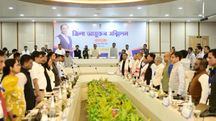
A two-day national conference on “Indigenous Traditional Knowledge, Clean Energy and Grassroots Innovation to Policy Solutions for Biodiversity, Climate Resilience and Land Restoration in Assam and Meghalaya” was recently organised in Guwahati as part of these efforts.
More than 150 community farmers, grassroots practitioners, representatives of 22 NGO partners, resource persons and development professionals from Delhi, Assam and Meghalaya participated in the conference, said Manish Kumar Pandey, national coordinator, SGP-India, TERI.
“We are focused on how successful grassroots initiatives supported through small grants can move beyond the pilot stage and gain larger institutional and financial support,” Pandey said.
Saikia said work with communities would continue through the SGP, including under the upcoming OP8, with the emphasis remaining on sustainable and community-driven interventions.