Post-Election Tremors in Bangladesh and Nepal: Gen-Z Revolts, Democratic Resets and India’s Strategic Dilemma
Generation Z voters in Bangladesh and Nepal are driving political change, demanding reforms and transparency. India faces strategic challenges as it navigates its role in the region.

- Mar 16, 2026,
- Updated Mar 16, 2026, 9:08 PM IST

South Asia is witnessing a generational churn rarely seen since the democratic transitions of the late twentieth century. In both Bangladesh and Nepal, elections held in the aftermath of youth-led upheavals have reshaped political narratives, weakened traditional elites and foregrounded the anger of Generation Z. These developments are not merely domestic episodes; they carry profound implications for India’s regional diplomacy, security architecture and normative claims about democracy in its neighbourhood.
From the violent student uprising that toppled Sheikh Hasina’s long-standing government in Bangladesh to the Gen-Z protests that forced the resignation of Nepal’s Prime Minister K. P. Sharma Oli, the region has entered a volatile phase of democratic renegotiation. The post-election climates in Dhaka and Kathmandu are thus defined by three interrelated forces: generational dissent, institutional reset and geopolitical recalibration.
Bangladesh: From the July Revolution to Electoral Uncertainty
The political tornado in Bangladesh began with the student-led protests of July–August 2024, which erupted initially over a controversial public-sector job quota system but soon transformed into a nationwide uprising against authoritarian governance. The protests were met with brutal repression; international estimates suggest that as many as 1,400 people may have died during the crackdown.
What started as a campus agitation quickly evolved into a broader movement challenging Sheikh Hasina's 15-year rule. Protesters used digital networks, memes and viral imagery to mobilise resistance, turning social media into a powerful infrastructure of collective identity and dissent.
By August 2024, the pressure became unsustainable. Hasina fled the country, and an interim administration led by Nobel laureate Muhammad Yunus assumed power. The uprising—often described as the “July Revolution”—marked the most dramatic political rupture in Bangladesh since the restoration of parliamentary democracy in the 1990s.
The July Charter: Attempting a Democratic Reset
In the aftermath of the uprising, Bangladesh embarked on an ambitious constitutional reform process culminating in the July Charter of 2025. Endorsed by two dozen political parties, the charter consolidated more than eighty reform proposals, many of them constitutional in nature. The document sought to address longstanding grievances—electoral manipulation, concentration of executive power, politicisation of the judiciary and restrictions on civil liberties. For the interim government, the charter represented a symbolic attempt to restore democratic credibility after years of institutional erosion.
Yet the charter has also exposed deep ideological divides. Some activists view it as insufficient, arguing that structural reforms cannot occur without dismantling entrenched security networks and patronage structures. Others worry that the reform process risks fragmentation if competing parties use the charter as a tool of political bargaining rather than constitutional renewal.
The result is a paradox: Bangladesh’s political system appears simultaneously open and unstable.
“Ayna Ghar”: The Necropolitics of Disappearance
No symbol better illustrates the darker legacy of the previous regime than the revelation of “Ayna Ghar”, literally the “house of mirrors.” Ayna Ghar refers to a network of clandestine detention centres allegedly operated by Bangladesh’s military intelligence and elite police units during Sheikh Hasina’s rule. These facilities were linked to enforced disappearances, extrajudicial detention and torture. Investigations after the regime’s fall uncovered hundreds of such cells scattered across the country, some hidden within intelligence headquarters. Detainees were reportedly held for years without trial, and many never returned. For survivors, Ayna Ghar represents more than a physical location; it embodies a necropolitical space—a site where the state exercises the power to decide who may live, disappear or remain suspended in a legal void. The exposure of these secret prisons has become a central demand of the Gen-Z movement, which insists that democratic transition must include accountability for past atrocities.
When Muhammad Yunus visited several of these facilities in 2025, he reportedly described the scenes as “horrific,” underscoring the moral shock generated by the revelations. Thus, Bangladesh’s post-election climate remains haunted by the ghosts of enforced disappearance and unresolved justice.
The Limits of Youth Politics
Ironically, the Gen-Z protesters who ignited the revolution have struggled to convert street mobilisation into electoral dominance. A youth-driven political formation emerging from the movement has already experienced internal divisions, including disputes over alliances with Islamist groups. This gap between protest energy and institutional power is not unusual. Revolutions often produce fragmented political landscapes in which traditional parties reassert themselves. Nevertheless, the symbolic power of the youth uprising continues to shape political discourse in Bangladesh.
For the first time in decades, the legitimacy of state institutions is being openly renegotiated.
Nepal: The Gen-Z Uprising and Electoral Earthquake
While Bangladesh’s upheaval unfolded over months, Nepal’s crisis erupted in a matter of days.
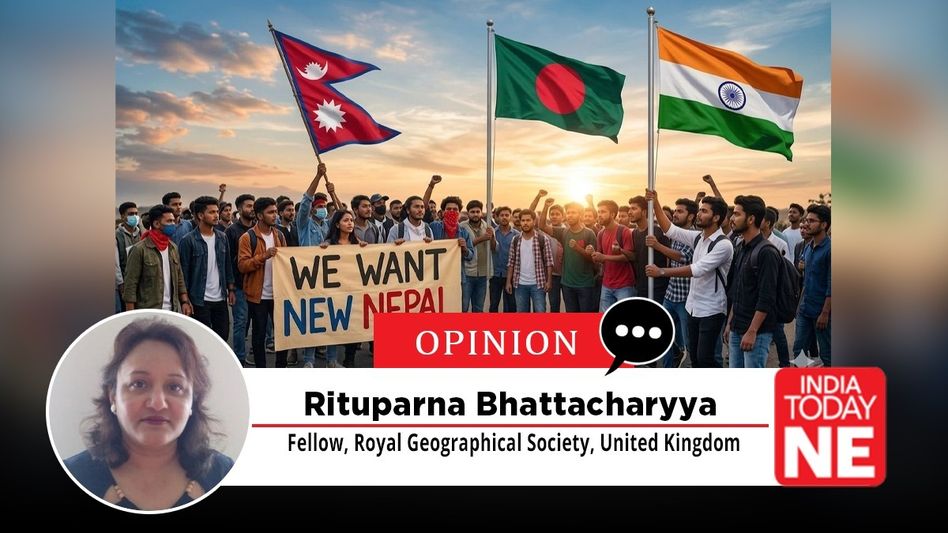
In September 2025, the Nepali government imposed a sweeping ban on major social-media platforms, citing regulatory concerns. The move triggered nationwide protests led largely by students and young professionals. Demonstrators quickly broadened their demands to include anti-corruption reforms and accountability for political elites. The protests escalated into violent clashes with security forces. Dozens of people were killed, and government buildings—including the parliament complex—were attacked or set ablaze. Within days, Prime Minister K. P. Sharma Oli resigned, and an interim government was formed. The episode exposed the fragility of Nepal’s political system, which had already witnessed more than thirty governments since the restoration of democracy.
A Generational Electoral Shift
The political consequences of the uprising became evident in the subsequent national elections.
In a stunning outcome, the reformist Rastriya Swatantra Party secured a landslide victory, winning an overwhelming majority of parliamentary seats and dismantling the dominance of traditional parties. The party’s leader, former rapper-turned-politician Balendra Shah, emerged as a symbol of generational change. His campaign capitalised on youth frustration with corruption, unemployment and elite privilege.
The election thus represented more than a change of government—it marked the arrival of a new political class shaped by digital culture and protest activism.
Social Media, Youth Identity and Political Mobilisation
A striking similarity between Bangladesh and Nepal lies in the central role of digital platforms in mobilising dissent.
In Nepal, the initial trigger for the uprising was the government’s attempt to restrict access to social media. The ban was interpreted by young citizens as an attack on freedom of expression and economic opportunity, prompting mass demonstrations. In Bangladesh, by contrast, social media functioned as a tool of resistance rather than repression. Protesters used online networks to coordinate demonstrations, circulate evidence of state violence and build solidarity across campuses.
In both contexts, Generation Z transformed digital communication into a political force capable of destabilising entrenched regimes.
Regional Implications for India
For India, these developments present both opportunities and strategic dilemmas.
1. Diplomatic Rebalancing
Bangladesh and Nepal occupy critical positions in India’s regional diplomacy. Political transitions in both countries require New Delhi to recalibrate its relationships with emerging leaders and movements.
India’s ties with Sheikh Hasina were historically strong, particularly in security cooperation and counter-terrorism. Her abrupt exit from power complicates the diplomatic landscape, especially given her temporary refuge in India during the crisis.
Nepal, meanwhile, has long balanced its relations between India and China. The rise of a youth-driven political leadership could either reset this balance or intensify geopolitical competition.
2. Security Concerns
The upheaval in Nepal has already generated cross-border anxieties. During the protests, thousands of prisoners reportedly escaped from jails, some of whom were allegedly linked to criminal networks operating across the India–Nepal border. Given the porous nature of the frontier, instability in Nepal can easily spill over into neighbouring Indian states such as Bihar and Uttar Pradesh.
Bangladesh presents a different security challenge. The exposure of secret detention centres and human-rights abuses has intensified scrutiny of security agencies that previously cooperated closely with India. If reforms weaken these agencies without replacing them with accountable institutions, transnational security coordination could suffer.
3. Normative Challenges
India has long projected itself as the region’s democratic anchor. Yet the Gen-Z uprisings in Bangladesh and Nepal highlight a generational critique of traditional politics—one that also resonates within India itself.
Young protesters in both countries have framed their struggles in terms of transparency, accountability and digital freedom. Their rhetoric reflects a broader global trend in which youth movements challenge hierarchical party systems and demand participatory governance.
For India, engaging constructively with this generational shift will be crucial to maintaining its moral influence in South Asia.
A New South Asian Political Generation
What ultimately links the crises in Bangladesh and Nepal is the emergence of a digitally connected, politically impatient generation.
Unlike earlier waves of student activism, these movements are decentralised and leaderless. They operate through memes, hashtags and encrypted messaging platforms rather than traditional party structures.
Their demands are not necessarily ideological but procedural: clean elections, transparency, accountability and respect for civil liberties.
This makes them difficult to co-opt yet equally difficult to institutionalise.
Conclusion: The Unfinished Transition
The post-election climates in Bangladesh and Nepal reveal two different trajectories of democratic transformation.
In Bangladesh, the challenge lies in translating revolutionary energy into stable constitutional reform while confronting the traumatic legacy of enforced disappearances symbolised by Ayna Ghar.
In Nepal, the question is whether a youth-driven electoral victory can overcome the structural instability that has long characterised the country’s politics.
For India, these developments represent both a strategic test and an opportunity. A neighbourhood undergoing democratic reconfiguration requires careful diplomacy—one that respects domestic aspirations while safeguarding regional stability.
If South Asia is indeed entering an era of Gen-Z politics, the traditional grammar of statecraft may no longer suffice. The streets of Dhaka and Kathmandu have already demonstrated that a generation raised on digital connectivity and political scepticism is capable of reshaping the region’s political landscape.
The true question is whether the institutions of power—both within these countries and across South Asia—are prepared to listen.