Tezpur University observes Zubeen Divas with silent march demanding justice
Tezpur University observed Zubeen Divas with a silent march across its campus on September 19, with students, research scholars, teachers, non-teaching staff and residents joining the programme and demanding justice for late Assamese singer and musician Zubeen Garg.

- Sep 20, 2026,
- Updated Sep 20, 2026, 3:58 PM IST

Tezpur University observed Zubeen Divas with a silent march across its campus on September 19, with students, research scholars, teachers, non-teaching staff and residents joining the programme and demanding justice for late Assamese singer and musician Zubeen Garg.
The two-day observance, held on September 18 and 19, was organised by the Tezpur University Charcha Mancha, a common platform comprising members of the university community. The programme featured panel discussions, tributes, cultural performances, a mural unveiling, tree plantation and campus-cleaning drives, as well as film and documentary screenings.
The programme began on September 18 with a panel discussion titled “The Crisis in Higher Education, Student Movement and Tezpur University” at the Council Hall.
The event opened with a tribute to Zubeen Garg and Jyotishmaan Baruah, an Integrated M.Sc. Chemistry student at Tezpur University who died recently. The gathering observed a moment of silence in their memory.
Prof Amarendra Kr Das, Pro Vice-Chancellor of Tezpur University, inaugurated the discussion and delivered the opening remarks. The panel comprised journalist and writer Munin Bayan, writer and former Tezpur University student Kishor Kumar Kalita, and Dr Kangkan Deka, Associate Professor at Darrang College.
The discussion examined various aspects of higher education in India, including the challenges confronting higher educational institutions. The panelists also discussed the student movement at Tezpur University a year ago, its context and experiences, and its wider implications.
Uddipan Hazarika, a research scholar, anchored the programme.
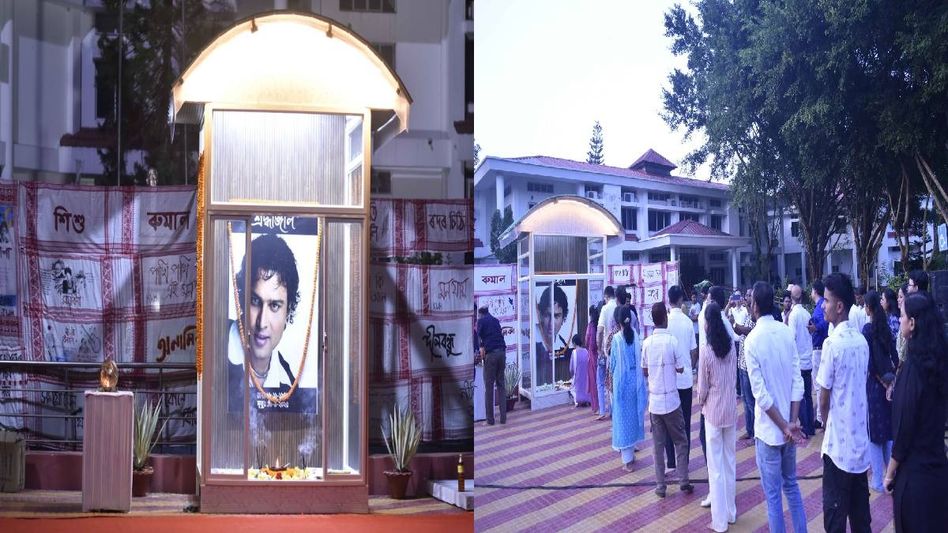
Following the panel discussion, a portrait of Zubeen Garg was installed at his memorial site on the university campus, where a tribute was also paid to the late artiste. Hostel residents later performed Né̄gara Naam and Dihanam, followed by a cultural evening and a screening of Kanchanjangha, a film directed by Zubeen Garg.
On September 19, the second day of the observance began with a tribute to Zubeen Garg, followed by a tree plantation and campus-cleaning drive.
Preliminary work for the installation of a statue of Zubeen Garg in front of the university's Central Library also began during the day.
A mural of the singer was subsequently unveiled at the Pobitora Madam Curie Women's Hostel and Community Hall.
The university community later participated in a candle-lighting ceremony and a silent march across the campus. The march was organised as a collective expression of protest seeking justice for Zubeen Garg.
The two-day programme concluded with a cultural evening and the screening of a documentary documenting the student-led movement that emerged at Tezpur University following Zubeen Garg's death.
The observance concluded with the screening of Roi Roi Binale, described by the organisers as Zubeen Garg's last film.