


The night Guwahati stopped being just a stopover
He looked like the kind of man who gets a venue shut down before the first note is played—barefoot, buzzed, inked head to toe, holding a red cup and a smoke like he didn’t care who was watching. Five minutes later, when he opened his mouth, everyone realised they weren’t witnessing chaos at all, but the beginning of something Guwahati had never seen before.
Advertisement

Aparmita Das
- Dec 13, 2025,
- Updated Dec 13, 2025, 1:00 PM IST
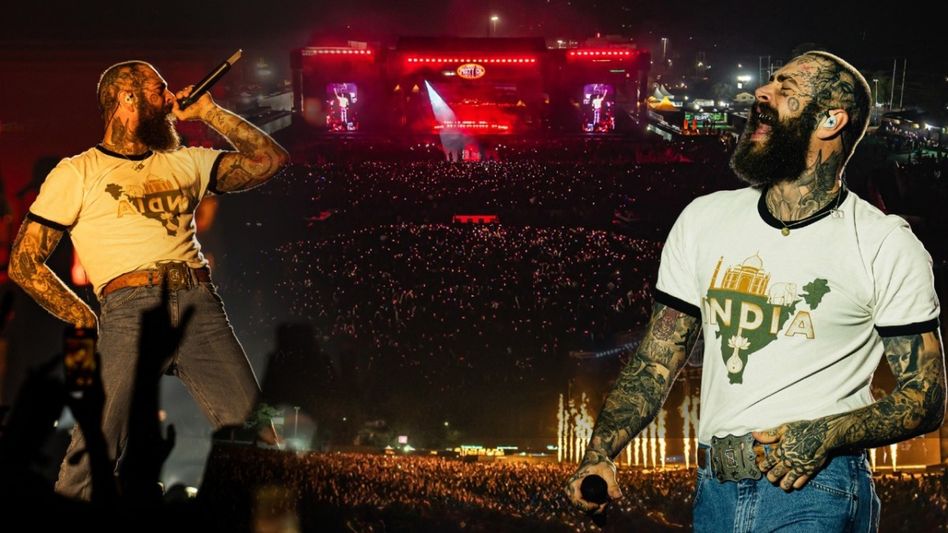
Slow, lazy walk. A red cup of some beverage—could be a hard drink, or maybe not. A joint in hand—could be a cigarette, or something else to smoke. Over 70 tattoos covering his body, including his face. He walks in. Barefoot.
For people who are not fans, this would actually make them think they entered some illegal gig they are not supposed to be a part of. The kind of entrance that screams trouble, the kind that makes you look around, wondering if security is going to shut this down any second. But this idea was going to change in not less than five minutes, when the artiste was going to start singing.
I have been to my share of concerts. The kind where you camp outside the venue three hours early just to get a decent spot. The kind where the crowd crushes you the moment the gates open. The kind where you are fighting for space, fighting for air, fighting just to see the stage. This wasn’t that.
Khanapara Veterinary Ground felt almost empty when I walked in. Not ‘empty’ empty, but comfortable. You could actually choose where to stand. You could move around without elbowing someone in the ribs. There was this weird calm in the air, like everyone was holding their breath, waiting to see if this would actually work.
Because let’s be honest—Guwahati hosting a BIG international act? That was new territory.
The sunset was doing its thing, painting everything gold. This was probably the most beautiful sunset I witnessed this year, one at a concert venue, and that too in what’s basically a concrete jungle. There’s something about that golden hour light that makes even a dusty ground look like it belongs in a movie.
Back in May, when Assam Chief Minister Himanta Biswa Sarma announced that an American rap and hip-hop sensation would perform here on December 8, half the state didn’t believe it. The other half started planning their outfits. “He will perform in Guwahati on December 8,” he said at a press conference in Golaghat, and just like that, social media went crazy.
An international artist. In Guwahati. For the very first time.
The thing is, if you’ve grown up in the Northeast and you love music, you know the drill. Want to see someone big? Fly to Mumbai. Or Delhi. Or drive to Shillong. Those were your options. That’s always been the deal.
Shillong has got the reputation locked down. Bryan Adams performed there. Blue performed there. Akon, Boney M, Ronan Keating, Jason Derulo, and Ne-Yo performed there. Def Leppard is coming in March 2026. The city has earned its stripes. You say “rock capital of India”, and people nod because, yes, that makes sense. Shillong breathes music. You can’t walk two blocks without hearing a band practice. Every café has live music. Every other person you meet is either in a band or knows someone who is.
So Guwahati stepping up? That was bold.
On paper, Guwahati should be the obvious choice. Better roads, better airport, better infrastructure overall. But concerts aren’t just about logistics. A recent report showed Shillong recording 213 per cent growth in live entertainment consumption this year. Two hundred and thirteen per cent. In a city where traffic can turn a ten-minute drive into a two-hour nightmare. In a city where half the streets aren’t even wide enough for two cars to pass each other.
But Shillong has something you can’t build with good roads. It has people who live for music. Not just enjoy it—live for it.
Donald Zacky drove down from Shillong with his friends. “For music, we are willing to travel anywhere,” he told India Today NE. And you could tell he meant it. There were so many Shillong folks at the venue, you’d think the concert was happening there instead.
“I think the fans in Shillong are really wild,” Donald said. “Wherever we do a concert in Shillong, you can see the hype there. So here I think it’s a bit downsized, but I feel like people will really enjoy it. Plus it’s a big concert. Post Malone is already big. So I hope that organisers can maybe arrange a Shillong concert as well.”
Then he got into it. The whole debate about which state is better for concerts, and which city should get the acts. “I feel like there’s no such thing as this state is bigger, that state is bigger, because at the end of the day, it comes down to the organisers and the state government helping out each other. So the concert economy is already rising, it’s a booming economy, especially in Saudi. So now it’s gaining traction in India, so Guwahati is a good start for the Northeast. Shillong already has a heart in everyone. Everyone knows Shillong. We have seen so many concerts right now in Arunachal Pradesh and Mizoram, and you already know the cultural Hornbill Festival as well, and I feel it’s doing very well. And especially hosting concerts in the Northeast is a plus because the weather is really good, because no matter how much you dance, you don’t even sweat. So I think people should really invest in the Northeast.”
That bit about the weather? Dead accurate. You could dance till your legs gave out and still not feel like you’re drowning in your own sweat.
Corrina, another attendee, put it even simpler. “Well, it’s not about one state defeating another. At the end of the day, if you listen to a particular artist and if that artist is coming here or to Shillong, you kind of run to both places. So I wouldn’t say that anyone is winning. I guess it’s like a win-win for both.”
That’s the whole point, isn’t it?
There was this moment a few days back when Assam Tourism Secretary Padmapani Bora posted a photo with an executive from Hybe Entertainment. If you don’t know Hybe, they’re the South Korean giant that manages BTS, TXT, SEVENTEEN—basically the biggest names in K-pop.
The comments section lost its mind. “BTS IS COMING TO GUWAHATI.” “SAVE MONEY NOW.” “THIS IS NOT A DRILL.”
Except it kind of is a drill. Or at least, it’s not happening anytime soon. BTS isn’t just big—they’re massive. Stadium-filling, government-coordinating, months-of-planning, massive. They’re managed by BigHit Music under Hybe, and hosting them would require infrastructure that Assam is still building toward. Maybe in ten years. Maybe.
What’s realistic? Smaller groups under Hybe. Newer acts. Rookies looking to build their fanbase. And honestly, that’s still pretty good. K-pop is growing here. Walk through any college campus, and you’ll find groups of kids who know every dance move, every lyric, every piece of behind-the-scenes drama.
The conversation has started. That matters more than people think.
The venue was split into sections. General Access, VIP, Fan Pit, and Lounge. Each area had its own energy. VIP looked comfortable, relaxed. Fan Pit was already packed against the barricades, people securing their spots early. GA was where the real energy lived—the people who bought cheap tickets but brought the loudest voices.
At 6:30, Kayan hit the stage. She’s good. She’s opened for Ed Sheeran. She knows what she’s doing. But here’s where things got weird—no emcee. Just gaps. A gap before Kayan. A gap after Kayan. Dead air that made people check their phones, wander off to get food, wonder when the main act would finally show up.
Those gaps gave everyone time to hit the bathrooms, grab drinks, stock up on snacks. Still, an emcee would have helped. Someone to keep the energy going, to build the hype, to make those gaps feel intentional instead of awkward.
Entry was smooth for VIP, Fan Pit, and Lounge. But GA? People were confused. Security was confiscating makeup but letting cigarettes through. Lipstick: dangerous. Lighter: totally fine. Make it make sense.
Then the lights went off. Smoke machines kicked in. The crowd started chanting: “POSTY, POSTY...”
And there he was.
Slow, lazy walk. Red cup. Joint. Tattoos everywhere. Barefoot.
POST MALONE.
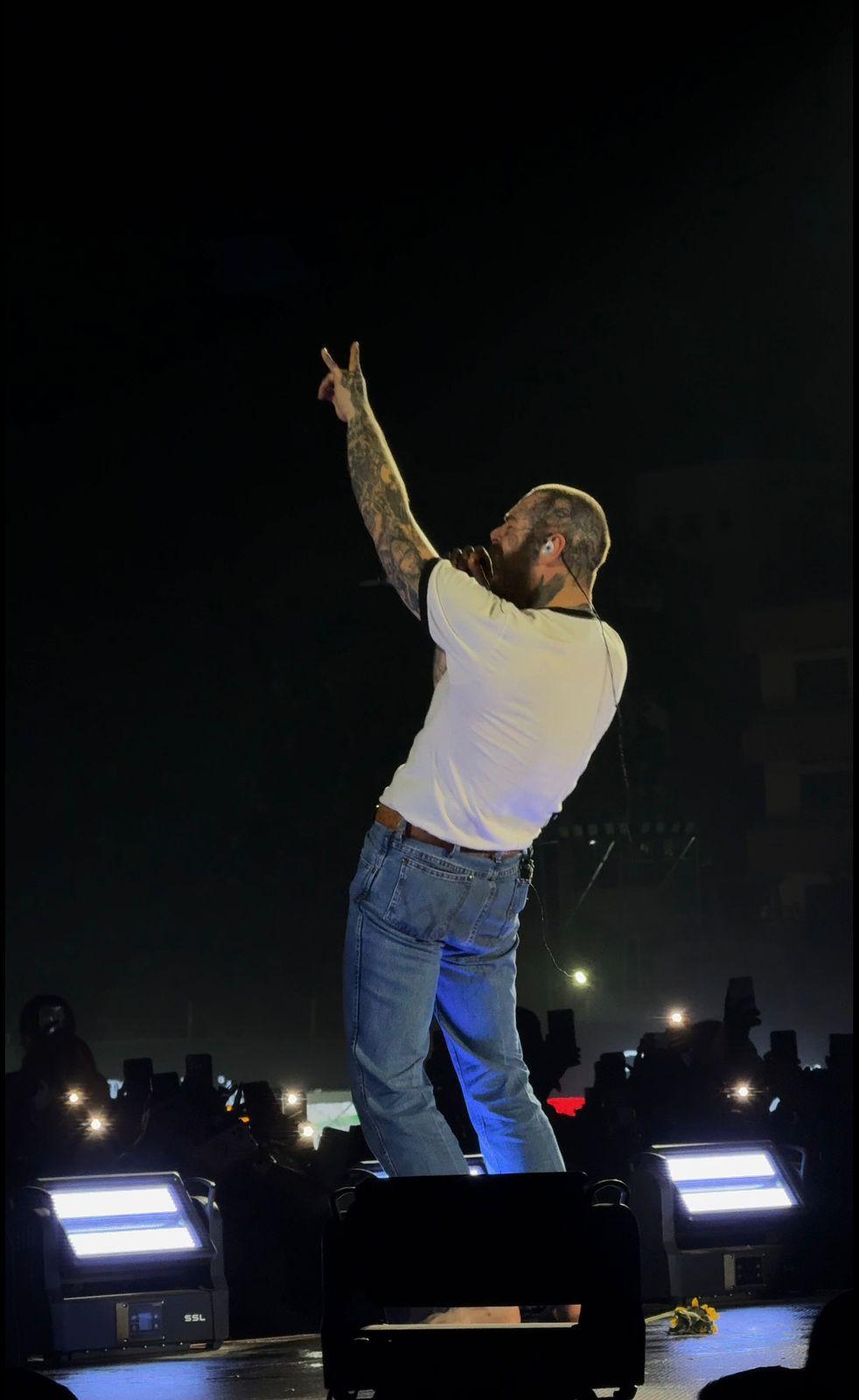
The place exploded.
After a couple of songs, he did something nobody expected. “It’s an honour to perform in the land of the legendary Zubeen Garg,” he said. Zubeen Garg, who passed away in September. The crowd roared. That one line meant everything. It showed he’d done his homework. He knew where he was. He knew who mattered here.
He came with a crew of at least 150 people. And he gave Guwahati everything.
“Circles.” “Sunflower.” “Rockstar.” “Congratulations.” “Better Now.” “Psycho.” “I Fall Apart.” No breaks. No long speeches. Just song after song, one bleeding into the next. He’d break down between tracks, get lost in the music, then snap back. At one point, he dropped and did push-ups on stage. People laughed, cheered, and pulled out their phones.
Toward the end, he walked to the second stage near GA. Barefoot on sandy ground. He tripped on the stairs—you could see him stumble—but kept going. Kept singing. Guitar in hand, pouring everything out.
This might've been the first concert in India where smoking was just... allowed. Vapes glowing in the dark. Joints being passed around. Cigarettes everywhere. The air was thick with it. Post might’ve been intoxicated too, but you couldn't tell from his performance. He was locked in. Focused. Present.
About Kayan, though. She's talented, no question. But she has already made it. She has opened for Ed Sheeran. She’s performed at major festivals. She’s got opportunities. Someone from the Northeast could have had that slot. There are bands in Shillong, singers in Nagaland, rappers in Manipur who’ve fought for every bit of recognition they have gotten. No industry backing. No big labels. Just raw talent and determination. Maybe next time. Maybe as this grows, local artists get their shot.
Post Malone walked back to the centre stage. Looked at his team. With them, he took two long bows. And that was it.
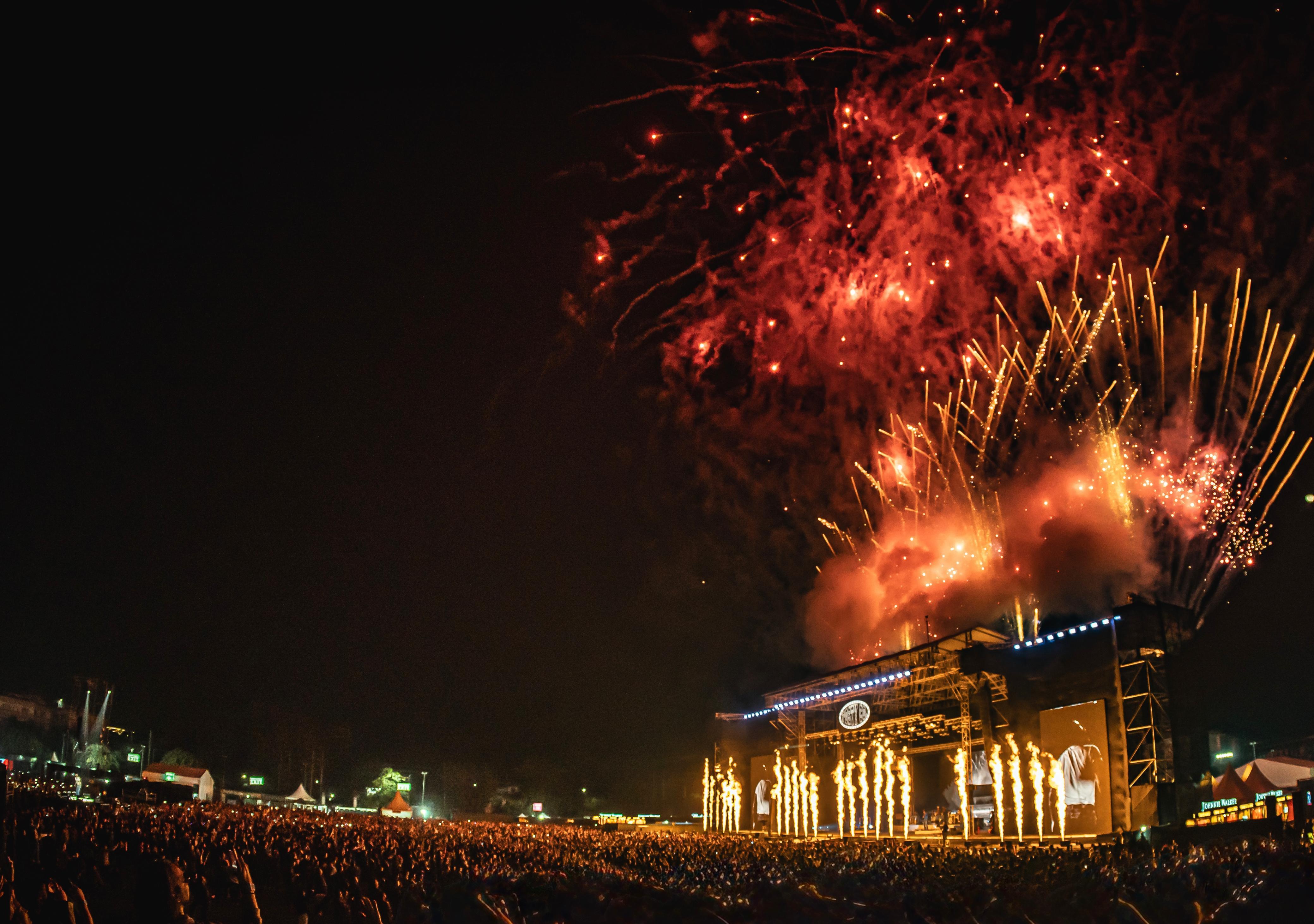
People started filing out slowly, still buzzing, still processing. The complaints would come later—the makeup thing, the gaps, the lack of an emcee. But right then? Right then, it felt like something had shifted.
India’s concert economy is exploding. Mumbai, Bangalore, and Delhi have been running the show for years. But places like Saudi Arabia are proving you don’t need to be an established market to make this work. You just need commitment. Investment. Vision.
The Northeast has something most places don’t—weather that doesn’t punish you for having fun. Music culture that runs deeper than ticket sales. People who’ll drive hours just to catch a show.
Guwahati proved something that night. Not that it’s better than Shillong or that it’s ready to host BTS tomorrow. Just that it’s in the game now. That international acts can work here. That the infrastructure’s there, the demand’s there, the passion’s there.
Whether this becomes a regular thing or just a one-off depends on what happens next. On whether organisers keep pushing. Whether the government keeps supporting. Whether artists keep saying yes to cities that aren’t Mumbai or Delhi, or Bangalore.
Post Malone walked off that stage barefoot, the same way he walked on. The sunset was long gone by then, replaced by stage lights and the glow of a few thousand phone screens. People perhaps woke up the next morning with sore throats and tired legs and videos they’d watch fifty times over.
Guwahati had hosted its first big international act. No disasters, no major mishaps, just a concert that actually happened. Sometimes that’s enough.
POST A COMMENT
MORE NEWS











Copyright©2026 Living Media India Limited. For reprint rights: Syndications Today
