Union cabinet approves Rs 18,662 crore underwater road-rail tunnel under Brahmaputra
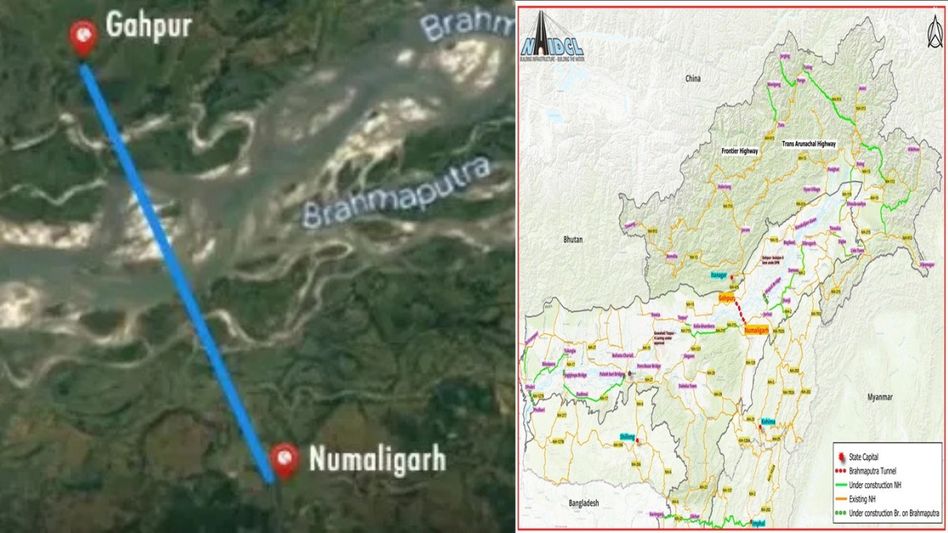
The Cabinet Committee on Economic Affairs, chaired by Prime Minister Narendra Modi, has approved the construction of a 4-lane access-controlled greenfield corridor between Gohpur (NH-15) and Numaligarh (NH-715) in Assam, featuring India’s first underwater road-cum-rail tunnel beneath the Brahmaputra.

- Feb 14, 2026,
- Updated Feb 14, 2026, 2:59 PM IST

The Cabinet Committee on Economic Affairs, chaired by Prime Minister Narendra Modi, has approved the construction of a 4-lane access-controlled greenfield corridor between Gohpur (NH-15) and Numaligarh (NH-715) in Assam, featuring India’s first underwater road-cum-rail tunnel beneath the Brahmaputra.
The project, to be executed under the Engineering, Procurement and Construction (EPC) mode at a total capital cost of ₹18,662 crore, includes a 15.79-km twin-tube TBM-driven tunnel accommodating two road lanes in each direction, with provision for railway infrastructure in one of the tubes. The overall project length stands at 33.7 km.
At present, travel between Numaligarh and Gohpur spans approximately 240 km via the Kaliabhomora bridge near Silghat, taking nearly six hours and passing through Numaligarh, Kaziranga National Park and Biswanath Town. The new alignment is designed to drastically shorten travel time, decongest existing routes and enhance all-weather reliability.
Once completed, the tunnel will be the first underwater road-rail tunnel in India and the second of its kind globally. Strategically, it is expected to significantly improve connectivity for Assam, Arunachal Pradesh, Nagaland and other Northeastern states, while reducing logistics costs and improving freight efficiency.
The corridor integrates with two major National Highways—NH-15 and NH-715—and connects with key railway infrastructure: the Rangia–Murkongselek section under the Rangia Division of Northeast Frontier Railway (NFR) on the Gohpur side, and the Furkating–Mariani loop line under the Tinsukia Division of NFR on the Numaligarh side.
The project also strengthens multimodal integration by linking 11 economic nodes, three social nodes, two tourist nodes and eight logistics hubs. It will connect four major railway stations, two airports and two inland waterways terminals, enabling seamless passenger and freight movement across the region.
Beyond connectivity gains, the project carries substantial strategic and economic implications. It is projected to generate approximately 80 lakh person-days of direct and indirect employment, catalyze industrial growth, and open new avenues for trade and regional development across the Brahmaputra valley.
Officials said the mega infrastructure push underscores the Centre’s focus on strengthening Northeast connectivity through transformative, technology-intensive projects with long-term socio-economic dividends.