
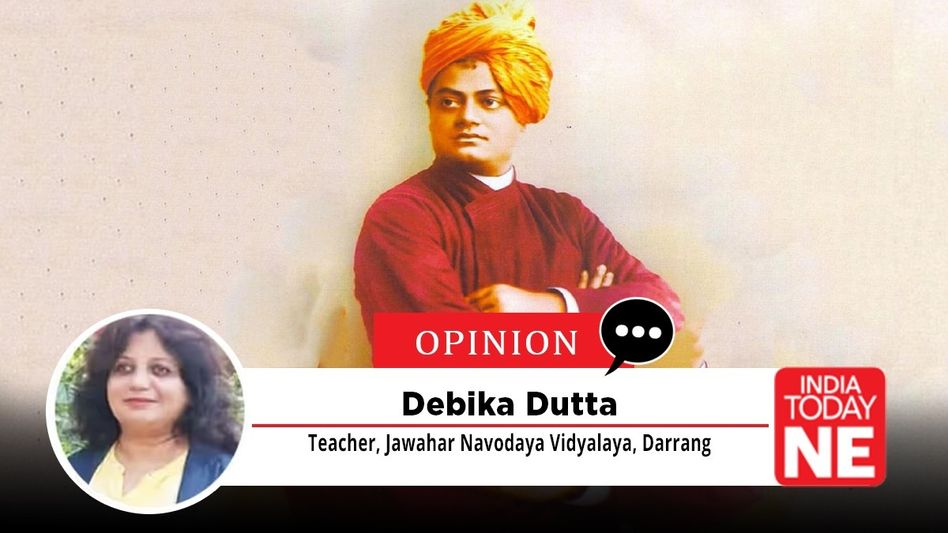
Vivekananda and the Burden of Strength
Every year on 12 January, Swami Vivekananda is remembered with reverence, repetition and remarkable comfort. National Youth Day is observed with quotations carefully chosen to inspire but rarely to unsettle. Yet Vivekananda was not a figure of comfort. He was a disturber of complacency. He spoke to a civilisation that had lost confidence in itself—and demanded that it rediscover the courage to stand uprigh

- Jan 12, 2026,
- Updated Jan 12, 2026, 3:09 PM IST

Every year on 12 January, Swami Vivekananda is remembered with reverence, repetition and remarkable comfort. National Youth Day is observed with quotations carefully chosen to inspire but rarely to unsettle. Yet Vivekananda was not a figure of comfort. He was a disturber of complacency. He spoke to a civilisation that had lost confidence in itself—and demanded that it rediscover the courage to stand upright.
That challenge has not aged.
Vivekananda’s engagement with the youth was never sentimental. He did not romanticise India’s past, nor did he flatter young Indians as inheritors of automatic greatness. Instead, he placed a burden upon them—the burden of strength. “Strength, strength is what the Upanishads speak,” he declared, at a time when India had been conditioned to equate humility with helplessness and tolerance with timidity. For Vivekananda, weakness was not a moral virtue; it was a historical liability.
At the centre of his concern was education. But not education as certification, employment or social mobility. He rejected, with characteristic bluntness, an education system that produced “a mass of clerks.” The phrase was not merely an attack on colonial administration; it was a civilisational diagnosis. An education that trained Indians to serve alien frameworks while severing them from their cultural roots could not produce citizens—only functionaries.
More than a century later, the diagnosis remains disturbingly relevant. India produces graduates in unprecedented numbers, yet public discourse is saturated with anxiety—about ethics in public life, about social cohesion, about the hollowing of institutions. The problem is not the absence of talent but the absence of anchorage. Vivekananda foresaw this imbalance. Knowledge without character, he warned, sharpens intelligence but weakens judgment.
His idea of man-making education is often misunderstood, sometimes deliberately so. The phrase unsettles contemporary sensibilities, inviting accusations of hyper-masculinity or exclusion. Such readings miss the historical and philosophical context entirely. Vivekananda was not celebrating brute force; he was demanding inner courage—moral resilience, intellectual independence and spiritual confidence. Strength, for him, was the ability to confront reality without fear, including the courage to reform one’s own society.
This insistence on inner strength brings us to Vivekananda’s idea of the nation. He did not speak the language of modern politics, yet his nationalism was unmistakably cultural. A nation, he believed, could not be built solely on borrowed ideas or imported
models. Political freedom without cultural self-knowledge would result in imitation, not independence.
Here lies the philosophical bridge between Vivekananda and what is now described as cultural nationalism. For him, India was not merely a political unit but a civilisation—held together by shared philosophical assumptions, ethical frameworks and spiritual imagination. To deny this inheritance in the name of modernity was, in his view, an act of self-erasure. Modernity, he insisted, must be negotiated from a position of confidence, not apology.
This position has invited criticism, especially in contemporary debates where cultural assertion is quickly conflated with exclusion. Critics argue that Vivekananda’s emphasis on Hindu civilisation risks legitimising majoritarian impulses. The concern deserves consideration, but it does not withstand a careful reading of Vivekananda himself.
His Hinduism was expansive, not defensive. Philosophical, not sectarian. He was unsparing in his criticism of Hindu society—of caste rigidity, ritualism without compassion, and social stagnation. He rejected the fossilisation of tradition as firmly as he rejected its dismissal. To reduce such a thinker to a crude ideological symbol is to do violence to his complexity.
Equally misunderstood is Vivekananda’s understanding of pluralism. He did not advocate the flattening of identities or the dilution of tradition. Pluralism, for him, was not born of insecurity but of confidence. His celebrated address at the World Parliament of Religions in Chicago was not an appeal for acceptance; it was an assertion of presence. India, through Vivekananda, spoke not as a supplicant civilisation but as a contributor to global thought.
In today’s climate, where engagement with the world often comes accompanied by cultural anxiety, this distinction matters. Genuine dialogue requires self-respect. A civilisation unsure of its own foundations cannot engage others as an equal.
Another recurring criticism concerns Vivekananda’s rhetoric of strength and masculinity. In an age rightly attentive to inclusion and equity, such language is sometimes read as aggressive or exclusionary. Yet Vivekananda’s call was ethical, not biological; spiritual, not chauvinistic. He was addressing a society that had internalised defeat. His demand was not domination over others but mastery over oneself.
If strength was the foundation, seva—service—was the expression. “They alone live who live for others,” Vivekananda wrote, rejecting both self-indulgent spirituality and hollow activism. The Ramakrishna Mission’s work in education, healthcare and disaster relief stands as enduring testimony that his nationalism was not rhetorical. It was lived, disciplined and deeply social.
This synthesis of spirituality and service remains one of his most enduring contributions. Contemporary discourse often separates faith from public life, portraying spirituality as private and service as bureaucratic. Vivekananda rejected this division. Service without spirit, he believed, becomes mechanical; spirituality without service becomes escapist.
It is important, therefore, to resist the temptation to appropriate Vivekananda crudely for contemporary political battles. He belongs neither to slogans nor to sanctification. His thought is demanding precisely because it refuses simplification. He asked of the youth not anger but discipline, not grievance but responsibility, not imitation but self-knowledge.
National Youth Day, then, should not be an exercise in ceremonial admiration. It should provoke uncomfortable questions. Are we educating young Indians merely to compete, or also to contribute? Are we producing skilled professionals, or responsible citizens? Are we confident participants in the world, or anxious imitators seeking approval?
Vivekananda offers no easy reassurance. He offers instead a demanding vision—of strength anchored in values, confidence tempered by compassion, and nationalism rooted in civilisational self-respect rather than hostility. To remember him honestly is not to quote him. It is to confront the burden he placed upon us—and decide whether we are prepared to carry it.
MORE NEWS









Copyright©2026 Living Media India Limited. For reprint rights: Syndications Today
