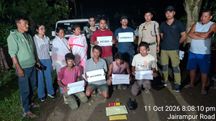
Wild elephants threaten paddy crop in Assam’s Rani, farmers build over 100 makeshift watchtowers
Farmers in Rani, along the Assam-Meghalaya border in Kamrup district, are keeping watch through the night to protect their standing paddy crops from wild elephants, with the sali paddy expected to be ready for harvest in about a month. More than 100 makeshift watchtowers have been erected across the area as cultivators try to prevent further crop damage and safeguard their annual food supply.


- Oct 12, 2026,
- Updated Oct 12, 2026, 1:45 PM IST

Farmers in Rani, along the Assam-Meghalaya border in Kamrup district, are keeping watch through the night to protect their standing paddy crops from wild elephants, with the sali paddy expected to be ready for harvest in about a month. More than 100 makeshift watchtowers have been erected across the area as cultivators try to prevent further crop damage and safeguard their annual food supply.
Rani, a major agricultural belt under the Palasbari Legislative Assembly Constituency on the western outskirts of Guwahati, witnesses recurring human-elephant conflict during the paddy season. The crop, which represents months of work for farming families, is now vulnerable to elephant raids as it approaches maturity.
Farmers have built temporary watchtowers using bamboo, timber, branches and thatch, placing them at heights of around 10 to 20 feet in fields and on trees. The practice has been followed for generations as a traditional method of protecting crops from elephants. Similar structures have also come up in neighbouring areas.
Villages affected by the recurring elephant movement include Jaypur, Nalapara, Jarashal Garopara, Belarguri, Challi, Moirapur, Secha, Khapegaon, Ghoraigadhowa Juli, Prankhukua, Mekurikuchi, Hatimaraghuli, Notun Rani, Bamabahar, Purana Sukurberia, Pat Haldia and Ganapati, among others, under the Rani Forest Range.
Farmers take turns keeping watch from dusk until dawn, monitoring the fields for approaching elephants. They carry drinking water and food, including rice, flattened rice, pitha, puffed rice, biscuits and bananas, to sustain themselves during the long hours of vigil.
To drive away elephants, villagers use a range of traditional methods, such as lighting fires, bursting firecrackers, burning tyres, beating tins and bamboo, and using bows and arrows and slingshots. However, these measures have not provided lasting relief, with elephants continuing to enter agricultural land and damage standing crops.
The recurring conflict has added to the uncertainty faced by cultivators who depend on the paddy harvest to meet household needs and support their livelihoods. With harvesting still weeks away, further damage could affect the quantity of produce farmers are able to bring home.
Residents have urged senior officials of the forest department to deploy additional teams to protect the fields and prevent further crop losses. They have also sought the intervention of Palasbari MLA Himangshu Shekhar Baishya to ensure that measures are taken to address the problem.
Farmers said timely intervention was necessary to protect the remaining crop before harvesting begins. They are continuing their night vigil in the hope of bringing home the harvest despite the threat posed by wild elephants.