
Advertisement
After the flood, Sivsagar's Nepali Khuti picks up the pieces, one home at a time

Priyanka Saharia
- Aug 11, 2026,
- Updated Aug 11, 2026, 3:45 PM IST
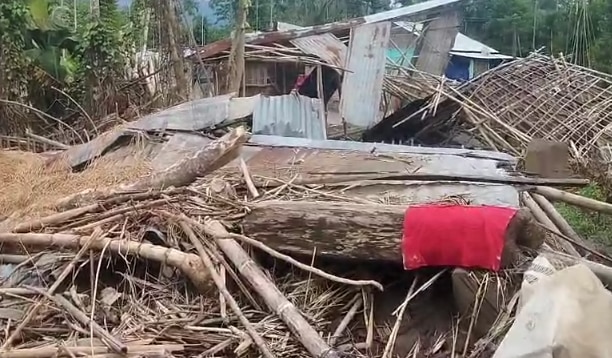
The floodwaters have receded from Nepalikhuti, but the devastation they left behind is still etched across the village. As families clear tonnes of mud and silt from what remains of their homes, temporary relief camps are now coming up to give those who lost their houses a roof over their heads.
The Dikhow River flood swept into the village on July 19, engulfing the entire area and leaving behind damaged houses, lost belongings, dead livestock and thick layers of mud and silt.
Now, with the sun shining again, villagers are slowly returning to their homes, clearing the sediment and salvaging whatever they can from the destruction.
For more than 20 days, several flood-affected families have been staying along the roadside after their houses were either severely damaged or washed away.
As the villagers struggle to rebuild, several organisations have stepped in to provide relief and help them find temporary shelter.
Organisations including the All Assam Students' Union (AASU), the All Assam Gorkha Students' Union and 'Ek Haath, Ek Saath' from Sikkim are helping set up temporary relief shelters for the flood-affected families.
'Ek Haath, Ek Saath' is a social relief initiative launched by the Alpine Riders Crew Motorcycle Club in Sikkim. Inspired by the support the club received during the 2023 Sikkim flash floods, the initiative has since expanded its relief operations beyond Sikkim to flood-affected areas such as Assam.
The shelters are being constructed using bamboo and tarpaulin sheets, with around eight to 10 families able to stay under one roof. Around 50 families are expected to benefit from these temporary shelters.
The organisations and local volunteers are also helping villagers clear the thick layers of mud and silt deposited by the Dikhow River. Some families have managed to clean two to four houses, while others are still struggling with the massive amount of sediment left behind by the flood.
“The flood has left mud and silt everywhere in our village. Many of us have lost our houses. Organisations have come forward to help us. The relief items have reduced now, but we still have some stock. They have also provided us with gas cylinders and cooking arrangements. They have also built temporary latrines and bathrooms for the people,” said Binod Sharma, a farmer and resident of Nepalikhuti.
Sharma said the government has assessed the losses suffered by villagers, including their damaged houses and livestock, and has assured them of assistance.
“The government has taken account of our losses and the livestock we have lost and said they will help us. We are waiting for it because it is our only hope. Maybe we will have to stay like this for another three to four months, as many houses have been destroyed and we have nowhere to live now,” he said.
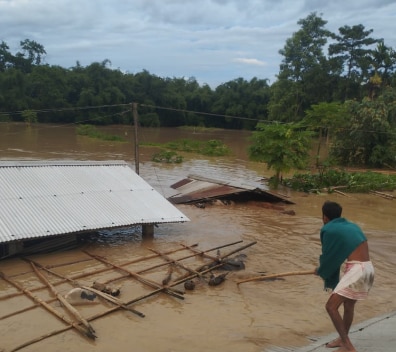
The flood has left the villagers facing several challenges. Apart from damaged homes and thick layers of mud and silt, people are also dealing with snakes in the aftermath of the flood, a lack of electricity and inadequate sanitation facilities.
The organisations helping the villagers have been providing essential relief items, cooking gas and cylinders. Temporary latrines and bathrooms have also been constructed, while volunteers continue to clear the mud and silt from the affected homes.
Govinda Sharma, another villager and community member, said the temporary relief shelters are almost ready.
“It was very difficult to clear the mud and silt, but with the help of different organisations and people, we have managed to clear it. Our relief camps are almost ready now,” he said.
For the people of Nepalikhuti, the flood did not end when the water receded. The difficult part of rebuilding their lives has only begun.
Homes have to be cleaned, damaged structures repaired and, in many cases, rebuilt from scratch. Families that have lost their houses are now dependent on temporary shelters while waiting for government assistance.
But amid the devastation, the relief camps have offered the villagers a temporary roof and a sense of hope.
As they clear the mud, gather whatever belongings remain and rebuild what they can, the people of Nepalikhuti are slowly trying to put their lives back together, one home, one family and one day at a time.
According to the Assam floods update for the period from April 29 to August 10, 2026, a total of 25 districts, 88 revenue circles and 2,690 villages have been affected, impacting 12,08,778 people.
The state has set up 257 relief camps, where 79,864 people are currently sheltered, along with 2,083 relief distribution centres. The floods have claimed 101 lives, while five people remain missing. A total of 4,657 houses have been fully damaged and 15,232 partially damaged, while 31,104 people have been evacuated.
The affected districts include Goalpara, Cachar, Lakhimpur, Dhemaji, Dibrugarh, Jorhat, Biswanath, Charaideo, Nalbari, Bajali, Chirang, Kokrajhar, Bongaigaon, Baksa, Sivasagar, Darrang, Sonitpur, Tinsukia, Udalguri, Golaghat, Nagaon, Karbi Anglong, Kamrup, Kamrup (M) and Hojai.


