BJP vs Congress: Which party has the better manifesto in Assam?
With days before polling, BJP and Congress unveil starkly contrasting Assam visions, one anchored in incumbency, delivery and identity assertion, the other in welfare guarantees, inclusion and systemic correction, turning the election into a contest between performance-backed continuity and promise-driven change.

- Apr 04, 2026,
- Updated Apr 04, 2026, 12:39 PM IST

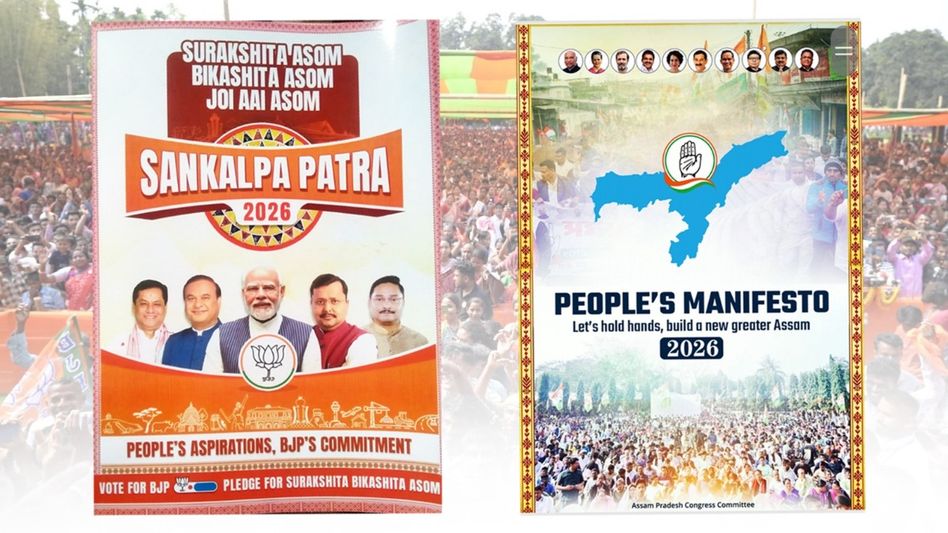
With less than a week before Assam votes on April 9, the state’s two principal combatants—the BJP and Congress—have laid out strikingly different visions for its future, one rooted in the confidence of incumbency and civilisational assertion, the other in the language of correction, inclusion, and a return to what it calls founding ideals. Together, the BJP’s 80-page Sankalp Patra and Congress’s 32-page People’s Manifesto offer not merely a catalogue of promises but a window into two fundamentally divergent ideas of what Assam is, what ails it, and who should inherit the right to govern it.
Reading both documents side by side is an instructive exercise in political storytelling. The BJP manifesto opens not with promises but with a ledger, a meticulous, data-heavy comparison between the UPA and NDA eras, listing everything from GSDP growth to the number of bridges over the Brahmaputra.
Congress, by contrast, opens with a punch, its five Pratishrutis (pledges) splashed across a single page in bold hexagons: unconditional monthly cash transfers to every woman, Rs 50,000 to start or grow business, Rs 1,250-a-month pensions for senior citizens, justice for Zubeen Garg within 100 days, conversion of Eksoniya pattas into permanent Miyadi pattas for 10 lakh indigenous people, and Rs 25 lakh cashless health cover for every family. Only after this opening salvo does state president Gaurav Gogoi’s letter follow, framed in the intimate register of a son of the soil speaking to his people, invoking “the crushing cost of living, the quiet desperation of unemployed youth, and the long-denied justice for indigenous communities”.
Congress leads with the transactional—here is what you will get—before pivoting to the emotional. The BJP leads with the retrospective—here is what we have already delivered. One party opens by making an offer; the other opens by presenting a receipt. This distinction, between the language of promise and the language of performance, may well determine who governs Assam for the next five years.
The architecture of ambition
The BJP manifesto is organised around a narrative of accomplished transformation. The initial pages are devoted entirely to backward-looking claims, what it calls “Paribartan Spashta” (Change is evident), before it arrives at its 31 forward-looking pledges, or Sankalpa. This is followed by elaborately themed sections: Surakshita Asom (Secure Assam), Biswamanor Antahgathoni (World-Class Infrastructure), Jubaprojonmor Pragoti (Youth Progress), Swanirbhar Naari (Self-Reliant Women), Samriddha Krishak (Prosperous Farmers), and so on.
Congress manifesto is built around a nostalgic-aspirational vision it calls “Natun Bor Axom” (a New Greater Assam), which consciously evokes the historical concept of Bor Axom, the civilisational unity forged by Chaolung Sukaphaa and spiritually consolidated by Srimanta Sankardeva. The document identifies five categories of “Builders” (women, youth, farmers, small entrepreneurs, and tea workers) and makes 11 “Ongikar” (commitments) spanning governance, identity, healthcare, education, industry, agriculture, rural prosperity, urban development, justice, climate, and welfare. It also includes a 100-day, one-year, and five-year implementation roadmap, a gesture towards credibility that tacitly acknowledges its own vulnerability on the question of deliverability.
The identity question: Polarisation vs pluralism
The BJP's opening Sankalpa is devoted to protecting “the land, heritage and dignity of the indigenous people of Assam”, but the specifics are revealing. It promises to implement the Immigrants (Expulsion from Assam) Act of 1950 to “expedite the process of detection and pushback of illegal immigrants”, to “free every inch of land from encroachment by illegal immigrants”, and to formulate laws against what it explicitly terms “Love Jihad” and “Land Jihad”. The party also commits to implementing the Uniform Civil Code, excluding Sixth Schedule areas and tribals, and to strengthening the Satra Aayog to reclaim encroached religious and cultural lands. This is identity politics as civilisational defence, a vision of Assam as a Hindu-indigenous homeland under siege, requiring legislative armour.
Congress frames the identity question entirely differently. It, too, promises to protect indigenous land rights—conversion of Eksoniya pattas into Miyadi pattas for 10 lakh indigenous people, three katha of rural land for flood- and erosion-displaced families, an SIT probe into large corporate land allotments above 10 bighas. But its identity chapter is titled “Shared Assamese Identity”, and its operative verb is “honouring every indigenous community”. There is no reference to illegal immigration. Instead, Congress invokes the Assam Accord, the Sixth Schedule, the Forest Rights Act, and Gopinath Bordoloi’s legacy of constitutional protection.
Both parties promise Scheduled Tribe status for the same set of communities—the six groups including Tai Ahom, Koch Rajbongshi, Moran, Matak, Chutia, and Tea Tribes. But the framing differs. The BJP says it will “actively pursue the Central Government to implement the recommendation of the Group of Ministers”, a formulation that subtly transfers responsibility to New Delhi while claiming local credit. Congress simply promises “implementation of ST status”, though with no timeline for delivery.
Women: The new electoral fulcrum
Both manifestos devote substantial space to women, reflecting a shared recognition that female voters, empowered partly by the BJP's own Orunodoi scheme, are now a decisive electoral constituency. The BJP’s headline promise for women is an increase in Orunodoi's monthly transfer from Rs 1,250 to Rs 3,000 “in a phased manner”, with an expansion to 15 additional lakh households. This would make it one of India’s most expansive state-level cash transfer programmes.
It also promises a second-phase payment of Rs 25,000 to existing beneficiaries of the Mukhya Mantri Mahila Udyamita Abhijan, with a target of creating “40 lakh Lakhpati Baideos”. The party also promises women-run community canteens called Aair Pakghor in every district headquarters, an all-women police battalion called Birangana, and free HPV vaccination.
Congress counters with a more aggressive set of structural commitments. Its flagship promise is an “unconditional monthly cash transfer to every woman’s bank account”, a universal offer that deliberately avoids the targeting constraints of Orunodoi. It pledges Rs 50,000 for women to start businesses, up to 40 percent reservation in government services, 26 weeks of mandatory paid maternity leave, and a Women’s Economic Empowerment Mission. Congress also promises village committees to check crimes against women and an Anti-Trafficking Corps.
Whether Assam’s women voters prefer a bird in hand or a bold new promise is one of the election's central questions.
The economy: Infrastructure vs livelihood
The BJP targets doubling Assam’s economy to $150 billion by 2031 and scaling it to $300 billion by 2036. It promises Rs 5 lakh crore in infrastructure investment under an Asom Gati Shakti Master Plan, including expressways, underwater tunnels, Water Metro systems, greenfield airports, and satellite townships. It points to the Rs 27,000 crore semiconductor plant, the Rs 10,600 crore Namrup fertiliser project, and the world’s first bamboo-based bio-ethanol plant as proof of industrial momentum. The manifesto promises an Electronics Manufacturing Hub backed by a Rs 1,000 crore corpus, Special Economic Zones, a Defence Corridor, and an Assam Global Capability Centre Policy to attract 20 GCCs and create 15,000 jobs.
Congress’s economic vision is more granular and grassroots-oriented. Its Industry & Infrastructure chapter leads with the revival of shuttered traditional industries, the paper mills of Nagaon and Cachar, jute mills, sugar mills, fertiliser units. It promises to harness ONGC and OIL resources for downstream industrialisation, establish North Bank and Barak Valley industrial corridors, and mandate that 80 percent of business signboard content be in Assamese.
On agriculture, both parties promise MSP guarantees, farm mechanisation, and expanded procurement. The BJP offers Rs 11,000 annually per small farmer through an expanded Mukhya Mantri Krishi Sa Sajuli Yojana, tractor subsidies for 10,000 farmers, and a Rs 3,000 crore Krishi Gati Shakti Plan.
Congress promises a 2.5x increase in farmers’ income, organic farming across 10 lakh hectares, cooperative bank credit at 0–2 percent interest, and shared farm equipment centres in every Gram Panchayat.
Healthcare: Scale vs access
The BJP plans to invest Rs 50,000 crore over five years in an Assam Swasthya Utkarsha Abhijan, promising 500-bed super-speciality hospitals in each administrative zone, AIIMS satellite centres in Dibrugarh and Sribhumi, proton therapy for cancer treatment, and 100 percent saturation of Ayushman Bharat. It points to its existing cancer care network of 17 hospitals, the AIIMS in Guwahati, and the reduction in maternal mortality from 300 to 110 per lakh live births as proof of trajectory.
Congress promises Rs 25 lakh cashless health cover for every family, substantially higher than the Rs 5 lakh Ayushman Bharat ceiling, along with 24x7 ambulance services within a 30-minute response time, a Family Doctor Programme mapping every family to a local PHC doctor, a Mental Health Mission, an Anaemia-Free Assam Mission, and a crackdown on quack doctors.
Youth and employment
On the youth question, the BJP promises 2 lakh additional government jobs (building on 1.64 lakh already claimed), Rs 5 lakh entrepreneurship grants to 10 lakh youth under CMAAA, global employment opportunities through CM FLIGHT, and a Maritime Skill Development Centre. Its education vision includes free education from KG to PG for the poor, 70,000 new teachers, CM Model Schools at Rs 8,000 crore, and a world-class Education City with foreign university partnerships.
Congress promises exam results within six months and appointments within three months—“written into law”—a separate contractor license category for engineering graduates, a Rs 1,000 crore tech startup fund, and “Zubeen Garg Fellowships” for youth in the cultural sphere. Its education section promises AI-enabled government schools in every block, the Zubeen Garg Centre of Excellence for Art and Culture, a 1:30 teacher-student ratio, and a “Tuition Didi” programme hiring local youth to reduce tuition costs.
The invocation of Zubeen Garg, the iconic Assamese musician whose death became a political flashpoint, runs through the Congress manifesto like a red thread. The party promises “Justice for Zubeen Garg within 100 days” as its very first governance commitment and closes its manifesto with his song lyrics. It is a calculated attempt to transform Garg’s memory into a political instrument.
Tea workers: The contested constituency
Both manifestos devote dedicated sections to tea workers, reflecting the community’s outsized electoral importance, concentrated across roughly 33 assembly constituencies.
The BJP promises land pattas for all eligible tea garden families, a phased wage increase to Rs 500, a Tea Tribes Wage Reform Expert Committee, Pradhan Mantri Cha Shramik Protsahan Yojana, 3 percent reservation in Grade I and II government jobs for tea tribes and Adivasi communities, and 100 additional Model Tea Garden Schools. It highlights what it has already delivered: 3.5 lakh land pattas distributed, 118 Model Schools established, and Rs 5,000 paid to 6 lakh workers under the bicentennial tea scheme.
Congress promises that tea will be recognised as Assam’s “premier industry” with workers entitled to “industrial minimum wages”, a demand that would structurally transform tea economics. It also promises free school buses, land rights, ST status implementation for Tea Tribes, free competitive exam coaching, pucca houses, and special healthcare programmes for women and children in tea gardens.
Floods: The perennial test
On Assam’s existential challenge, annual flooding and erosion by the Brahmaputra and its tributaries, the BJP makes its most concrete promise: the Badh Mukt Assam Mission, with Rs 18,000 crore in investment, featuring a River Rejuvenation Mission, National Waterway-2 development, and a Badh Nirikkhak Bahini (youth volunteer corps for embankment monitoring).
Congress promises a Brahmaputra Basin Plan for scientific river management, a dedicated Climate Resilience Fund, early warning systems, mandatory climate-resilient certification for housing, one million solar rooftops, and Green Accounting. Its approach is more systemic, embedding flood management within a broader climate and environmental framework, but lacks the BJP’s specificity on investment quantum.
Governance and anti-corruption
Here, Congress plays offence. Its manifesto leads its governance section with an anti-corruption plank: no government contracts or welfare schemes for immediate families of MLAs, an independent Anti-Corruption Commission with judicial oversight, a Nagarik Odhikaar Act, a Citizen Charter with online portal, biannual White Papers on state finances, and citizen budgets of Rs 2–5 lakh per ward.
The BJP’s governance section is oriented differently, towards administrative efficiency rather than anti-corruption. It promises Dibrugarh as a second capital, a full Secretariat in Silchar, Mission Basundhara for land rights, digital land records, and 78 new co-districts. It highlights its Sewa Setu platform (900 services, 2 crore applications, 90 percent disposal rate) and AI-enabled drones for law enforcement.
The unspoken one
Neither manifesto engages seriously with Assam’s fiscal position. The BJP’s cumulative promises—Rs 5 lakh crore in infrastructure, Rs 50,000 crore in health, Rs 18,000 crore for floods, and so on—would dwarf the state’s annual budget. Congress’s universal cash transfer to every woman, Rs 25 lakh health cover per family, and across-the-board institutional creation would also require fiscal resources far beyond current capacity. Both manifestos operate in a realm of aspiration unburdened by fiscal gravity.
Strip away the data and the schemes, and each manifesto reveals a distinct emotional proposition. The BJP’s is confidence: we have transformed Assam, we have the machinery, we have the Centre’s backing, and we will do more of what works. The manifesto’s recurring tagline, “double engine government”, is itself a promise of synergy between Dispur and Delhi that Congress, by definition, cannot match.
Congress’s is yearning: for a time before polarisation, for governance that listens, for an Assam where identity is shared rather than weaponised. Its closing appeal invokes Bhupen Hazarika and Zubeen Garg, the two musical souls of Assam, and asks voters to build “a humane, united and prosperous Natun Bor Axom”. It is unmistakably a pitch from the heart, aimed at voters who feel something has been lost.
Whether Assam votes with its ledger or with its longings, this election will turn on which of these two emotional registers resonates more powerfully across the Brahmaputra and Barak Valley.