
From floods to identity: Decoding BJP’s 31-promise manifesto for Assam
Assam BJP releases its election manifesto with promises of UCC, job creation, and flood management. The party focuses on development and improving livelihoods in Assam

- Mar 31, 2026,
- Updated Mar 31, 2026, 10:28 AM IST

- BJP promises Uniform Civil Code excluding tribal areas
- Two lakh jobs to be created over five years
- Rs 18,000 crore allocated for flood control efforts
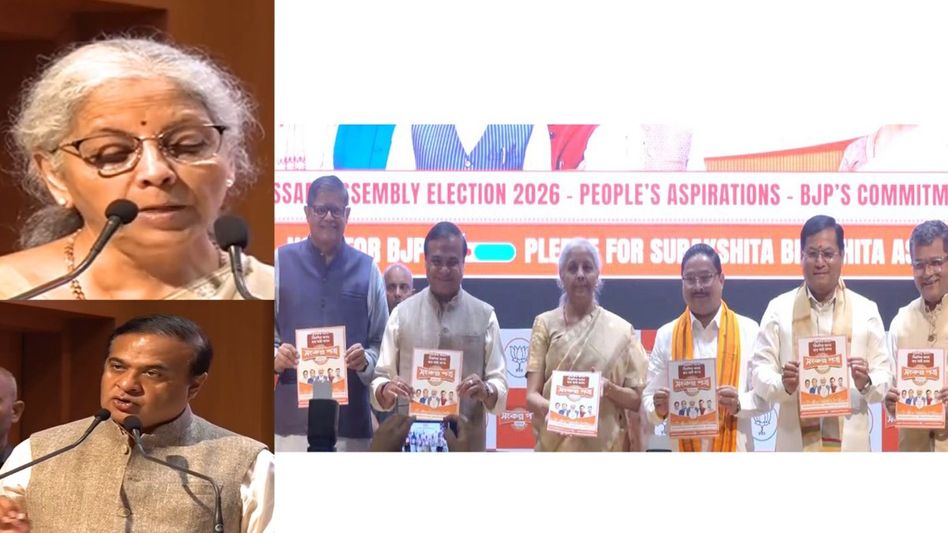
The Bharatiya Janata Party launched its 'Sankalpa Patra' for the 2026 Assam Assembly elections in Guwahati on Tuesday, March 31, setting out 31 pledges spanning a Uniform Civil Code, two lakh government jobs, a flood-free Assam and an ambition to build Dibrugarh as the state's second capital — all to be delivered within the next five years should the party win a third consecutive term.
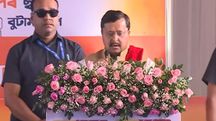
Chief Minister Himanta Biswa Sarma, Union Ministers Nirmala Sitharaman and Sarbananda Sonowal, and state BJP president Dilip Saikia were present at the release. The party said it had received 2.45 lakh suggestions from across Assam while drafting the document. "Our resolve is to make a secure Assam, a developed Assam," Saikia said.
The manifesto's opening pledges focus squarely on identity and immigration — among the most politically charged issues in the state. The party promises to implement the Immigrants (Expulsion from Assam) Act, 1950, to expedite the detection and pushback of illegal immigrants, free every inch of encroached land, and extend land rights to all genuine citizens under Mission Basundhara. It also promises to free the lands of Satras, Namghars and Devalayas from encroachment, strengthen the Satra Aayog, and redevelop heritage sites, including the Madhupur Satra and Talatal Ghar.
On legislation, the party has committed to working towards a Uniform Civil Code — excluding Sixth Schedule areas and tribal communities — while also promising a dedicated law to end what it terms "Love Jihad" and firm measures against "Land Jihad."
The infrastructure section is among the most expansive. The BJP promises to invest Rs 5 lakh crore to position Assam as India's Eastern Gateway under an Asom Gati Shakti Master Plan. Road projects include a Greenfield Siliguri-Shillong-Silchar Expressway, a Gohpur-Numaligarh underwater road-cum-rail tunnel across the Brahmaputra, a Guwahati Ring Road and a Guwahati-Tinsukia Expressway via Dibrugarh. New Vande Bharat trains are promised on the Guwahati-Dibrugarh, Guwahati-Agartala and Guwahati-North Lakhimpur routes. Greenfield airports are proposed for Manas, Umrangso, Charaideo, Diphu, Majuli and Doloo. A Water Metro system is planned for Guwahati, Dibrugarh and Tezpur, along with integrated river logistics hubs at Bogibeel, Pandu and Jogighopa.
On flood control — a perennial crisis for the state — the party promises to launch a Badh Mukt Assam Mission with an investment of over Rs 18,000 crore, including a River Rejuvenation Mission to rebuild embankments using modern technology, systematic dredging of National Waterway-2, and the creation of a Badh Nirikkhak Bahini of youth volunteers to monitor embankments.
For employment, the manifesto promises two lakh government jobs alongside entrepreneurial support through the Chief Minister's Atmanirbhar Asom Abhijan, which proposes financial assistance of up to Rs 5 lakh to cover 10 lakh youth. Fresh graduates would receive Rs 25,000 under the CM's Jibon Prerana Scheme to prepare for employment. A wage subsidy of Rs 10,000 per employee is also promised to new industries investing in the state.
On education, the party proposes free schooling from kindergarten to postgraduate level for the poor, the launch of CM Model Schools with an Rs 8,000 crore investment to upgrade 1,000 secondary schools, and the appointment of over 70,000 teachers in five years. A world-class Education City with Indian and foreign university campuses is also envisaged.
For women, the monthly Orunodoi assistance is to be raised to Rs 3,000 in a phased manner, with coverage extended to an additional 15 lakh households. The manifesto also promises women-run community canteens — called Aair Pakghor — in every district headquarters.
Tea tribe communities receive dedicated attention, with the party promising to raise daily wages to Rs 500 in a phased manner, provide land pattas and housing to all eligible families, and set up a Tea Tribes Wage Reform Expert Committee.
The manifesto also promises to pursue Scheduled Tribe status for six communities — Koch Rajbongshi, Tai Ahom, Adivasis and Tea Tribes, Chutia, Moran and Matak — and constitutional status for the Autonomous Councils of seven tribes including the Mising, Rabha and Deori. Seven additional communities are to be recommended for inclusion in the Central OBC list.
On healthcare, the party promises a five-year Assam Swasthya Utkarsha Abhijan with a corpus of Rs 50,000 crore and plans to introduce Proton Therapy for cancer treatment. The economy, the manifesto pledges, will be doubled to 150 billion dollars by 2031 and scaled to 300 billion dollars by 2036, aided by an Asom Electronics Mission with a Rs 1,000 crore corpus.
For Dibrugarh, the party promises a second secretariat and legislative assembly infrastructure, upgrading the airport to international status and establishing a High Court Bench. For Barak Valley, it promises a fully functional Assam Secretariat in Silchar, a satellite centre of AIIMS in Sribhumi and expedited development of the Doloo Greenfield Airport.
Union Ministers Nirmala Sitharaman and Sarbananda Sonowal were also present at the ceremony in Guwahati alongside Sarma and Saikia.
Sitharaman, speaking as Union Finance Minister, made the economic argument the centrepiece of the BJP's pitch. Assam's Gross State Domestic Product stood at Rs 2.24 lakh crore in 2015-16; it now stands at Rs 7.41 lakh crore — a 3.3-fold rise in a single decade. Per capita income climbed from Rs 1.03 lakh in 2020-21 to Rs 1.59 lakh in 2024-25, a 54 per cent increase in four years.
She drew a sharp contrast with the Congress era on fiscal transfers. Assam's share of central tax devolution was roughly Rs 10,000 crore annually under the previous government; in 2025-26, that figure has reached Rs 50,000 crore. Since 2014, total central transfers — including grants — have amounted to Rs 5.61 lakh crore, with an additional Rs 27,000 crore provided as 50-year interest-free loans since 2020. "This manifesto has been built on a decade of delivery," she said. "The state has been transformed in the last 10 years in ways the six decades of Congress rule could never achieve."
Among the landmark projects she cited was the Tata Electronics semiconductor facility in Jagiroad, Morigaon — described as India's first indigenous semiconductor assembly and testing plant, built at a cost of Rs 27,000 crore and expected to produce 48 million chips a day, generating up to 27,000 jobs. She also pointed to the Numaligarh refinery expansion, which will triple capacity from 3 MMTPA to 9 MMTPA at a cost of Rs 34,000 crore, and the revival of the Namrup ammonia urea plant in Dibrugarh — a Rs 10,601 crore investment she said had been left to decay under Congress. "We are not just creating jobs for the youth," Sitharaman said, "we are building an advanced and globally competitive ecosystem that Assamese talent across the world is choosing to come back to."
On infrastructure, she noted that Congress built three major bridges across the Brahmaputra over five decades, while the BJP has built nine in under ten years, with five more under construction. The Bogibeel Bridge, conceived in 1985 and delayed for three decades, was finally inaugurated in 2018. Assam has also achieved 100 per cent rail electrification, 1,840 km of new railway tracks have been commissioned across the Northeast, and four airports — Jorhat, Tezpur, Lilabari, and Rupsi — have been operationalised under the UDAN scheme. The average budget for the entire Northeast under the UPA stood at Rs 2,122 crore; in 2025-26, it is Rs 10,440 crore.
On welfare, tap water coverage in rural Assam has risen from 1.76 per cent in 2019 to 81.65 per cent today under the Jal Jeevan Mission. Twenty lakh houses have been built, 40 lakh families receive Rs 1,250 monthly under a state direct benefit transfer scheme, and Ayushman cards now cover 92 per cent of the population. Health spending has risen from Rs 150 crore annually to Rs 9,000 crore, seven government-run cancer hospitals have been established, and the number of operational medical colleges has grown to 15. Sitharaman also noted that 4.5 lakh tea garden worker families have received land pattas under Mission Basundhara — "for the first time."
Sitharaman cited a dramatic fall in insurgency-related violence, contrasting 474 militant attacks and 287 civilian deaths recorded in 2007 under Congress with zero civilian deaths between 2019 and 2023-24. Between 2001 and 2015, she said, Assam suffered 810 bomb blasts that killed 471 people.
Union Minister Sonowal called the Sankalp Patra a document prepared by the people rather than the party. "Our aim is to make Assam the strongest state in the country," he said.
Assam goes to the polls on April 9 across all 126 constituencies, with results due on May 4. The BJP-led NDA government is seeking a third consecutive term, while Congress is looking to return to power after nearly a decade in opposition.
MORE NEWS








Copyright©2026 Living Media India Limited. For reprint rights: Syndications Today
