
'Accused' Review: A woman's rise, an anonymous fall
She has done everything right — built a career, a marriage, a future — until a single anonymous email begins to rewrite her story. In Accused, the real suspense isn’t just who is lying, but how quickly you are willing to believe that she might be.

- Mar 01, 2026,
- Updated Mar 01, 2026, 11:40 AM IST

You're watching a woman at the top of her game. Fourteen years at a London hospital. Youngest Head of Department. First female dean on the horizon. A marriage. Plans to adopt a child. Dr Geetika Sen has done everything right.
Then the emails start.
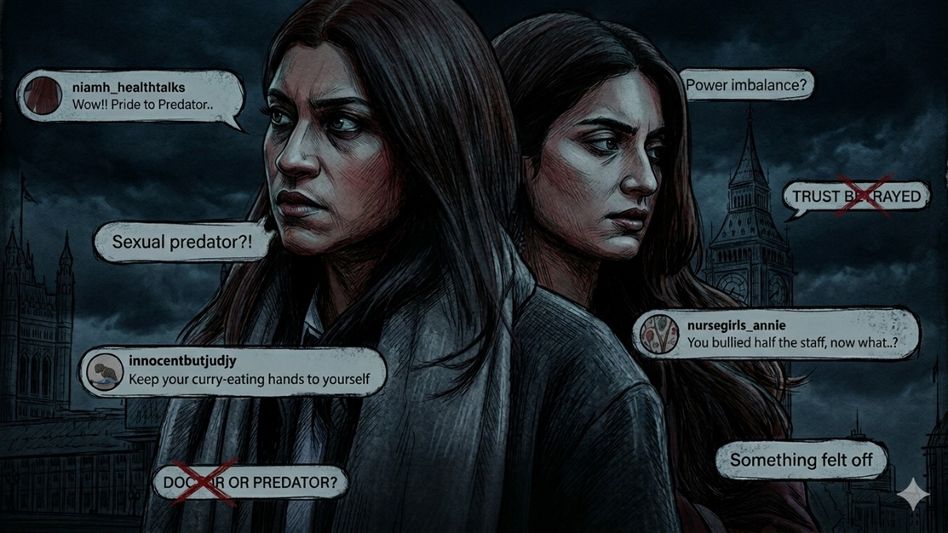
Anonymous. Damning. Accusing her of sexual misconduct with a patient. And just like that, the life she spent decades constructing begins to crack — the circumstances, the evidence, the people around her, including the woman she loves most.
Accused, directed by Anubhuti Kashyap, arrived on Netflix on February 27, and it wastes no time establishing its central provocation: this time, it is a woman standing accused as a predator, not a victim. A fact the male hospital investigator delivers with barely disguised satisfaction.
From the opening frame, you are already building your suspect list. Him? Her? Definitely him. Wait — what if it's her? Is Geetika really capable of this? She can't be. But what if she is? The film keeps you circling, never quite letting you land.
Can a woman be a sex offender? Not in the way we've been conditioned to think. Our instinct is to say no, and Accused knows that. It uses that instinct against you. Every time you want to dismiss the accusation as absurd, the film plants a detail — a look, a closed door, a line of dialogue — that makes you second-guess yourself. It's unsettling in the best way.
Konkona Sen Sharma carries this entirely on her back and does not flinch once. She plays a woman disintegrating on the inside while fighting to stay composed on the outside. Her silences do as much work as her dialogue. When she says, "Is case mein bhi victim ek aurat hi hai" — that the real victim here is still a woman — you almost don't want to believe her. And that's precisely the trap the film sets. It is built to expose the bias we hold against women who are ambitious, sharp, and unapologetic about it.
The surprise is Pratibha Ranta as Meera, Geetika's wife. She plays a woman caught between the love she has built and the doubt she cannot shake. The small shifts across her face — not quite distrust, not quite faith — do remarkable work. Standing opposite Konkona Sen Sharma and holding your own is no small thing. Ranta does it. Though it has to be said, the writing doesn't always give her enough to work with. There are scenes where Meera's choices feel rushed, her motivations squeezed into too little screen time. You want more of her, and the film doesn't quite deliver.
The supporting cast fills out the world with the right amount of menace and ambiguity. The colleagues who watched Geetika rise and now watch her fall with a little too much interest. The hospital board investigators who frame their process as neutral while being anything but. Each character carries the potential to be the one behind the anonymous emails, and the film earns that tension — mostly. A few supporting characters remain frustratingly thin. You sense there are richer stories behind some of these faces, but the film moves past them before they can take shape.
At the heart of the story is a queer couple preparing to adopt, on the verge of everything they have worked for — and the allegation arrives like a grenade thrown into that future. What makes Accused genuinely interesting is how it handles its themes without preaching. Homosexuality is present in the film not as a plot device or a statement, but as a fact of the characters' lives. The film doesn't stop to explain it or frame it as unusual. It's just there, treated with the same matter-of-fact openness that makes the whole thing feel grounded. The problem, however, is that the groundwork for this relationship never quite gets laid.
Konkona and Ranta share the screen but rarely feel like two people in love. The age gap between them works against the casting — in scene after scene, you'd be forgiven for mistaking them for an older and younger sister rather than wives. The warmth, the history, the small intimacies that make you believe two people have built a life together — none of it comes through. And that's a significant crack in the film's foundation. Because if you don't feel what Geetika stands to lose, the stakes of everything that follows feel smaller than they should.
And then social media gets hold of the whole "sex offender" story. The trolls arrive ugly: "Keep your curry-eating hands to yourself." Racism is not a subplot. It is the atmosphere — the extra layer of contempt that attaches itself to a South Asian woman in Britain the moment she becomes useful to a mob. The film doesn't linger on it or editorialise. It just shows you the comments scrolling past and lets them sit there. Public shaming moves faster than facts. As one line in the film puts it: Anyone with a phone feels empowered with a voice.
Accused also has something precise to say about how evidence gets constructed. How the smallest details of your life — how you live, what's on your walls, who visits — can be assembled into a story about you. Not because they prove anything. But because once a narrative takes shape, it becomes nearly impossible to dismantle.
But here is where the film stumbles. For a thriller with this much tension in its bones, it is surprisingly timid about payoff. The pacing in the middle stretch sags — scenes that should feel urgent start to feel procedural. And the eventual reveal of who is behind the emails, while logical, arrives without the gut punch the build-up promises. You've been held on the edge of your seat for so long that when the answer finally comes, it lands with a quiet thud rather than the crack it deserved. The climax plays it safe when the story was begging it not to.
There is also a certain emotional distance the film never quite closes. Geetika is a compelling character on paper, and Konkona is extraordinary in the role — but the script keeps her at arm's length. You understand her situation completely. You feel it less than you should. A few scenes that should crack the film open instead stay sealed. Whether this is a directorial choice or a structural one is hard to say, but it costs the film its final emotional mile.
None of this makes Accused a bad watch. Far from it. The questions it raises are real, and they stay with you. Can a woman be a predator? How quickly do we convict the driven, the unconventional, the queer? What does it cost to be innocent in a world that has already made up its mind? And what do you do when the truth is more complicated than either verdict on offer?
Accused doesn't tie these up neatly. It just makes you sit with them. And in a landscape full of thrillers chasing the next twist, that restraint might be the most radical thing about it.
MORE NEWS











Copyright©2026 Living Media India Limited. For reprint rights: Syndications Today
