ARIRANG: BTS returns from silence and rewrites every record that mattered
BTS didn’t just break records — they erased the idea of a ceiling. In forty-eight hours, every measurable benchmark bent, then shattered, under the weight of numbers no one had ever seen before.

- Mar 22, 2026,
- Updated Mar 22, 2026, 9:19 AM IST

Nobody comes back like this. Not after four years. Not after military service swallowed them one by one, not after the world moved on and filled the silence with other names and other sounds. BTS came back anyway — and in the span of forty-eight hours, they didn't just reclaim their place at the top of the music world. They rebuilt the ceiling entirely.
The album is called ARIRANG. It is named after the centuries-old Korean folk song that has served as the country's emotional spine through occupation, war, and diaspora — a deliberate, quietly defiant choice for a group that has always insisted on being exactly where they came from, no matter how far the world took them. It is their fifth full-length studio album, their first in six years, and by every measurable standard, the most impactful release in K-pop history.
The numbers tell the story most honestly.
On Spotify, ARIRANG accumulated 110 million streams on its first day — making it the most-streamed K-pop album in the platform's history on a single day, and the twelfth highest opening day performance of any album ever recorded on Spotify. To understand the weight of that figure: it places BTS ahead of first-day performances from Bad Bunny, Drake, Travis Scott, and Playboi Carti — artists who record in English, the assumed default language of global pop consumption.
BTS did this in Korean, after a near-four-year group absence, and still outran them. All fourteen tracks from the album simultaneously occupied all fourteen of the top positions on Spotify's Global Top 50 — a clean, unbroken sweep with no recorded precedent anywhere in the platform's eleven-year history.
On the physical side, the figures are, if anything, more staggering. ARIRANG sold one million copies in under ten minutes from release — the fastest any album has ever reached that threshold on the Hanteo Chart, South Korea's primary real-time sales tracker. By end of day, total physical sales stood at 3.98 million units, shattering BTS's own previous single-day world record of 3.37 million copies, which had been set by Map of the Soul: 7 back in 2020. The album is projected to cross six million cumulative copies sold within its first week — a number that would place it among the fastest-selling albums in recorded music history regardless of genre or language.
On iTunes, lead single "Swim" reached number one on the Top Songs chart in over ninety countries at the same time, while ARIRANG topped the iTunes Albums chart in eighty-eight regions simultaneously. On YouTube, the "Swim" music video crossed thirty-six million views and four million likes within its first twenty-four hours, trending at number one in nearly seventy countries — among the highest single-day view counts for any K-pop video in the past three years. Pre-release, the album had already logged over three million Spotify pre-saves, a figure that foreshadowed the organised, coordinated arrival of a fanbase that had spent four years waiting and had not wasted the time.
The economic reverberations are already being tallied. Analysts in Seoul estimate the full comeback cycle — album, tour, merchandise, broadcast deals — will generate approximately 2.9 trillion Korean won, or roughly $1.93 billion. For context, that figure sits in the same conversation as Taylor Swift's Eras Tour.
The album behind these numbers is BTS's most rooted and most confident work. Production credits span Diplo, Flume, Kevin Parker, Mike WiLL Made-It, and JPEGMafia — a remarkable spread of sonic worlds — and yet ARIRANG never sounds assembled. It sounds inhabited. The Western collaborators bend toward the emotional architecture of the songs rather than the reverse, and threaded throughout is the Arirang folk melody itself, surfacing in fragments and swells and, in one breathtaking moment, fully and nakedly. "It was all about showcasing who we are, our identity and our roots," j-hope said of the project. RM described the source melody as carrying "lyrics and melodies that are very universal." What they discovered, and what the album proves, is that specificity is the most reliable route to universality — be precisely and honestly yourself, and the feeling travels.
Then came the concert.
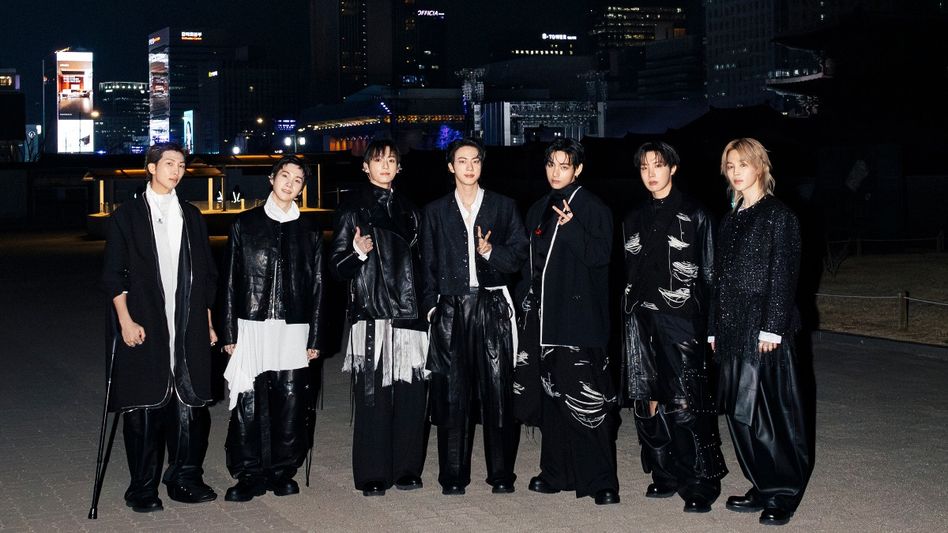
On the evening of March 21, Gwanghwamun Square in central Seoul — the historic plaza fronting Gyeongbokgung Palace, a site layered with centuries of Korean political and cultural memory — became the site of the largest public concert in South Korean history. By the time the show began, an estimated 260,000 fans had gathered. Twenty-two thousand held Golden Tickets for the fenced inner zone. The remaining 238,000 filled surrounding streets for more than a kilometre in every direction, standing in the March cold, light sticks raised, watching on screens. Simultaneously, over one million people watched live on Netflix from around the world. It was the first full-group performance since the Yet to Come concert in Busan in October 2022 — and the gap between that night and this one was felt by everyone present.
The production matched the scale of the moment. The stage was constructed as an enormous LED picture frame physically enclosing the Gwanghwamun gate, with the mountains of Seoul rising behind it — a visual argument, made in light and steel, about where this music comes from and what it carries. Five female vocalists in traditional hanbok appeared throughout the night, performing the Arirang folk melody on traditional instruments, threading ancient sound through a stadium spectacle with a subtlety and intention that critics noted immediately.
RM opened with four words: "Annyeonghaseyo — we're back." Then all seven of them were moving, together, for the first time in four years.
He performed the entire night on an injured ankle. A stool was placed on stage for certain moments, but he never left it, never gave the crowd anything less than everything. It is the kind of detail that interviews cannot manufacture.
The setlist opened with five consecutive world premieres — new material delivered straight into a live setting, without the safety net of familiarity — a decision that was either fearless or foolish and turned out to be entirely the former. "Butter," "MIC Drop," and "Dynamite" arrived in the second half and did what those songs have always done, which is to turn whatever number of people are present into a single organism moving together. The encore was "Mikrokosmos" — always the most honest thing in their catalogue, always the song that sounds most like BTS talking directly to the people who love them — and it closed the night in a communal singalong of a scale that made the word "concert" feel insufficient.
The moment that has stayed with everyone who watched: mid-set, the five vocalists returned in hanbok, and the Arirang melody surfaced inside "Body to Body" — carried on traditional instruments, bare and unadorned for a handful of bars, before the stadium bass returned underneath it. Old and new, folk and global pop, grief and joy, occupying exactly the same breath. It lasted under a minute. It will be talked about for considerably longer.
After the show, each member named their favourite track from the album. Jungkook said "FYA." Jin chose "Into the Sun." Jimin named "they don't know 'bout us." SUGA picked "Body to Body." V went with "Aliens." RM said his answer kept changing, but mentioned "Like Animals." Seven people, seven different answers — and in that small, ordinary divergence, something essential about what BTS are. Not a monolith. A harmony. Seven people who happen, together, to make something none of them could make alone.
The Arirang World Tour opens April 9 in Goyang, South Korea. Eighty-two dates. Thirty-four regions. The largest tour of their career.
Before any of this began, SUGA said the ambition was simply to "shake things up" — to make "something very new." What they actually made is something very true. And the truth, as it turns out, was more than enough to shake everything.