Navakanta Barua and the Night the City Learnt to Listen
Memory does not protest at first. It adjusts. It accommodates. Until one quiet morning, something within you stirs with a strange ache, and you recognise that a certain brightness you once lived with has gently slipped away.

- Apr 18, 2026,
- Updated Apr 18, 2026, 2:28 PM IST

Memory does not protest at first. It adjusts. It accommodates. Until one quiet morning, something within you stirs with a strange ache, and you recognise that a certain brightness you once lived with has gently slipped away.
In the spring of 2026, when the air carries the familiar rhythm of Bihu and the earth renews itself in colour and song, we quietly arrive at a 100 years of Navakanta Barua. And yet, for a fleeting while, it seemed as though the season had come and gone, the drums had found their beat, but we had not fully turned to honour the moment that was waiting for us.
This was no ordinary poet. Honoured with the Padma Bhushan in the year 1976 for his contributions to Literature and Society, Barua did not simply describe the world. He revealed its undercurrent. He led Assamese poetry away from the comfort of pastoral nostalgia into a city that was restless, thinking, uncertain, and alive. He wrote of the inner weather of people learning to live with change. The river was no longer just a river. It carried reflection, doubt, and the soft fracture of modern life.
And yet, somewhere along the way, we allowed that language to dim at the edges. Perhaps that is why the idea did not feel like a plan. It felt like a necessity.
As the Guwahati Bihu Sanmilani prepared for its platinum jubilee, a thought lingered, refusing to be ignored. If we could gather for celebration and remembrance, could we not pause for a poet who reshaped the very cadence of our thinking?
It was from that quiet insistence that the thought was placed before the committee. Not as a demand, but as a gentle nudge. One evening for Navakanta Barua.
There was grace in the acceptance. What followed was not the work of one mind alone. Alongside Anuj Bishaya, the cultural secretary whose clarity anchored the effort, and Birina Chakraborty, an old family friend whose instinct for tone and presence brought warmth to the structure, and Pooja Sharma choreographing the children dances, the evening began to take shape. The intention was simple and yet demanding. To create a space where people could return to a finer sense of listening. To ensure that legends are not remembered out of obligation, but out of love.
Dr Amarjyoti Choudhury came into this journey with a generosity that felt both reassuring and rare. He did not just agree to be present. He agreed to open the evening in a manner only he can. Thoughtful, measured, and quietly commanding. His presence alone carried the weight of continuity.
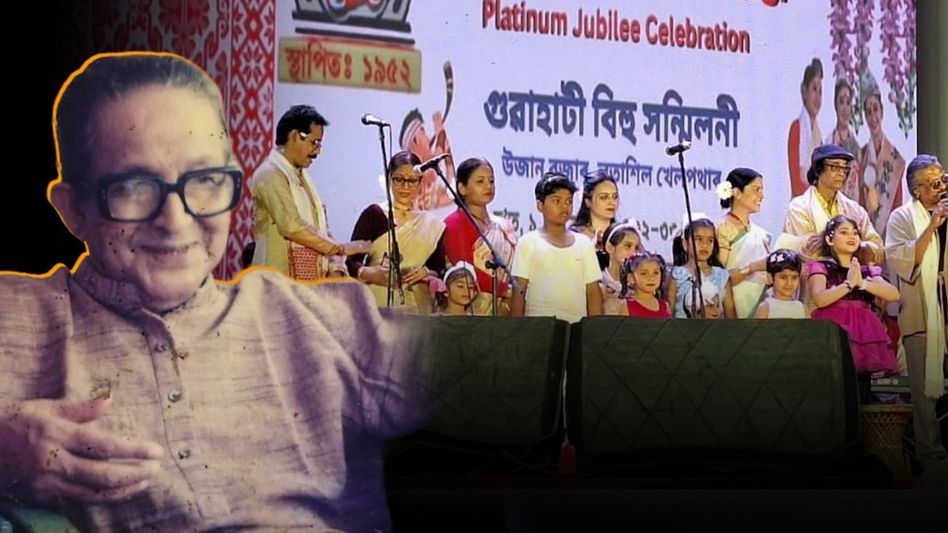
On the evening of 16th April at Latasil Playground, the stage chose dignity over display.The lamp was lit. The photograph received its silence. And then, gently, the evening began to breathe.It felt only fitting that the evening found its early resonance in the words of the Guest of Honour, Srimati Mrinalini Devi, who reflected on Navakanta Barua with a rare clarity and warmth. Drawing from a deeper cultural well, she evoked the image of the four wheels of the Jagannath chariot, suggesting that literature, music, memory, and lived experience must move together to carry a civilisation forward. In Barua, she observed, these elements did not exist in isolation. They travelled as one, creating a journey that continues to guide us, if only we choose to walk alongside it.
Dr. Amarjyoti Choudhury did not rush into the introduction. He allowed the space to settle. When he spoke, it was with the calm authority of someone who understands that literature is not to be announced. It is to be entered. He spoke of Barua not as a figure confined to pages, but as a living current within Assamese thought.
And then came a request. Simple, almost tender. He asked the audience to listen with respect. To receive the evening in stillness. Not as a spectacle, but as a moment of shared remembrance.
What followed was remarkable.The city listened.In that listening, something shifted. The noise that often surrounds such gatherings softened. The restlessness paused. It was as if Guwahati, for a brief while, remembered how to sit with itself.When he recited the opening lines of the poem “Bihur Botorot Burha Manuh,” the words did not echo outward. They moved inward.
Antara Das carried forward that inwardness with a song “Akasha Botahey Kiman Xur,”that held both innocence and depth. Barua never wrote down to his audience. Even in his gentlest lines, there was a quiet intelligence. Birina Chakraborty, guiding the evening with a grace that felt effortless, brought the poem “Loghun” (Fasting) alive with a warmth that bridged the distance between poet and listener.
“Niyorore Phul” arrived like a memory that had been waiting patiently at the edge of the evening. First given voice by Dr Bhupen Hazarika and later embraced with deep affection by Zubeen Garg, the song carried within it the gentle weight of continuity and loss. As Rita Das Medhi rendered it, Dr Amarjyoti Choudhury paused to reflect, his words settling into the air with a certain stillness. He shared, “Some compositions find new life across generations, yet never losing their original soul. Bhupen Hazarika gave it its first breath,” He observed, “but it was Zubeen who carried it into the hearts of a newer time, and in his absence, that resonance feels even more tender.” What remains, he suggested, “Is the enduring lyrics of Navakanta Barua, holding them all together in a single, unbroken thread of feeling.”
Then came a moment that felt deeply personal. Barua’s grandson, Arkupal Ra Acharya stepped forward, carrying both legacy and affection. When asked to choose a favourite poem of his grandfather, he offered a response that lingered. “How does one choose, when each poem carries a different shade of love.”He chose to recite “Monot Poreney Arundhuti.” (Do You Remember Arundhuti) And in his voice, the poem unfolded like a quiet confession. Love, in Barua’s world, was never loud. It waited. It revealed itself slowly, with a patience that feels almost unfamiliar today.
Then the evening found its surge.Dwipen Barua stepped onto the stage and with the very first note of “Ekhon Nedekha Nodir Xiparee,” the air changed. His voice did not merely perform. It awakened. Tuned by his elder brother Ramen Barua, the composition carried with it a lineage of sound that belongs to a generation that did not separate craft from feeling.
Finally, when “Kune Aji Abeli”followed, the energy turned luminous. Smiles returned. Recognition travelled through the audience like a quiet ripple. And in that moment, a gentle realization surfaced. These songs that lived so easily within us were shaped by the same poet we had almost allowed to fade into the background.
He was never absent. We had simply stopped noticing.
NavakantaBarua was not divided by generations. He connected them. As he reflected, “I am the generation bridge.” That’s what he claimed. A child could find wonder in his lines. An elder could find reflection. He did not create distance. He created passage.As the evening approached its close, I decided to recite “Xexor Xaree” (The Last Line)
“And, on the toes of your final word,
I will, unknowingly,
begin to write your poems.”
There is something about brevity that demands honesty. In those few words lies a quiet insistence. That we must refine our sense of taste. That volume is not expression. That conflict is not strength. That we must learn again from those who built with care, who wrote with restraint, who believed that beauty is not an indulgence but a necessity.
That evening was never about grandeur.It was about restoration.About returning to a certain sweetness that once defined us. About acknowledging that even in a time where trust feels fragile, there are still those who seek warmth, who believe in gentleness, who understand that art is not separate from life.And as the night settled over Latasil, besides the Brahmaputra, there was a quiet certainty.We had not merely remembered Navakanta Barua.
We had allowed the city to listen once more.And in that listening, something within us had begun, ever so softly, to return.