
OutStation | Generation that borrowed everyone else's boy bands finally has its own
OutStation | Generation that borrowed everyone else's boy bands finally has its own
OutStation aren't just a new band trying to find an audience — they're five young men stepping into a space Indian pop has left empty for years. What's unfolding around them feels less like a launch and more like the beginning of something the country has been quietly waiting for.
Advertisement


Aparmita Das
- Apr 17, 2026,
- Updated Apr 17, 2026, 8:18 PM IST
Ten thousand people showed up.
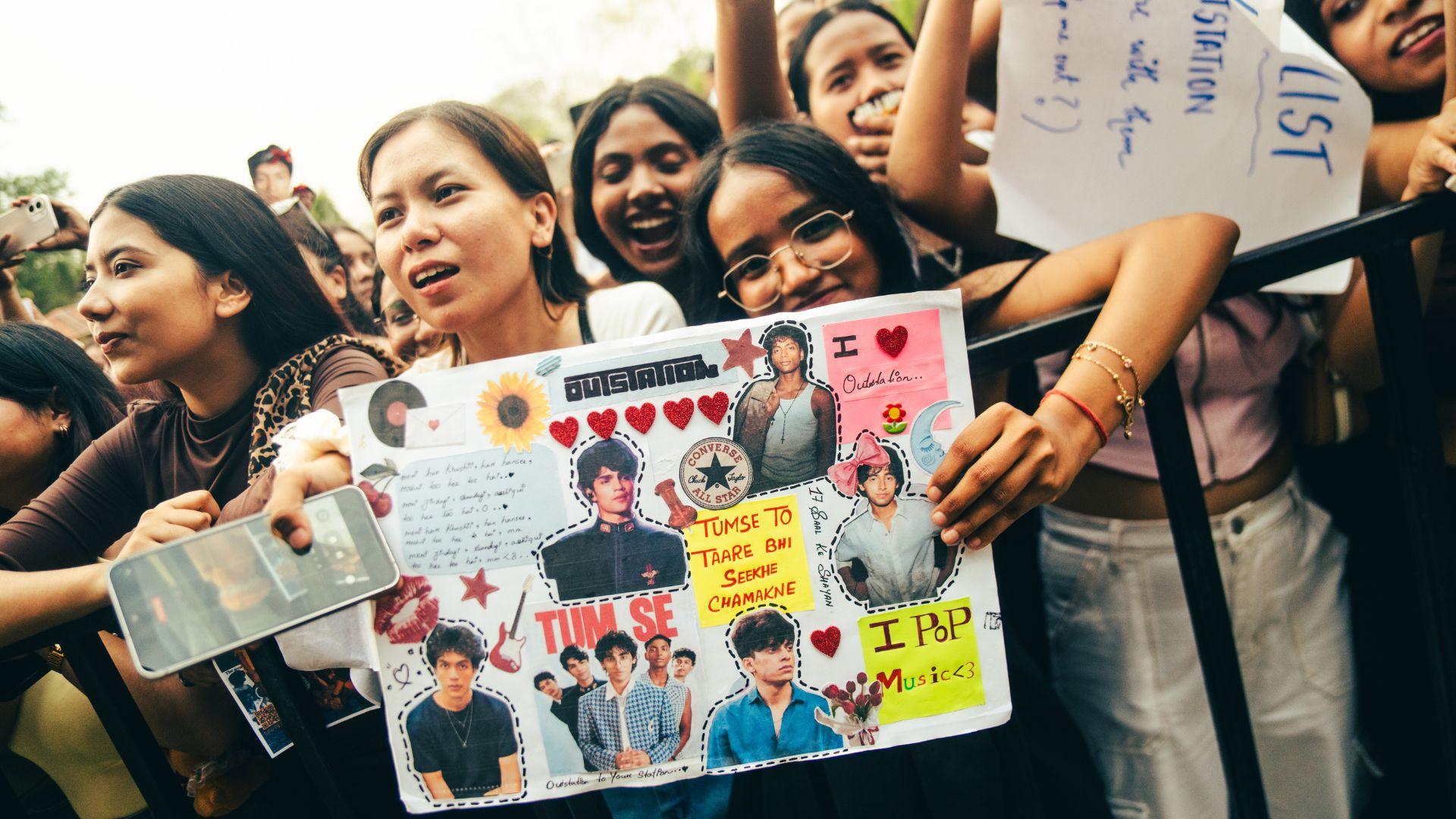
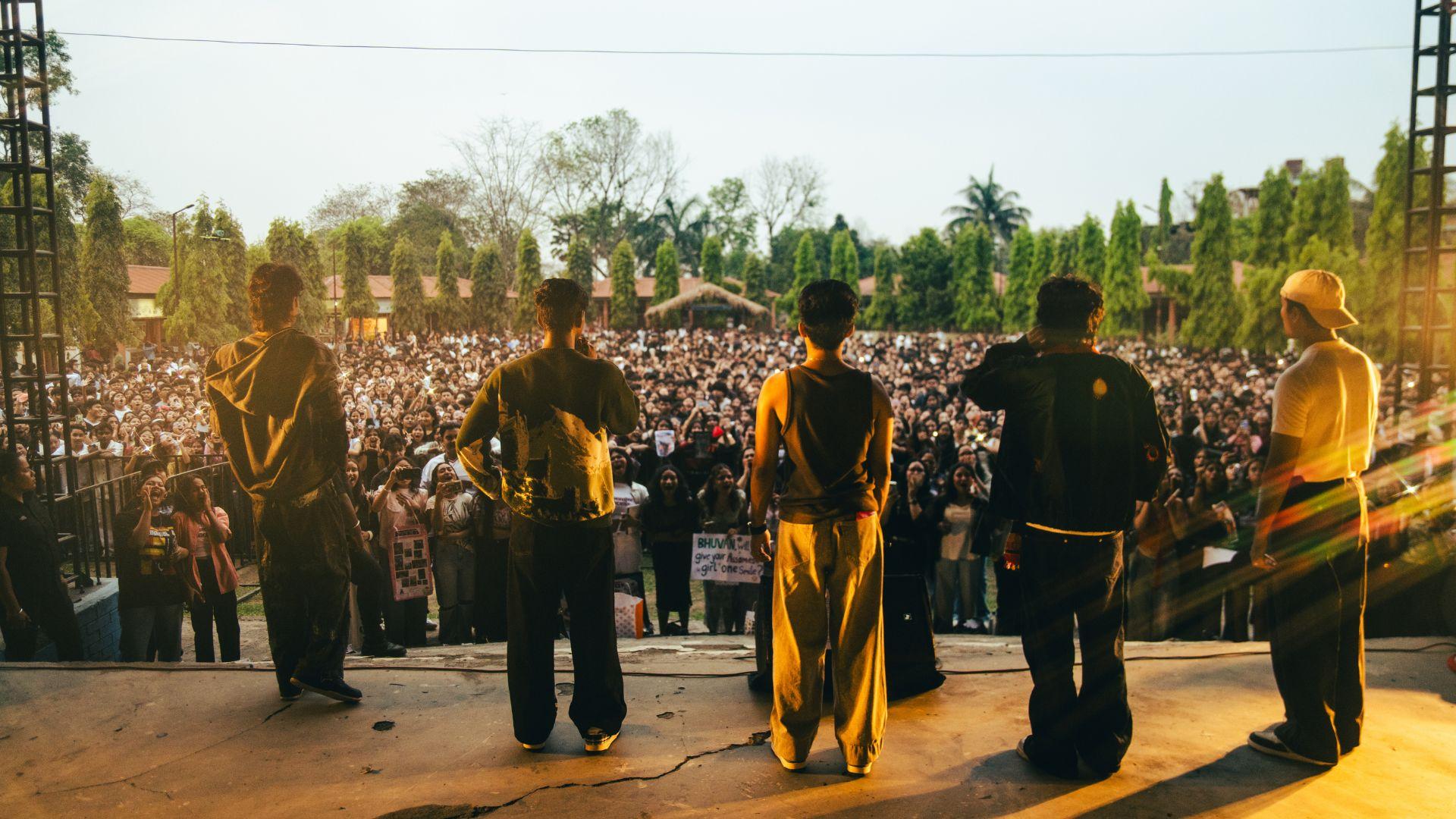
Let that number sit for a moment. Ten thousand people, in Guwahati, on a Saturday evening in April, for a band that has exactly two songs out. Girls in carefully coordinated outfits, they had planned for weeks. Boys who would never admit they planned their outfits but clearly had. Mothers. Fathers. Grandparents who had been dragged along and were, by all accounts, having a better time than they expected. The kind of crowd that doesn't happen by accident. The kind of crowd that happens when something has been building quietly, in comment sections and fan group chats and midnight release countdowns, and then finally, all at once, breaks into the open air.
A few hours before any of that, five young men were sitting in a hotel restaurant in the same city, laughing too loudly, slightly crammed together, and telling me things they probably hadn't planned on saying out loud.
This is what that looked like.
There is a particular kind of dismissal reserved for music or anything that girls love.
It has been happening for decades, across every culture, with remarkable consistency. The Beatles were dismissed as noise before they became the most critically acclaimed band in history. One Direction were called manufactured nonsense until it became embarrassing to say so. BTS, whose fandom, ARMY, stands apart from other fandoms through the ways it has mobilised with an unrivalled level of organisation, who have spoken at the United Nations, who broke every record they touched, were called a K-pop gimmick right up until they became the biggest band on the planet. The critics always catch up eventually. The girls were right all along.
India has not been immune to this. A Band of Boys formed in 2001 after auditions with over 1,000 candidates. Songs like Gori and She Drives Me Crazy got people grooving, and they were called the Backstreet Boys and Boyzone of India. They were real, they were talented, and they were eventually swallowed by the same Bollywood machine that has swallowed most independent Indian pop — the one that decided, implicitly, that music made for young women was not music worth taking seriously.
That was 2001. The people who loved A Band of Boys are in their thirties now. But this is not just their story. The millennials who stayed up for Westlife albums and printed One Direction posters and found BTS before anyone around them understood what K-pop was, and the Gen Z kids who grew up with fan cams and choreography tutorials and midnight drops from Seoul as a basic fact of life, all of them share the same quiet, persistent awareness: that none of it was theirs. None of it came from their streets, their languages, their specific, irreducible experience of being young in India.
That gap existed for a long time. It is only now, in 2025 and 2026, that India is filling it in earnest — with OutStation leading the charge with the loudest, most globally positioned claim of them all.
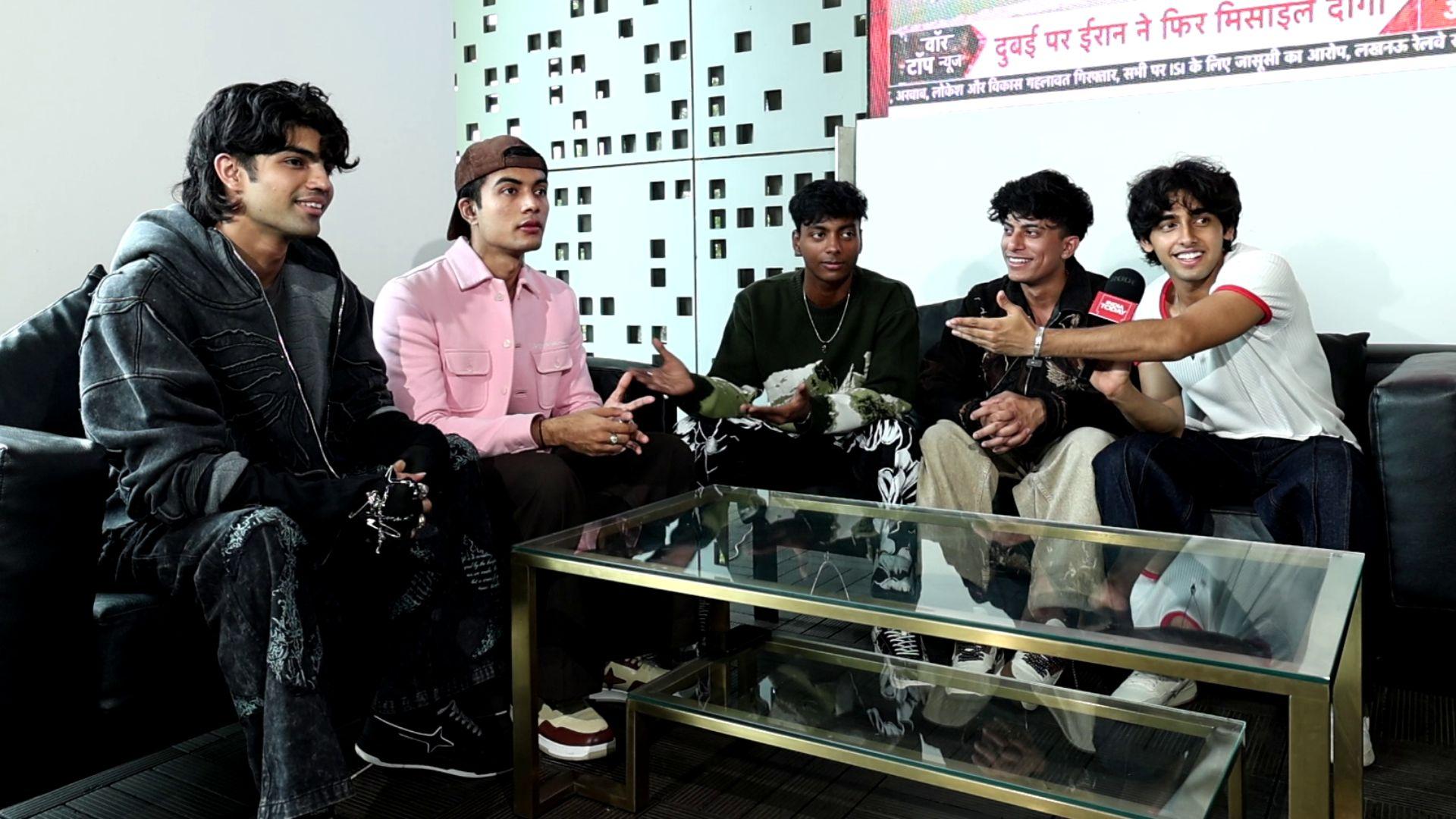
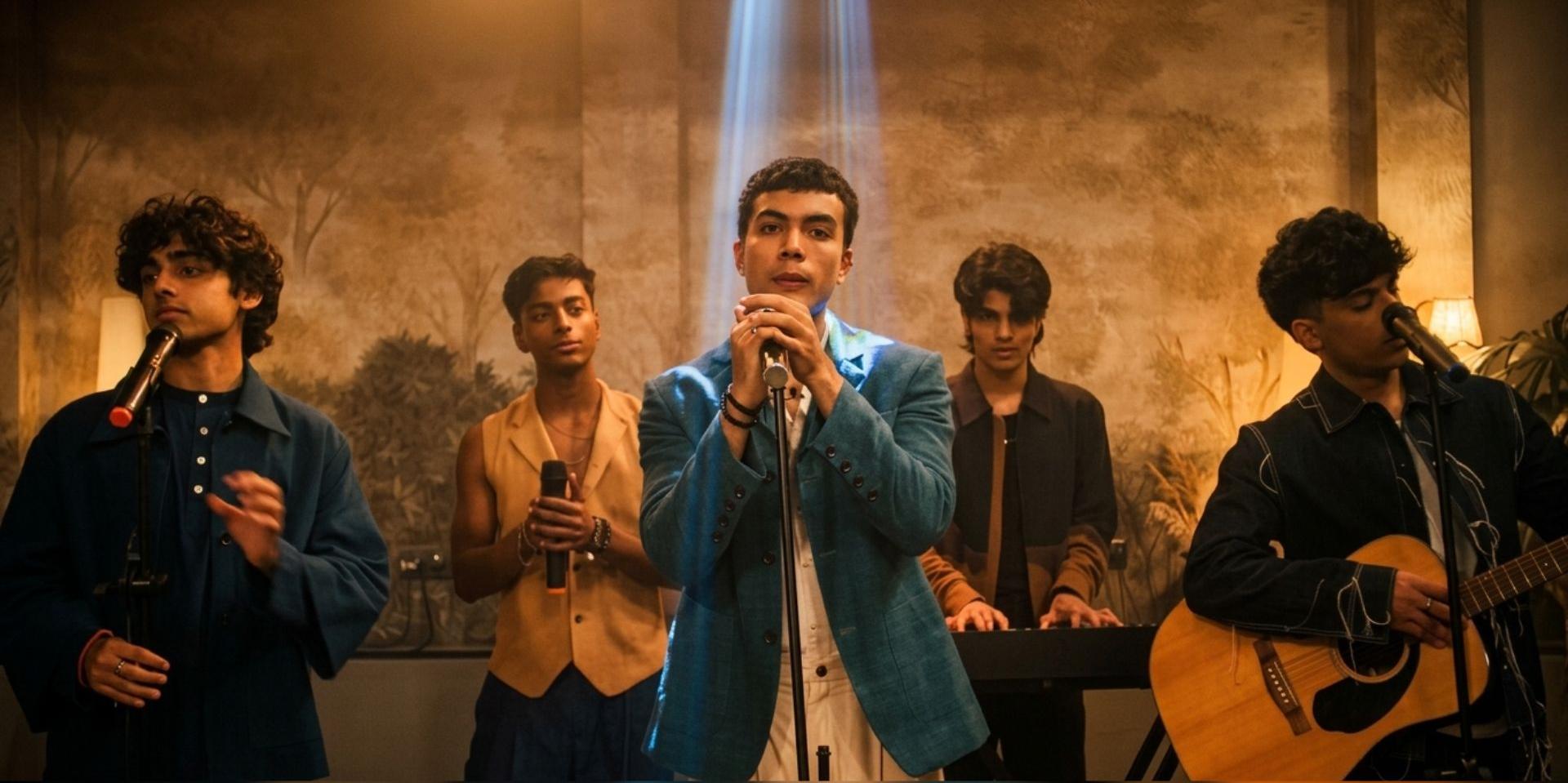
The restaurant of the hotel has the slightly suspended quality of all hotel restaurants; a space designed to be nowhere in particular, to belong to no specific city. OutStation make it immediately specific. Mashaal Shaikh arrives in a coal-black jacket with cut-out artistic patterns, knuckle gloves threaded with chains and safety pins, looking like he is headlining a significantly more dangerous concert somewhere else tonight. Next to him, Hemaang Singh's jacket is covered in angelic figures in brown and off-white — cosmic, or intentional, or both. Bhuvan Shetty is in a white polo shirt and a baby pink coat (or a jacket maybe), effortlessly stylish in the way that only works when you are genuinely not trying. Kurien Sebastian has hand-painted white floral patterns on his black pants, bottle-green sweatshirt, the easy confidence of someone who knows exactly which version of himself he wants to be today. And Shayan Pattem, the youngest, who had greeted me in the corridor with an apology for wearing a neck rest because he thought it might be disrespectful, is in a white T-shirt with a red border and blue jeans, already laughing at something Kurien has said.
They are very comfortable with each other in the way that only happens one of two ways: years of friendship, or months of extremely intense shared experience. In their case, it is the latter. They have lived together, travelled together, performed together, shared hotel rooms and tour vans and the specific intimacy of being strangers who became something else entirely inside a bootcamp in Goa at 6 am.
I ask them to introduce themselves using one thing that has nothing to do with music. The couch erupts immediately.
Shayan: "I'm Shayan, and I eat everyone's food." Hemaang, with complete seriousness: "I'm Hemaang, and I can bench 75 kilos." Kurien, dissolving instantly: "Damn, I can't match that. I'm Kurien, and I'm very jealous of Hemaang's record." Bhuvan, quietly: "I'm Bhuvan, and I like my privacy." Mashaal, without missing a single beat: "I'm Mashaal, and I like to interrupt Bhuvan's privacy."
The whole table loses it. Bhuvan looks at Mashaal with the patience of a man who has accepted his fate.
This, it turns out, is an entirely accurate description of the group dynamic.
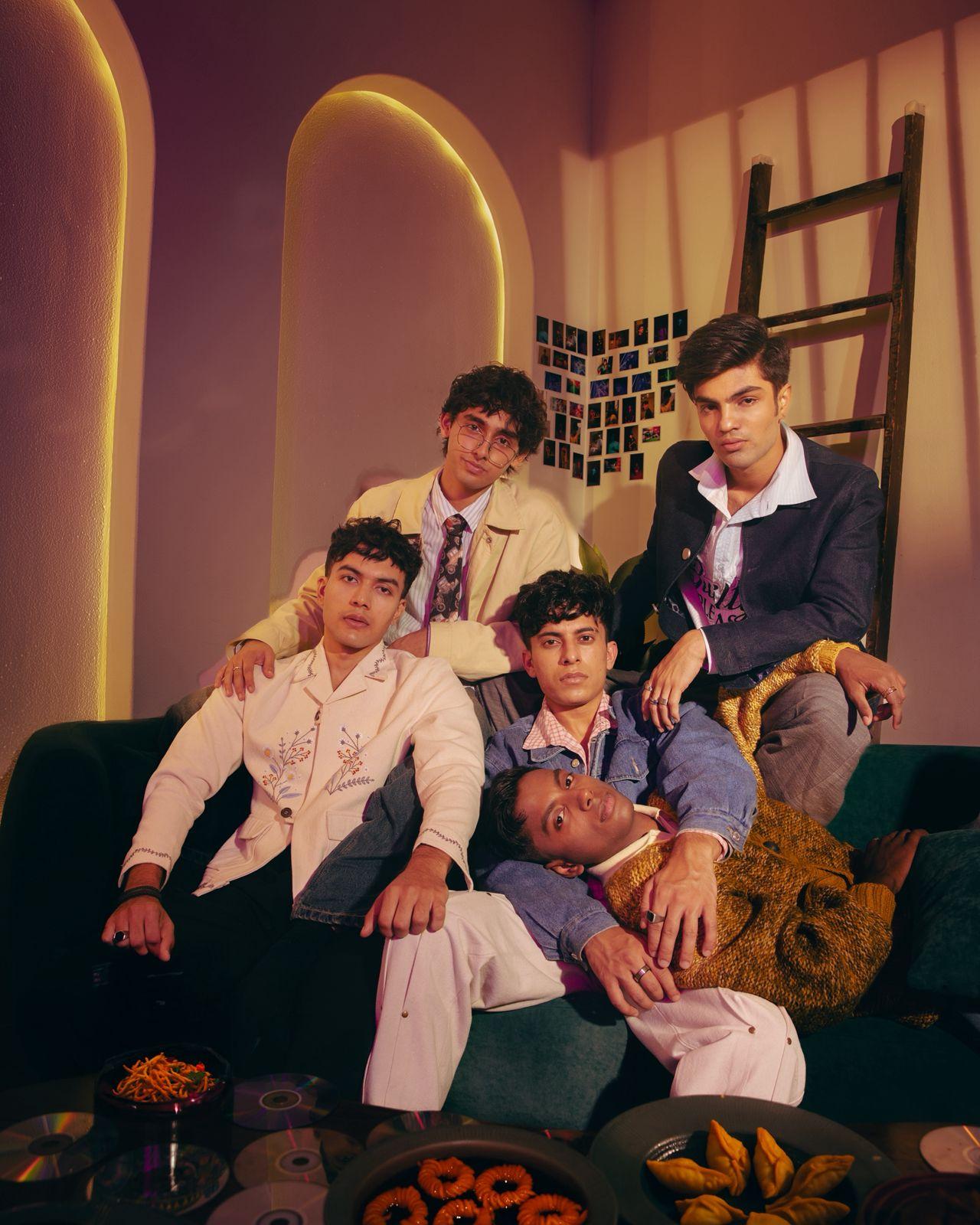
OutStation was assembled through a nationwide search by Visva Records, a new imprint from Indian-American songwriter-producer Savan Kotecha, in partnership with Republic Records and Universal Music India. Savan Kotecha (**for context**) has written for One Direction, Ariana Grande, The Weeknd, and co-wrote Sapphire with Ed Sheeran and Arijit Singh. When you are 16, and you Google that name and understand what those credits mean, you do what Shayan did. You run to your mother.
Most of the others, however, thought the audition post was a scam. Reasonable, in retrospect. "The greatest Indian boy band" is an ambitious thing to put on an Instagram post, and the internet has conditioned an entire generation toward healthy scepticism about things that sound too good. But something made each of them send the clip anyway...some pull toward something they couldn't quite name but recognised immediately.
For Bhuvan, the path had been quieter and longer. He had been posting covers online... Manwa Lage, Laal Ishq, Tu Har Lamha... not strategically, just because singing was what he did when nobody was telling him what to do. The covers went viral. He grew a following. And then he stopped. "I kind of got bored," he says. "I wanted to make my own songs. So I stopped completely. And then this opportunity came."
For Hemaang, it meant leaving college in his third year, which meant a conversation with his father that was not easy. His father created a WhatsApp group during the Goa bootcamp, "Hemaang Bootcamp Updates Goa", and monitored every update. He is happy now. The WhatsApp group presumably still exists.
For Shayan, who had been asked repeatedly by teachers, parents and friends what he wanted to do with his life, and who had answered honestly every single time that he didn't know, it was simpler and more profound than the others. "The only option was music or academics," he says. "I didn't want academics. Everyone kept saying figure it out. It's getting late. I just didn't know. And then this happened, which was what I actually wanted since the start. I just didn't know how to make it happen."
There is something quietly devastating about that — a teenager who wanted something so specifically he couldn't name it, until someone named it for him.
Guwahati was not supposed to be what it became the first time OutStation came here.
Their team, already at the venue, called ahead. Not many people had shown up, they said. The boys deflated in the car. "No one came, bro," Kurien remembers thinking. "It's a fail." And then they arrived. And then they heard it. Two thousand voices singing Tum Se back at them, in a city that had decided, entirely on its own terms, to show up.
"It was like a mini concert," Bhuvan says. "Like a real mini concert." Mashaal adds, in the tone of someone still slightly processing it: "All of them were so fashionable, you know? That's crazy." Shayan, nodding: "Guwahati had the best fashion out of every city."
This was not a throwaway compliment. This was five boys from other parts of India encountering the Northeast for the first time and finding something that exceeded every expectation they didn't know they had. It is why, when it came time to launch Aaj Kal, their second single, the song their fans had been singing back at them at every show for months before it had a release date, there was only one city under discussion. "We couldn't think of anything better than to come back to Guwahati," Mashaal says simply, "where we got the most love."
The pop-up event received over 11,000 RSVPs, with thousands turning up and singing along. The kind of crowd that doesn't gather for hype. The kind of crowd that gathers because something real is occurring, and people can feel it even when they can't explain it.
After the restaurant, after the interview, after the laughter and the knock-knock jokes and the singing and the confessions, they left for soundcheck.
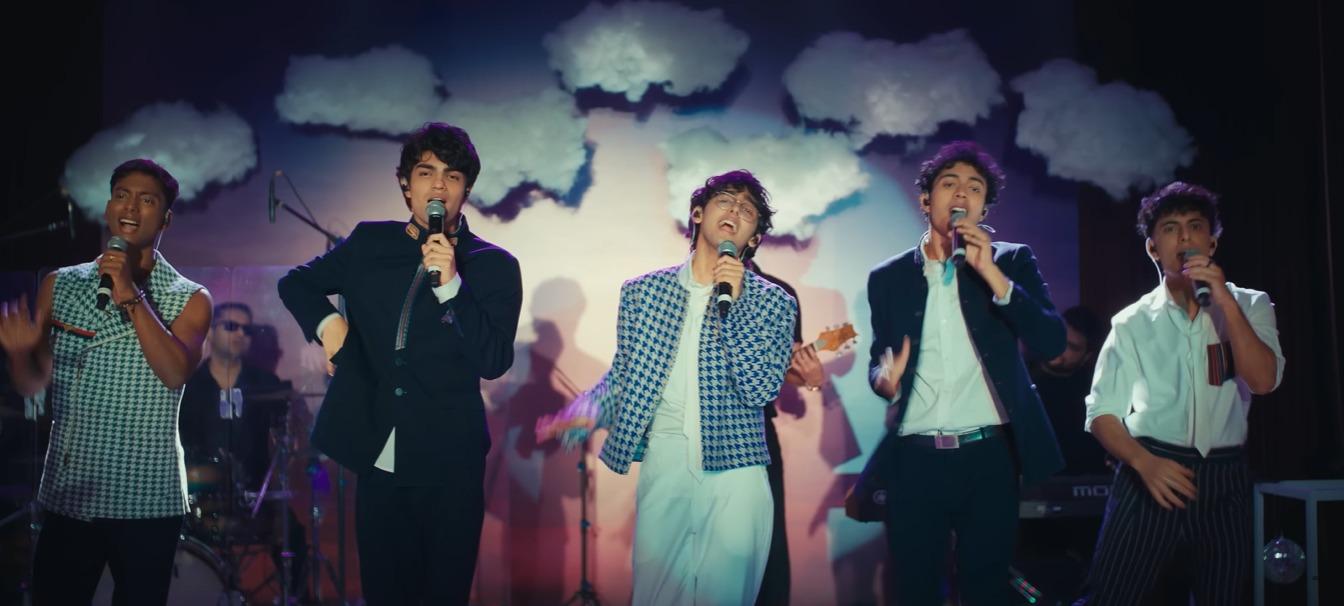
Aaj Kal is a song about longing. Specifically, the longing of being away from home for the first time. From family, from comfort, from the version of yourself that existed before all of this. The band has said the song holds deep personal significance because they are all away from their families and friends for the first time, and every time they perform it, they try to channel that sense of longing into the emotion of the song.
It had been a fan favourite for months before it had a release date. Hemaang's DMs, he says with a mixture of pride and mild exhaustion, were "filled with 'when is Aaj Kal getting released.'" The debate about which single to release first was genuine — Aaj Kal was the contender right up until Tum Se won. After Tum Se dropped and climbed to the top of the Spotify Viral Charts in India, the only remaining question was when. "After that, there was no other option," Hemaang says. "We had to release Aaj Kal."
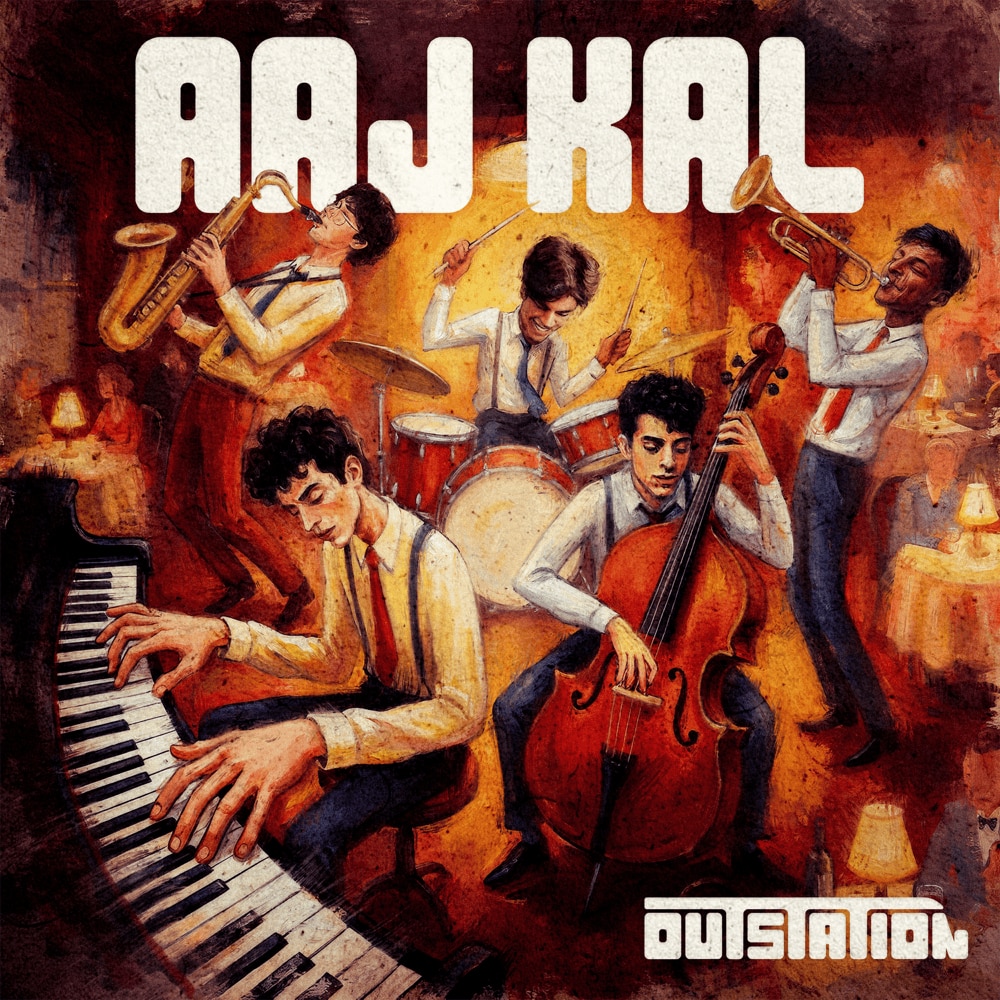
The cover art shows each of them playing a classical instrument — Mashaal on drums, Kurien on trumpet, Hemaang on cello, Bhuvan on piano, Shayan on saxophone — illustrated in caricature, connected to the visual world of the music video. And at the end of the song, just when you think it has finished telling you everything it came to say, there is an alaap — a fragment of Indian classical vocal improvisation — that surfaces briefly and disappears. It is Bhuvan's. When Mashaal, grinning, suggests he demonstrate it in the restaurant, Bhuvan looks at him with the expression of a man who has been friends with a chaos agent for long enough to know he has no good options.
The question of what each of them brings to OutStation that nobody else can is worth asking carefully, because the answer is not what you might expect from a band assembled through auditions and a bootcamp.
Bhuvan carries something classical in his voice — Carnatic roots, an understanding of melody's architecture, the ability to find a key not by calculating it but by remembering the placement of his throat. Hemaang brings riyaz: disciplined, daily, loud enough that entire hotel floors have been known to hear it. Kurien — who everyone calls the funny one, and who is, genuinely, very funny — is also the one quietly holding more than he shows. When asked which version of himself is real, the funny one or the emotional one, he pretends to cry. The others console him with the half-serious energy of people who have done this before. He attempts a knock-knock joke that lands slightly sideways. Everyone laughs anyway, including him. "I'm all fake," he says, and means it less than it sounds. Shayan, the youngest, shows up to every room as exactly himself — no armour, no performance, no calculation. In a band, that is rarer than any technical skill.
And then there is Mashaal.
During COVID, during what he describes as a period where he felt nothing — not emotionally, not even physically, if he got hurt he would not feel it — he sat with music because it was the only thing that made him feel anything at all. "I created so much," he says, the laughter from five minutes ago entirely gone now, "that I just understood the instrument well and then went to other instruments also." He pauses. "I think my depression made me a better musician. So I'm grateful for my depression." He clocks what he has just said, clocks the weight of it, and adds: "Shout out depression."
The table erupts again. It is the only response available when someone says something that true.
And then there is the matter of their voices. In an era where every other young Indian singer sounds like they are auditioning to be the next Arijit Singh or channelling Prateek Kuhad or Anuv Jain...where a certain kind of "breathy," melancholic indie-pop delivery has become so dominant it has started to sound like a uniform. OutStation are doing something quietly radical. They sound like themselves.
Bhuvan's voice carries the weight of classical training without announcing it. It is warm and architectural, the kind of voice that knows exactly where it is going before it gets there. Shayan, at this age, has no business sounding as assured as he does — there is a clarity to his voice, an openness, that most singers spend years trying to find and never do. Kurien is the one who catches you completely off guard — you look at him, easy and laughing, and then he opens his mouth and something powerful comes out, the kind of voice that fills a room before the room is ready. Mashaal is fresh in the truest sense. Unforced, unhurried, carrying something that feels genuinely new rather than assembled from influences. And Hemaang is perhaps the most interesting of all — technically rigorous in the way that only years of daily riyaz produces, and yet raw underneath it, as if the discipline and the feeling have not cancelled each other out but sharpened each other instead.
None of them sound like anyone else. In 2026, that is rarer than it should be.
They are giving up things they do not talk about publicly.
Bhuvan gives up sleep — with the conviction of someone who means this literally and philosophically. Hemaang gives up his comfort zone. Being in front of a camera, he says, was the hardest thing he could imagine. Now it is most of his life. They are 17 to 23. This was supposed to be the most anonymous stretch of time they would ever have — the years for making mistakes that nobody records, for figuring out who you are in private, for being wrong about yourself without consequence.
Instead, every move is documented. The Passengers — their fans, a name the fans themselves came up with and then OutStation made official in the Tum Se music video — show up with bouquets made from their own Snapchat selfies. They go to orphanages on birthdays to cut cakes in a member's name. They stay up until midnight for a release and then fill comment sections asking if anyone else made it. They know unreleased songs word for word. At live shows, they record videos in which OutStation's sound is almost entirely inaudible — because the fans are singing so loudly. "I just love that," Bhuvan says. "That makes us the happiest." Hemaang nods. "Sometimes it's just unbelievable. How do we get so much love from people?"
He is not performing this question. He is actually asking it.
The Labyrinth series on Instagram — a micro-drama that ran in the weeks leading to Aaj Kal's release — is more considered than it first appears. Each member found a tarot card. Each card corresponded to a different insecurity, a different struggle that is ordinary and human and therefore universal. Shayan's was about the harshest critic, being often wrong, about the violence of judging yourself in the way no one else would judge you. Hemaang's was the last to drop, and then, the next day, Aaj Kal released. "I think it was kind of poetic," Mashaal says. It was.
They know Taba Chake. Mashaal sings a line, unprompted, and this feels like the most honest possible answer to the question of whether the Northeast is on their radar. They have heard of Rebel, the Meghalaya rapper who performed at Rolling Loud India. They know, at least intuitively, that this region has been making extraordinary music for decades, that the rest of India has treated as peripheral, as somehow less central, as interesting but not important. When this is put to them directly, there is a flicker of recognition across the table. "It was really unexpected for the Northeast to have such a good reception for us," Shayan says, and the wonder in his voice is not condescending — it is the wonder of someone who came to a place with low expectations and found something that remade their understanding of what an audience could be. "The best reception, the best people, the best atmosphere we'd had yet."
There is something worth sitting with here. Five boys from cities that the music industry also doesn't fully pay attention to — Udupi, Prayagraj, Hyderabad, Goa, Delhi — finding their biggest crowd in a part of the country the industry pays even less attention to. The Passengers in Guwahati were fashionable and loud, and they knew every word. They did not need to be discovered. They were already there.
The interview is winding down. In a few hours, ten thousand people will gather at Shilpagram. OutStation will perform Aaj Kal live for the first time as an official release. The fans who RSVPd weeks ago, the ones who made their outfits and brought their friends and their younger siblings and, in some cases, their slightly bewildered parents — all of them will be there.
The laughter in the restaurant has not really stopped since it started.
I ask them, at the end, what they want to say to their Passengers. Not as OutStation the band — as Bhuvan, Hemaang, Mashaal, Kurien, and Shayan. Five people who left home and somehow ended up here.
Hemaang speaks first, and he speaks carefully. "We love each and every one of you. Thank you for believing in us. Thank you for supporting us. We see everything you do, and we appreciate it, and sometimes it's just unbelievable how much love we get." He pauses. Then Mashaal says, "I love it when you record a video and your voice is the loudest thing in it. Like, there's none of our sound in that video. Just you."
Bhuvan: "I love that too. That makes us the happiest."
Shayan: "It makes us really happy to see you all happy."
It is, in its simplicity, the most honest thing any of them has said all afternoon.
India has always had the talent. It has always had the fans. It has always had the longing for music that sounds like here, that comes from here, that knows exactly what it means to be young and Indian and full of feeling in this specific, extraordinary, maddening moment.
OutStation is five boys carrying all of that. They are 17 to 23. They have two songs out. They just played to thousands of people in Guwahati and then left for Mumbai like it was something they do every day, which, increasingly, it is.
Ask them if they expected any of this, and they will tell you — with complete honesty, without hesitation — that they did not. Ask them if they are grateful, and they will tell you that grateful is not the right word, that grateful is too small, that sometimes they sit in the tour van and look at each other and cannot quite believe that this is the thing that happened to them.
What stays with you, after the restaurant empties and the interview ends, is not any one thing they said. It is how they said all of it — comfortable and warm and completely unguarded, five young men who have every reason to be performative in front of a camera and simply are not. Shayan, whom you expect to be the quietest, turns out to be one of the most well-spoken. All of them, in fact, are exactly who they appear to be — respectful, grounded, a little bit disbelieving of their own story, and entirely, unstoppably themselves.
The Passengers chose well.
Aaj Kal is out now. The Passengers were there when it happened.
They always are.
ALSO READ: BTS's ARIRANG | Album Review: The boys who went under come back 'SWIMming'
POST A COMMENT