
Where the river teaches you to listen: Mongeet, Assam’s soul music festival
On Majuli, as the Brahmaputra slips quietly beneath a moonlit sky, music rises, not to entertain, but to heal, teach, and transform. Here, art is unhurried, applause is secondary, and learning unfolds as gently as the river’s flow. This is Mongeet, a festival that does not merely showcase talent, but reshapes those who pass through it.
Advertisement
 Mongeet, Assam’s soul music festival
Priyanka Saharia
- Jan 21, 2026,
- Updated Jan 21, 2026, 11:07 PM IST
On Majuli, as the Brahmaputra slips quietly beneath a moonlit sky, music rises, not to entertain, but to heal, teach, and transform. Here, art is unhurried, applause is secondary, and learning unfolds as gently as the river’s flow. This is Mongeet, a festival that does not merely showcase talent, but reshapes those who pass through it.
Meaning “soul music,” Mongeet has grown into one of Assam’s most intimate and purposeful cultural movements. Every year, it brings together young creators and seasoned artistes for an immersive training programme rooted in the guru–shishya tradition. Set at Dekasang in Majuli, the world’s largest river island, the festival becomes a rare space where art, culture, and mentorship converge.
For five to six days, Majuli transforms into a living classroom. The river, the moon, and the quiet rhythm of island life frame intense creative engagement. The island itself carries the legacy of the Satras founded by Srimanta Sankardev (1449–1568), the saint-scholar and reformer who shaped Assam’s cultural and spiritual identity. His foremost disciple, Madhavdev (1489–1596), carried this vision forward through devotional poetry and music, including the timeless Borgeets. That lineage, where art is devotion, flows quietly through Mongeet’s spirit.
At Mongeet, creation is intentional. The festival hosts initiatives such as Montulika, a creative painting workshop, and Monmrittika, dedicated to Assam’s sculptural traditions. These are not merely technical sessions; they are exercises in rethinking imagination. Participants are reminded that art carries responsibility, that it can question, preserve, and influence.
Under one roof, young creators learn from some of the most respected names in Indian arts and music: actor Adil Hussain, singer-composer Joi Barua, singer Rupam Bhuyan, sarod artiste Tarun Chandra Kalita, music composer/producer Dhrubajyoti Phukan, singer Saswati Phukan, guitarist Kalyan Barua, painter Manoj Roy, actor Mintu Baruah among others. Beyond formal lessons, it is the informal conversations, the jokes, silences, shared reflections, that leave the deepest imprint. Participants begin to understand not just how art is made, but how an artiste lives with it.
For founder Kaushik Nath, Mongeet is deeply personal. He established the Raul Kaushik Foundation in memory of his son, who lost his life in 2018 while saving another boy from drowning. “My son loved music,” Nath has said, “and through this initiative, I wanted to give back to my motherland.” What began as an act of remembrance has since grown into a collective legacy.
Mongeet also provides a platform for young talents to present original compositions across genres, hip-hop, rap, rock, folk, and experimental music, without age barriers. Musicians such as Papon, Joi Barua, Tarali Sharma, Kalyan Barua, Dhrubajyoti Phukan, Anurag Saikia, and Nilotpal Bora mentor participants, reinforcing the festival’s belief that music belongs to everyone, beyond labels and limits.
Now in its seventh year, Mongeet was held from January 10 to 20, growing larger yet remaining deeply intimate. Many past participants return, not as attendees, but as volunteers, mentors, and family. “Mongeet gives us friendships, learning, and motivation that lasts the entire year,” said one former participant. “It pushes us to create with purpose.”
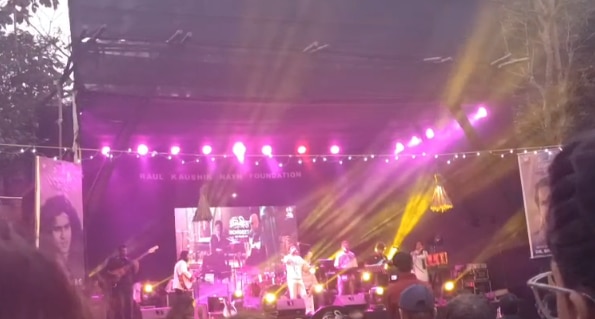
The final evening on January 20, unfolded as both celebration and tribute. Veteran and acclaimed artistes, including Pulak Banerjee, Dwipen Barua, JP Das, Malabika Bora, Shanta Uzir, Monojyotsna Mahanta, Shashwati Phukan, Anindita Paul, Joi Barua, and Shankuraj Konwar, performed in the presence of eminent personalities such as Adil Hussain, Utpal Borpujari, Baharul Islam, and Manisha Hazarika. The night honoured Dr. Bhupen Hazarika on his birth centenary and Assam’s beloved Zubeen Garg, with Bhupen Hazarika’s grandson Sage Hazarika in attendance.
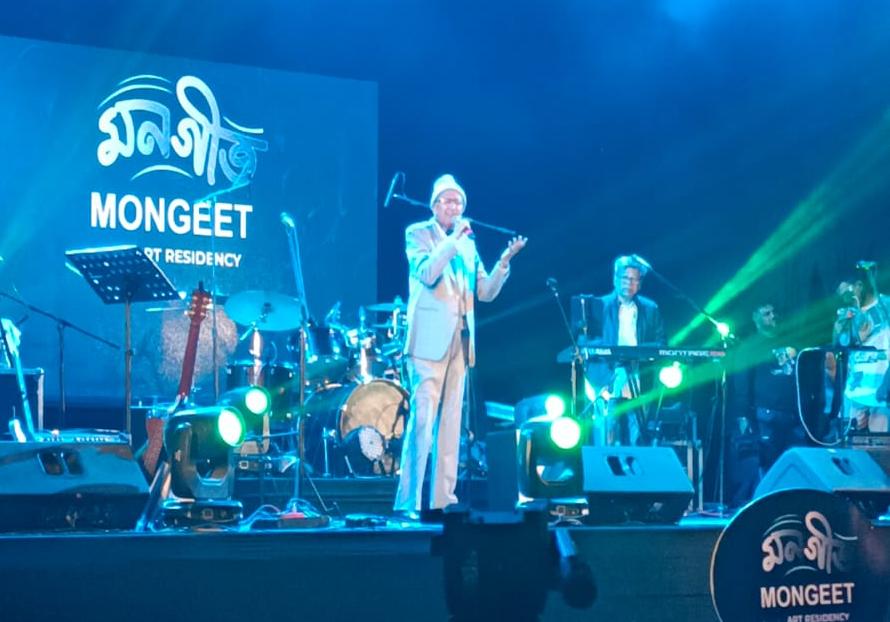
As singer Shankuraj Konwar performed “Dur Ximonat” alongside Kalyan Barua, Manasquaam Mahanta, and Bhaskar Saikia on guitars raised and electric notes soaring, participant Dhiraj Kumar Nath, who performs under the stage name Lenience, watched with quiet determination. “One day,” he said, “I will perform like this.” In that moment lay the essence of Mongeet: inspiration, self-discovery, and the courage to dream.
As voices rose and the audience sang along, the divide between stage and ground dissolved. What remained was shared memory, gratitude, and belonging.
Mongeet does not end when the music stops. It lingers, in the minds it shapes, the art it births, and the quiet confidence it leaves behind. Like the Brahmaputra itself, it flows forward, carrying stories, songs, and souls, connecting Assam to the world, and the world back to the heart.
POST A COMMENT