A Forbidden Love in Colonial India
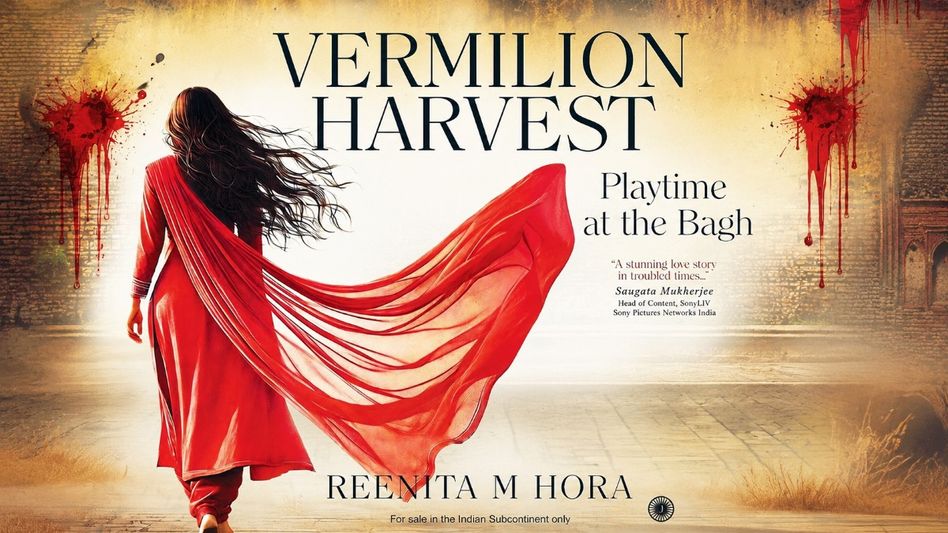
Reenita M. Hora's Vermilion Harvest follows Aruna Duggal and Ayaz as their forbidden bond takes shape in 1919 Amritsar. The romance unfolds against communal tension, political upheaval and the shadow of impending tragedy.

- May 29, 2026,
- Updated May 29, 2026, 9:12 AM IST

- The story opens with Aruna entering a male-dominated Punjabi dhaba
- Her attraction to Ayaz begins unexpectedly with a rat-triggered encounter
- Their bond deepens through literature, identity debates and secret courtship
“That particular afternoon was no different from any other—except that a woman had just stepped into a male-frequented eatery.”
Even though this extract from Reenita M Hora’s book is enough to raise eyebrows, I will still call the opening chapter a rushed affair.
If you have always enjoyed reading heartbreaking love stories unfolding against the backdrop of political unrest, war, rebellion and social upheaval, then ‘Vermilion Harvest: Playtime at the Bagh’ might just interest you. It carries all the ingredients of a tragic historical romance — longing, politics, communal tensions, rebellion and, of course, doomed love wrapped carefully within the chaos of 1919 Amritsar.
It is not exactly a straightforward book on the Jallianwala Bagh massacre; neither is it a particularly “subtle” read quietly navigating themes of religion, communalism, politics, activism or romance. Instead, it throws all of them at you almost immediately — whether you are prepared for it or not.
That said, let me shed some light on the complexity that is the first chapter. Interestingly, it is a lot to take in. Of course, there is a woman — apparently a rather good-looking one at that — seated at a Punjabi dhaba, which most Indians would know is usually populated with truck drivers, other vehicle drivers, and men seeking a drink, good company, an occasional bonfire and a scrumptious meal.
Most abruptly, she develops a crush in that very food joint, and the love story begins with a rat. You read that right.
To her surprise (as well as mine), the worker Ayaz turns out to be an “almost-lawyer”, a political activist, as well as a Muslim — communalism practically announcing its arrival in the chapter — as he himself raises the question of identity: “A young man or a young Muslim man?” He is also well-versed in literature, and the woman — an English instructor — completely smitten by his personality, also notices his “sex appeal”.
Wait, it gets more interesting.
The duo exchange niceties over Jane Austen’s ‘Pride and Prejudice’ and the famous Mr Darcy — all perhaps a little too much happening inside a dhaba in Amritsar. And this is merely the first chapter; enough to persuade you to either pick up the book immediately or quietly put it back on the shelf.
“I had to have him, and it was much more than just a physical attraction” — at least Aruna Duggal, the protagonist, was certain of that.
Before I forget, the year is 1919, and Duggal is “attracted to a waiter”. The next few pages make it clear that romance is the dominant genre here, though heavily stained with casteism, politics, and communal divides from the very beginning.
“How could I fall in love with someone so different? He a Muslim, I, a young Anglo-Indian schoolteacher. He, so fearless and daring. And I, naturally drawn to keeping up my guard…”
Keeping the escalating drama aside, Hora manages to shape a crystal-clear picture of a love story brewing in a politically tense Amritsar with almost zero possibility of a happy ending. Although the mention of a literary heavyweight like ‘Pride and Prejudice’ in this context feels slightly unsettling to me, Hora’s historical fiction flows smoothly and gathers all the attention it seeks.
The book will especially appeal to romance and historical fiction aficionados looking for a story that efficiently blends tragic love, colonialism, communalism and politics.
If one looks at the bigger picture, Hora is rather straightforward with her approach. Her choice of genres is vivid and she ensures they constantly overlap to keep the reader invested. Her characters — Aruna and Ayaz — trudge along the path of secret courtship despite strong opposition from the former’s culturally rigid mother. Aruna simply “didn’t care what others thought”. She blatantly questioned her mother: “Perhaps I am daring, Ma…I’m not your regular Hindu girl, am I?”
Almost fifty pages in, the author begins introducing the brutal realities of politics, laws, rights and rebellion into an already “daring” love story. There is mention of the ‘Anarchical and Revolutionary Crimes Act of 1919’, Mahatma Gandhi, the Indian National Congress and the All-India Muslim League — all making it painfully clear that the duo’s relationship is difficult, let alone their union.
Quite honestly, the picture becomes clear fairly early on.
The couple — ‘drowning’ in love — begin discussing politics and the complexities attached to it. Obviously, the love they share is “forbidden” as per societal expectations and deeply marred by countless factors, the largest of them being politics itself. And as the story proceeds, quite predictably, the English teacher grows increasingly worried about her Muslim partner.
“I wanted to support his cause, but I was also against any risks on our chance of being together.”
And before one even realises it, Aruna is stripped of her freedom to pursue the affair once her job is threatened because she has been “seen cavorting with a local Muslim chap.” Meanwhile, Ayaz is labelled a “revolutionary”. At this point, tragedy no longer feels like a possibility — it feels inevitable.
It does not take long for the story to transition from a romance into a full-fledged political account of what transpired in Amritsar in 1919. The love story gradually takes a back seat, ushering in the larger political climate and historical horrors surrounding the period.
What happens next is not particularly difficult to anticipate. Nevertheless, I would still recommend giving this book a shot — if only to witness how love attempts to survive, however briefly, amidst history, politics and inevitable ruin.