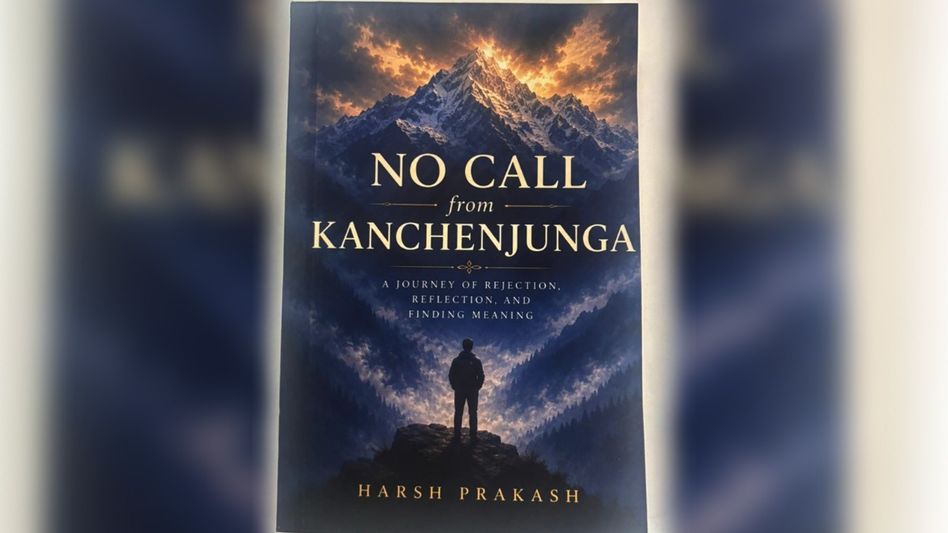
No Call from Kanchenjunga — When Rejection Becomes a Journey of Self-Discovery
Harsh Prakash's book follows Arya after a job rejection into Sikkim and the Northeast. The journey turns disappointment into a reflection on identity, peace and self-worth.

- Jun 22, 2026,
- Updated Jun 22, 2026, 2:42 PM IST

- Arya's rejected interview becomes the starting point of an inward journey
- Sikkim's roads, monasteries and borders drive reflection rather than sightseeing alone
- The narrative examines ignorance about Northeast India and overlooked histories
In an age obsessed with achievement, rankings, and constant validation, No Call from Kanchenjunga by Harsh Prakash arrives as a timely reminder that life's most meaningful journeys often begin with disappointment.
At its heart, the book tells the story of Arya, a young professional whose life takes an unexpected turn after a job interview rejection. The title itself is brilliantly symbolic. The "call" that Arya anxiously waits for represents far more than a corporate job offer. It stands for acceptance, recognition, success, and the external validation that so many young Indians are conditioned to chase. Yet as the narrative unfolds against the backdrop of the Eastern Himalayas and India's Northeast, the reader gradually realizes that the absence of that call may have been the greatest gift of all.
What distinguishes No Call from Kanchenjunga from conventional travel writing is that the journey is never merely geographical. The mountains, roads, monasteries, rivers, and borderlands of Sikkim are not treated as picturesque backdrops. Instead, they become catalysts for introspection. Every destination becomes a question, every encounter becomes a lesson, and every landscape becomes a mirror reflecting Arya's evolving understanding of himself and the country he inhabits.
Harsh Prakash demonstrates remarkable skill in portraying the psychology of an ordinary young Indian navigating the uncertainties of adulthood. Arya is not a larger-than-life hero. He is relatable precisely because he is flawed, uncertain, and painfully aware of his own limitations. His struggle with mediocrity, self-doubt, and the pressure to succeed resonates deeply with a generation raised on expectations and comparisons.
One of the book's most compelling themes is ignorance—not in the conventional sense of lacking information, but in the deeper sense of overlooking realities that exist beyond one's immediate world. Arya's realization that he knows little about Northeast India becomes the narrative's moral turning point. Through his travels, readers are introduced to histories, cultures, philosophies, and communities that rarely receive adequate attention in mainstream discourse.
The chapters set in Sikkim are particularly memorable. Whether describing the vibrant streets of Gangtok, the disciplined calm of MG Marg, the winding roads leading to Nathula Pass, or the spiritual aura surrounding monasteries and mountain landscapes, the prose remains vivid without becoming excessive. The author captures the sensory richness of the Himalayas while maintaining an introspective tone that gives every scene emotional weight.
Among the book's strongest sections are those exploring Nathula Pass and Baba Harbhajan Singh Mandir. Here, Harsh Prakash moves beyond travel literature into philosophical territory. The narrative examines the true meaning of peace, borders, memory, sacrifice, and belief. Peace, the book suggests, is not the absence of conflict but the presence of discipline, mutual respect, and constant effort. This insight becomes one of the work's most enduring ideas.
The supporting characters also deserve praise. Rather than serving merely as guides or cultural representatives, they emerge as fully realized individuals whose stories and perspectives challenge Arya's assumptions. Through these interactions, the author avoids the common pitfall of exoticising the Northeast. The region is portrayed not as an "other" India but as an integral and dynamic part of the nation's identity.
Stylistically, the writing is reflective, elegant, and accessible. Harsh Prakash possesses an eye for detail and a talent for transforming ordinary observations into meaningful reflections. At times, the introspection can slow the narrative's pace, but even these quieter moments contribute to the book's larger purpose: encouraging readers to pause, think, and reconsider what truly matters.
The book's greatest achievement lies in its central message. By the final pages, readers understand that the story was never about receiving a phone call. It was about learning to stop waiting for one. The mountains of Kanchenjunga become a metaphor for the journeys we postpone while waiting for permission to begin living. Arya's transformation reveals that meaning is rarely found in destinations or achievements; it is discovered through curiosity, humility, and the courage to embrace uncertainty.
No Call from Kanchenjunga is ultimately a coming-of-age story, a travel memoir, and a philosophical reflection rolled into one. It invites readers to look beyond familiar horizons, challenge inherited assumptions, and recognize that rejection can sometimes open doors that success never could.
For readers who enjoy reflective travel writing, personal growth narratives, and explorations of India's lesser-understood regions, this book offers a rewarding and thought-provoking experience.