Poetry with Symphony of Sounds from Assam
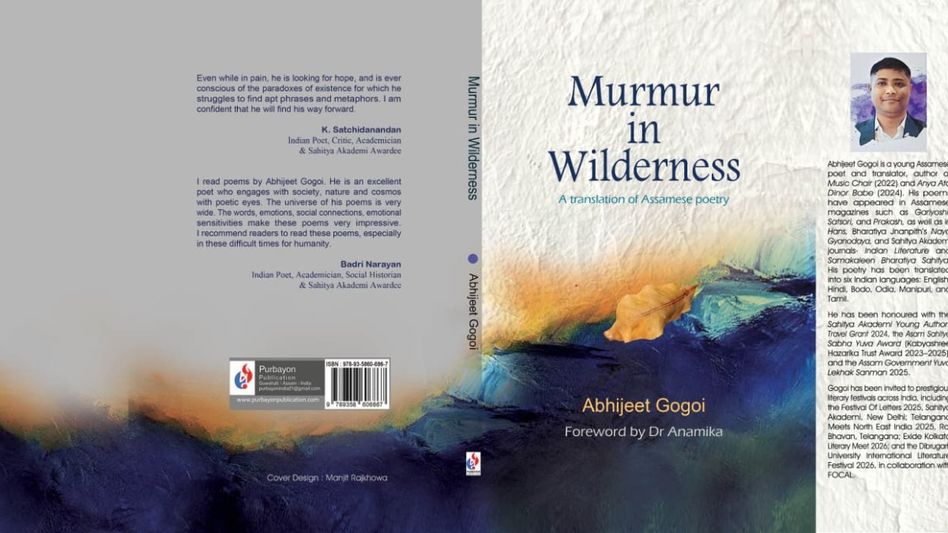
Reading the newly published book ‘Murmur in Wilderness:A translation of Assamese poetry’ of young Assamese poet Abhijeet Gogoi was a pleasant experience. ‘Murmur in the Wilderness’ is a very apt name to his poetry book.
- Oct 16, 2026,
- Updated Oct 16, 2026, 2:31 PM IST

Reading the newly published book Murmur in Wilderness: A Translation of Assamese Poetry by young Assamese poet Abhijeet Gogoi was a pleasant experience. Murmur in the Wilderness is a very apt name for his poetry book. There are many connotations to the title of this book. These murmurs are the poems written by Abhijeet in his own style.
He captures the wilderness of the land of Assam, the topography of Assam and the nature of Assam. A reader can hear the sound of the songs of the rivers, the trees, the forest, the birds in this poetry. He can see the riverbanks, the stones, the tales, the myths of Assam in this poetry. This symphony of various sounds from Assam creates a rich texture of the poetry. Abhijeet says that earth is his real home and he is the latest-born child. He is taking lessons from the earth. ‘Sutradhaar’ is one of the important poems from this collection.
The earth is my real home
I’m the child latest born
The earth is the courtyard of my first lesson
My childhood my adolescence my youth
(Sutradhaar-23)
Abhijeet has a profound view about life and power of words. In one of his poems, he writes:
If only
The words that have clotted hard
Breaking the bones in the ribcages
Could be expressed
Would have understood the
Medley of life
(For a custom without Bars-27)
Abhijeet is trying to understand his time and the space in which he lives. He is exploring through his poetic expressions. He is a contemporary Assamese poet who is conscious and aware about the depths and expanse of language. The way he uses past literary references in his poetry clearly indicates that he is well aware of the poetic tradition of Assamese poetry. A poet has to become a part of collective human conscious and write poetry. In a poem he connects with earth and becomes a part of the universe.
All things touched by this earth
Have a ground
And the ground
Begets the win in life
(Ground -15)
Abhijeet has pointed out the itching nerves of life in these poems. The first poem in this collection, called ‘A voice of pain’ says:
A bloom hanging
And an encounter
Like some snapshots
The weather gets dampened by night
The mind stashed
Under the wet leaves
What a voice of pain
That appears to never end
A reader can feel the sensitivity of the poet that listens to the never-ending voice of pain. The poet is also sensitive towards basic human values like equality and he says in a poem:
Where there is no easy way
Where at no point of time
No one’s dominance matters
Transparent and free
For all classes
(For all classes-14)
In a poem called ‘For another Day’, the wooden logs are kept for drying in the sun. They will be used for fire and undried ones lying in the corner for burning on some another day. This metaphor points us towards human life cycle and the hassles of living. Abhijeet tries to say something more from the reality.
And as the logs slowly turn to ash
The undried ones lie in a corner
(For Another Day-17)
The poem ‘Murmur in the Wilderness’ is also a significant poem from this book. The murmurs that we hear in the wilderness are polyphonic. It unleashes multiple voices. It explores the relation between ‘You and Me’ in diverse conditions; it talks about the ancient curtains and the pain in eyes and chest; it talks about craving for food; it also tries to explore pure magic of life.
Abhijeet tries to explore relation between life and literature through his poetry. He tries to build a bridge even if he is aware that ‘Nobody Knows Who dies and Who survives’. This poetry is full of varied images. We see many places like Hari Pera Road, the courtyard and many objects, hot water springs, breaking waves of a river.
When a poet's first book is published, in any language, he takes an oath to remain committed to poetry and to literary values. He declares his association with the language in which he writes and its tradition. He expresses his gratitude towards the land where he is born and dwells. He also expresses his solidarity in the best interest of humanity. I am sure Abhijeet will also agree to this and go a long way ahead in the wilderness of language.
In conclusion, I would like to place on record my deepest sense of appreciation for the remarkable translational endeavours of the eminent translators — Ananda Bormudoi, Bibekananda Choudhury, Bibhash Choudhury, Nirendranath Thakuria and Sudhir Kumar Das. I also wish to laud the commendable literary commitment of Purbayon Publication, a leading and reputed publishing house of Assam, for bringing forth such significant works.
Review by Prafull Shiledar
Eminent Poet & Translator | Sahitya Akademi Translation Awardee