Rhythm of the Looms: When Northeast Textiles Found Their Voice
Rhythm of the Looms positively struck the right notes last week, bringing the pulse of Northeast India’s textile traditions to the fore through a refreshing contemporary showcase and an engaging panel discussion—something that is still rare in the region, especially within academia.

- Mar 09, 2026,
- Updated Mar 09, 2026, 2:02 PM IST

Rhythm of the Looms positively struck the right notes last week, bringing the pulse of Northeast India’s textile traditions to the fore through a refreshing contemporary showcase and an engaging panel discussion—something that is still rare in the region, especially within academia.
Hosted by the Royal School of Fashion Technology at the auditorium of Royal Global University, the event unfolded as a tribute on the occasion of the International Women’s Day Conclave 2026, celebrating the women who continue to preserve and promote the timeless textile traditions of Northeast India.
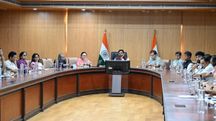
The conclave brought together designers, revivalists, artisans, students and policymakers in a rare space where heritage and enterprise could speak to each other without hesitation.
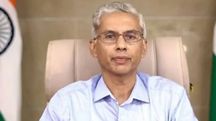
The event was graced by Chief Guest Hara Kanta Baro, Regional Director for the North Eastern Region under the Ministry of Textiles, Government of India, along with Guests of Honour Patricia Mukhim, celebrated journalist and Editor of The Shillong Times, and Jesmina Zeliang, textile revivalist and founder of Heirloom Naga. Setting the tone for the conclave, Jesmina Zeliang reminded the gathering that textiles of the Northeast are not merely commodities but living cultural expressions. “Our fabrics are our living stories. If we want them to travel the world, we must work towards novelty, authenticity and careful positioning. That is the need of the hour,” she observed in her welcome address. Her remark lingered in the room, particularly among the young fashion students who filled the auditorium with attentive curiosity.
Guest of Honour Patricia Mukhim offered a thoughtful reflection on the region’s evolving identity within the broader national narrative. She spoke about the importance of owning the stories that emerge from the Northeast and allowing them to find confident expression in public spaces. Designers from across the region also presented creations in the exhibition that moved effortlessly between heritage and modern form, turning the evening into a lively conversation between craft and creativity. Crisp, confident and quietly powerful, Rhythm of the Looms proved that the Northeast’s design voice is not just evolving—it is ready to be heard far beyond the region.
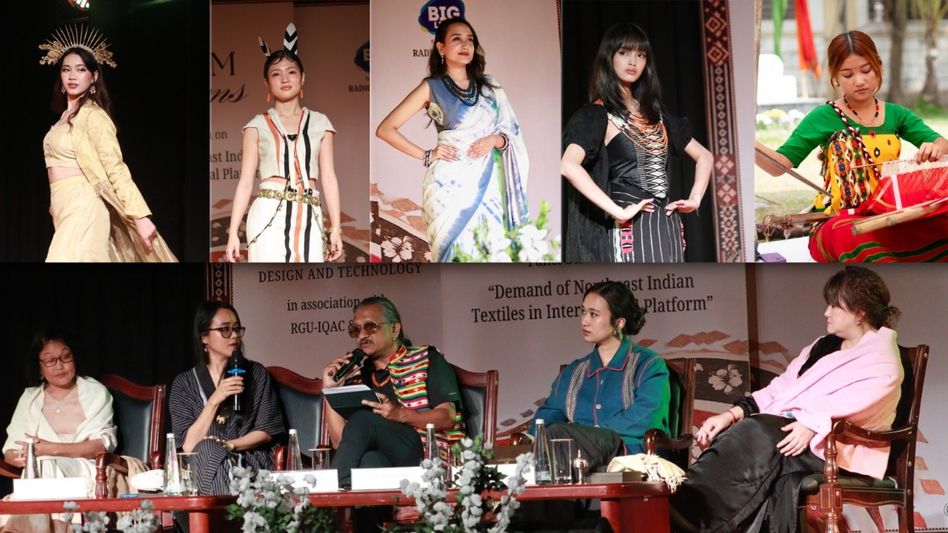
The conclave also featured live demonstrations by artisans from Thamakitila Bowa Kata Samabay Samity Ltd. and Saneki Weaves, who patiently demonstrated weaving techniques and the distinctive craft of Kokal Xhaal. Their rhythmic movements at the loom quietly reminded the audience that every finished garment begins with the discipline of hand and thread.
At the heart of the conclave was a panel discussion titled Demand of Northeast Indian Textiles in International Platform, moderated by yours truly. The conversation brought together voices from different corners of the region, each carrying their own journey of craft and enterprise. Among them was Richana Khumanthem, designer and founder of Khumanthem in Manipur. Her creations often weave comfort with cultural storytelling. “Comfort remains an essential element in my garments,” she explained during the discussion. “But equally important are the stories that live within them. Our traditional motifs and patterns are not decorative additions. They are identities that travel with every piece we create.”
From Meghalaya, Iaishah Rymbai, founder of Eri Weave Pvt Ltd, spoke about the community-driven philosophy that shapes her work. “Our weavers are truly the soul of what we do,” she shared. “The Eri silk we use grows in the Ri Bhoi district, and with it grows the livelihood of many families. My belief has always been simple—creativity should allow women to earn with dignity while doing what their hands already know.” Her efforts have steadily built a model where traditional knowledge becomes a pathway towards financial independence for women artisans.
Representing Nagaland, Asenla Jamir, founder of Otsü Clothing, highlighted the digital gap that still exists in presenting Northeast fashion to global audiences. “Our garments are still not well represented in the online segment despite the distinctive visual grammar we possess,” she remarked. “There is immense curiosity about our textiles. What we must do now is ensure that our stories reach people through the right digital platforms.” Her insight brought attention to the new frontier that designers from the region must navigate.
The discussion also touched upon the practical challenges that designers face while navigating institutional support systems. While acknowledging the importance of government initiatives aimed at supporting handloom and textile enterprises, the panelists collectively pointed out that the process often involves extensive documentation and lengthy procedures. As one voice from the panel reflected, the intent of these initiatives is undoubtedly valuable, yet the paperwork and administrative requirements can be time-consuming for small designers and emerging entrepreneurs who are already juggling production, marketing and community engagement.
“There are many government initiatives meant to support our work,” one of the panelists noted during the discussion, “but the paperwork and procedural timelines can sometimes slow things down. If these processes are simplified, many more designers and artisan groups would be able to benefit from them.” The sentiment was shared across the panel, with designers emphasising that streamlined processes and easier access to schemes could significantly strengthen the growth of Northeast India’s textile ecosystem.
From Sikkim, Chimi Ongmu Bhutia, founder of Lagstal Design Studio, emphasised the role of storytelling in shaping perception. “Digital storytelling plays a crucial role today,” she observed. “The craft already carries depth and authenticity. What we need to do is narrate those journeys in ways that the world can understand.” Bhutia’s work with bamboo-based materials and corn husk weaving has empowered rural women and marginalised communities while bringing sustainability to the forefront of design.
Interestingly, these reflections gained additional significance in the presence of Chief Guest Hara Kanta Baro. His presence underscored the continuing dialogue between policymakers and practitioners within the textile ecosystem. The interaction subtly highlighted how platforms like this conclave can serve as important bridges between government initiatives and grassroots designers, ensuring that support mechanisms evolve in ways that remain accessible, responsive and practical for the region’s growing community of textile entrepreneurs.
As the discussion progressed, themes of sustainability, authenticity, digital storytelling and market positioning emerged as recurring notes. What became clear was that Northeast textiles are steadily entering larger global conversations around ethical fashion and responsible design. The conclave also acknowledged the vital role played by women Self Help Groups across the region, which for generations have sustained weaving traditions while quietly strengthening rural economies.
As the evening moved towards its conclusion, the energy in the auditorium shifted from dialogue to celebration. Students of the Royal School of Fashion Technology presented a crisp fashion showcase, unveiling collections inspired by the region’s textile heritage while experimenting with contemporary silhouettes. The stage became the final canvas of the evening, where young designers walked the line between tradition and imagination with remarkable confidence. Their creations reflected not only technical learning but also a deep respect for the textile narratives that define the Northeast. It was perhaps the most fitting way to close the conclave.
Ultimately, Rhythm of the Looms was never only about fabrics. It was about voices—voices of artisans who continue to weave with patience, voices of designers who reinterpret those traditions, and voices of institutions that create platforms for these conversations to flourish. And if the energy in the auditorium that evening is any indication, the looms of the Northeast are no longer weaving in quiet corners alone. They are preparing to be heard by the world.