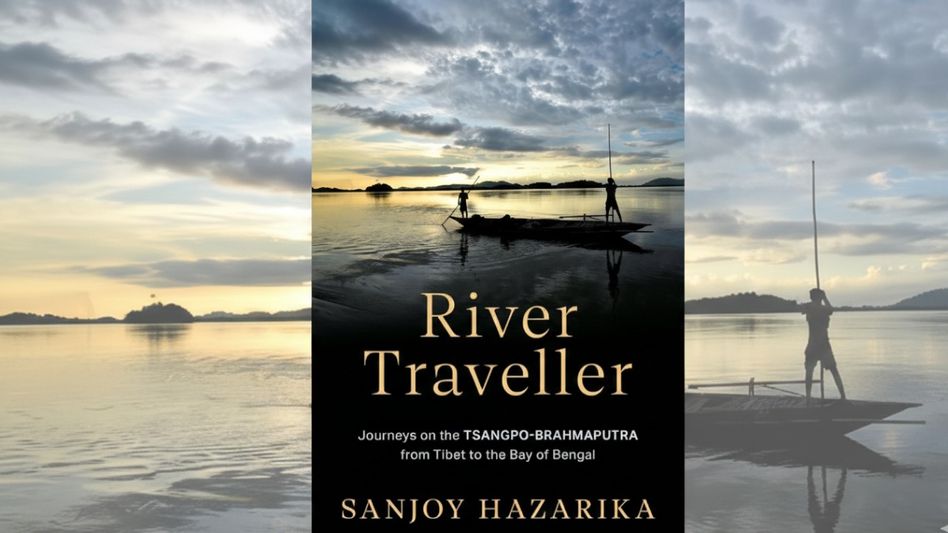
'River Traveller' is one man’s quiet pursuit of the mighty Brahmaputra
What begins as a travelogue slowly reveals itself as something far more urgent. The river emerges not as scenery, but as witness — to ambition, conflict, devotion and resilience — carrying forward questions that refuse to sink.

- Feb 18, 2026,
- Updated Feb 18, 2026, 10:03 AM IST

"In the midst of many uncertainties in an unsure world, like the river, the region and its neighbourhood never cease to delight, surprise, inspire, sadden and confound."
The mighty Brahmaputra finds its "leitmotif" perfectly placed and deeply resonant in 'River Traveller: Journeys on the Tsangpo-Brahmaputra from Tibet to the Bay of Bengal' by Sanjoy Hazarika.
Hazarika is not merely a narrator of this journey – he is its most devoted traveller. What unfolds is a first-hand engagement with the Brahmaputra, a river he holds in the highest regard. The book reads almost like an ode, a love story shaped by admiration and reverence for a river that has written histories, shaped civilisations, and left behind enduring legacies – all of which are thoughtfully explored in these pages.
From the very opening chapters, the content commands attention. The introductory pages set the tone, leading readers into stories from a historical past that stretches back nearly 800 years. Intriguing as it sounds, it truly is.
Hazarika opens with a deep dive into history – 1215 AD – introducing Tai-Ahom prince Siu-ka-pha, and the origins of what would become the Ahom dynasty. The intent was clear: to conquer the Brahmaputra valley. This long look back anchors the narrative, grounding the river’s story in power, ambition, and movement.
"Siu-ka-pha, our Shan prince and founder of the Ahom dynasty, once described the Brahmaputra as Nam dao phi—River of the Star God."
The introduction itself is richly textured, offering vivid accounts of the northeastern terrain, its people, lifestyle, flora and fauna, and sites that have since gained global recognition – Charaideo maidams, for instance, standing as silent witnesses to a storied past.
This extract sets the emotional and cultural tone of the book. More than merely informational, River Traveller evokes a quiet sense of pride and awareness, particularly for readers in Assam and the Northeast, many of whom may still be unaware of the depth of their own history.
At its heart, this book is a "yatra", a journey, divided into three distinct sections. Hazarika spans the regions of:
- Tibet
- Arunachal Pradesh
- Assam
- Bangladesh
What makes 'River Traveller' especially compelling is that it never limits itself to geography alone. The author does not simply catalogue the river, its territories, or its regions in totality. Instead, he ensures that the narrative remains engaging, immersive, and fluid. The book never feels imposed upon the reader, never reads like an encyclopedia spilling facts. Rather, it invites curiosity. It tempts the reader enough to be picked up from a stack of others.
All in all, the book carries the reader across territories, while its pages are interspersed with anecdotes and essential facts that quietly elevate the reading experience. It is neither heavy-handed nor distant – certainly not philosophical in excess. Instead, it unfolds with a fluency that feels almost conversational, as though the author were recounting these stories face to face.
The book itself is an amalgamation of many layers: historical record, travelogue, legacy of a river, anecdotes, brief reportage, a book in the making and even a documentary. The extract below captures that intersection beautifully.
"Would a documentary on the Brahmaputra interest him, I asked again on a phone call, soon after the idea had crossed my mind during one of my visits to Assam... ‘We have to travel to the sea, it may be very far, and I can’t think of anyone else who has the sensitivity, the knowledge of the area and people, and skills to make such a film.’ Jahnu smiled... 'Let’s do it,’" he said.
In the interim, the Brahmaputra – arguably one of the most significant rivers in geopolitical and local political discourse – raises some of the book’s most pressing questions.
Hazarika begins with Tibet, detailing the challenges of travel, border negotiations, floods, water politics, the plight of pundits, and the political upheavals that continue to shape the region.
He then moves to Arunachal Pradesh, where he discusses the India-China LOC, unfolding strategic plans, and the growing importance of the state for India – pipelines, highway projects, and infrastructure, set against the backdrop of an extraordinarily beautiful terrain.
Part two, which focuses on Assam, stands out as particularly striking. It opens with the devastating earthquake of August 1950.
"For days after that apocalyptic collapse into itself, the fallen, flattened hill, destabilised slopes and the rubble of rock and trees halted the surging flow of water."
He follows this with a shift in the river’s temperament: "Meanwhile, the Brahmaputra, spreading as far as eye can reach, flows along in an angry mood."
Hazarika then turns his attention to Assam’s tea gardens, its rising economies, local communities, and diverse tribes — each thread pointing toward the state’s rich and layered heritage.
One particularly evocative extract explores Majuli and its mythological resonance: "Majuli, the great river island between Jorhat and Lakhimpur, gave Sankardeva the mental and physical space to pause, reflect and create his epic ballads and plays centred around the life and loves of Krishna."
And then comes a detail that surprises many: "The presence of dolphins in the Brahmaputra has long been documented. As a child, I would look forward to our visits to Guwahati so we could go to the riverbank and watch river dolphins leap, play and dance,"
This passage not only reveals an often-overlooked fact but also underscores how tenderly the book is written.
The third part of the book takes us to Bangladesh, opening with an anecdote that reads almost like a scene from a film. "We are being chased by pirates? I repeated, stressing the last word. I looked at him in complete bewilderment. This could not be happening. It was just unbelievable. One of the things you did not expect to happen to you in real life was to be hunted by pirates on an open sea. This was the stuff of cinema and fiction."
This section delves into boats and boatmen, financial realities, irrigation innovations, migration and immigration, and life on the flatlands. It becomes evident that for India — particularly the Northeast — and Bangladesh to coexist and function meaningfully, unity and goodwill are indispensable.
Above all else, 'River Traveller' stands as a testament to one man’s enduring love for a river — his yearning to understand it, and his willingness to learn from it.
"...the Brahmaputra has sheltered me and kept me safe. For me, that is enough."