Shelter Without Security: “Daughters of Manipur” in Relief Camps, Three Years On | Ground Report
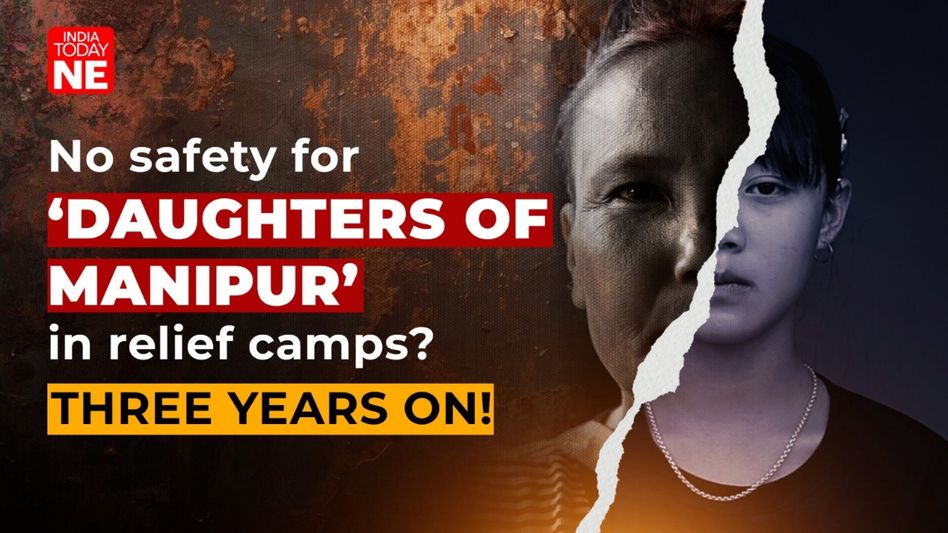
Three years after Manipur ethnic violence 2023, the camps meant to save lives now quietly test them—especially for women who fear the very shelters they depend on. Behind fading headlines, a harsher question lingers: when home is gone, who keeps you safe where you land?

- May 03, 2026,
- Updated May 03, 2026, 4:15 PM IST

Ethnic violence that erupted in Manipur in May 2023 has forced thousands to flee their homes, pushing entire families into relief camps that were meant to offer temporary shelter but have now become long-term living spaces.
Today marks three years of this continuing conflict. While the immediate violence may have faded from national headlines, life inside these camps tells a different story—one marked by uncertainty, overcrowding, and a deepening sense of insecurity, especially for women and children.
In recent months, reports of sexual violence, harassment emerging from within relief camps have raised serious concerns about the safety of women internally displaced by the conflict. Against this backdrop, a critical question persists: how safe are women IDPs in Manipur today?
India Today NE went on the ground across relief camps on both sides of the buffer zones to understand this reality.
On April 5, a minor girl living in an internally displaced persons (IDP) camp in Imphal East went missing. Within 24 hours, her body was recovered near the same relief camp under mysterious circumstances. She was allegedly raped and murdered by another IDP residing in the same camp. The incident has left a deep scar on the already fragile sense of safety within these settlements.
For many, especially children, the psychological and physical toll of prolonged displacement is becoming increasingly severe. Girls, in particular, appear to be among the worst affected.
Safety inside these camps is described as fragile and constantly under strain. As one student, Khoirom Rebita Chanu, living in a relief camp in Manipur, explains, everyday life is marked by discomfort and fear. She alleges instances of inappropriate remarks from elderly individuals and even from security personnel stationed near the camps.
'We cannot speak out freely,' she says, pointing to a culture of silence shaped by dependency and vulnerability.
For mothers, the anxiety is even more pronounced. With limited livelihood options and a daily government assistance of ₹85, many are forced to leave their children behind as they step out in search of work. That separation, however, comes with constant fear.
As Kongjengbam Anjali Leima, a mother of a young girl, puts it:
'I am scared for my daughter after hearing about all the crimes happening against girls. I am scared to leave her here in the camp even for a moment...'
Privacy, too, has become an almost impossible expectation inside the camps. Overcrowded conditions and shared spaces have blurred boundaries, leaving women and girls with little personal space or sense of security.
Rebita notes that while boys may find ways to adjust, young women struggle significantly due to lack of space, dignity, and privacy in tightly packed living conditions.
'It is easier for the boys; they can adjust anywhere. But for us girls, we need space. Here, we don’t feel safe,' she says.
The situation is not very different on the other side of the buffer zone. In Churachandpur’s Tuibong area, Sankhil Santina, a mother of two, describes life inside the camp as a continuous negotiation with hardship.
'Problems are there, many problems are there, but we stick together,' she says, reflecting both resilience and resignation.
Experts say the impact goes beyond physical living conditions. Psychiatrist Dr. R.K. Lenin Singh points to overcrowding, family separation, lack of privacy, and constant exposure to distressing news as major factors affecting mental health among displaced women and adolescents.
'The living conditions and separation of partners is a major reason for frustration among IDPs. Adolescents are deprived of privacy and hygiene, and constant exposure to negative news also impacts their mental health,' he explains.
As the crisis enters its fourth year, a larger question emerges—who is listening?
These are women who have lived through displacement, adapted to uncertainty, and continued to endure conditions that challenge both dignity and safety. While national debates often focus on political representation and policy frameworks, the lived reality inside these camps tells a quieter, more urgent story.
According to official figures, the government has confirmed 58,821 displaced persons across 174 relief camps as of March 2026. The conflict has also left 7,894 permanent houses destroyed and 2,646 partially damaged. These details came to light after months of data pursuit through an RTI application filed by Congress leader Hareshwar Goshwami.
Three years on, relief camps in Manipur continue to stand not just as shelters, but as reminders of a conflict that remains unresolved for those still living its consequences every day.