Six Killings, a 46-Day Blockade, and a State on Edge: Inside Manipur's new crisis
Tensions between Nagas and Kukis, particularly in Kangpokpi, Senapati and parts of Ukhrul district, have created a fresh security challenge. The emergence of abductions, retaliatory violence, economic blockades and new displacement patterns indicates that the crisis is no longer confined to the Meitei-Kuki fault line.

- Jul 02, 2026,
- Updated Jul 02, 2026, 5:00 PM IST

For more than three years, Manipur's conflict has largely been understood through the lens of the Meitei-Kuki divide that erupted on May 3, 2023. The violence effectively split the state between the Meitei-dominated Imphal Valley and Kuki-dominated hill areas, resulting in hundreds of deaths and large-scale displacement.
However, developments over the past few months suggest the conflict is entering a new phase. Tensions between Nagas and Kukis, particularly in Kangpokpi, Senapati and parts of Ukhrul district, have created a fresh security challenge. The emergence of abductions, retaliatory violence, economic blockades and new displacement patterns indicates that the crisis is no longer confined to the Meitei-Kuki fault line.
The developments have also raised concerns about the possibility of a broader ethnic polarisation in the hill districts of Manipur.
Since the outbreak of the Meitei-Kuki conflict in 2023, the Naga community largely remained outside the direct confrontation. Unlike the Meiteis and Kukis, Nagas were not principal participants in the conflict and, along with the Pangal community, were among the few groups that could move across territories controlled by both sides.
This relative neutrality began to change in early 2026.
The first signs of tension emerged on February 7 following a reported drunken altercation between members of the Kuki and Naga communities at Litan Sareikhong village in Ukhrul district. Community leaders and civil society organisations intervened, preventing immediate escalation. However, according to local residents and community representatives, the incident contributed to growing mistrust between the two communities.
Over the following months, a series of localised clashes and confrontations were reported in parts of the hill districts. Community organisations from both sides have alleged attacks against their respective members. Sources estimate that nearly twenty people from both communities were killed in separate incidents in this new conflict.
The situation deteriorated sharply on May 13 when three Thadou church leaders, along with their driver, were killed while returning from a religious convention in Churachandpur district.
According to reports, unidentified armed men opened fire on two vehicles travelling along a corridor between Kotlen and Kotzim villages in Kangpokpi district. All three church leaders were killed in the attack.
Names of the leaders: Reverend V. Sitlhou, Reverend Kaigoulun (or Kaigoulen), and Pastor Paogoulen (all affiliated with the Thadou Baptist Association).
The incident triggered widespread outrage within the Kuki-Zo community.
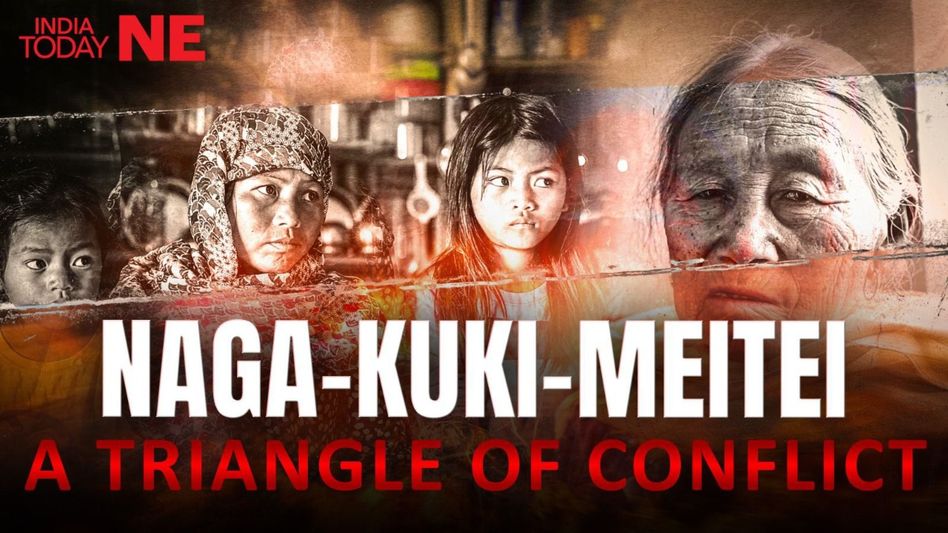
WATCH: HOW MANIPUR'S CONFLICT BECAME A NAGA-KUKI-MEITEI TRIANGLE | ITNE REPORT
Following the killings, several Kuki organisations alleged the involvement of Naga armed groups. Naga organisations denied the allegations and demanded an impartial investigation. As of now, responsibility for the attack remains disputed.
Regardless of who carried out the killings, the incident became a major turning point in Naga-Kuki relations.
Shortly after the killings, retaliatory abductions were reported from both communities.
According to reports, twenty-eight Kukis were abducted from Senapati district and adjoining areas and twenty Nagas were abducted from Leilon Vaiphei village and neighbouring locations in Kangpokpi district.
On May 14, within twenty-four hours of the abductions, fourteen hostages from each side were released following negotiations. However, fourteen Kukis and six Nagas remained in captivity.
A breakthrough came on June 8 when the remaining fourteen Kuki hostages were released alive after twenty-five days in captivity.
However, concerns remained regarding the whereabouts of the six missing Naga abductees.\
On June 9, security forces conducting search operations recovered six dead bodies of the missing Naga abductees near Leilon Vaiphei village in Kangpokpi district, according to the testimonies of family members of the dead Nagas.
Following the violence and abductions, Nagas living in Kuki-majority areas moved to Naga-dominated regions, while Kukis living in Naga-majority areas relocated to Kuki areas. Several relief camps have been established to accommodate displaced families.
On May 17, the United Naga Council announced an inter-district bandh along National Highway 2, citing concerns over the hostage crisis and the deteriorating security situation.
The blockade has had a particularly severe impact on Kangpokpi district.
Since the Meitei-Kuki conflict began in 2023, the Imphal-Kangpokpi route has remained largely inaccessible to Kukis and the Meiteis. As a result, NH-2 became the primary lifeline connecting Kangpokpi to Nagaland, Assam and the rest of the country. Essential commodities, fuel, medicines and other supplies have largely depended on this corridor.
With disruptions along the highway, prices of essential commodities have increased sharply. Residents report that the cost of rice, cooking gas and fuel has risen to unprecedented levels, placing enormous pressure on households already struggling with displacement and loss of livelihoods.
Stocks of food grains, cooking gas, fuel and medicines are reportedly dwindling, raising fears of a humanitarian crisis in parts of the district. The situation is particularly concerning for vulnerable groups, including internally displaced persons, widows, daily wage earners, children and the elderly.
The impact of the blockade is perhaps most visible in the lives of ordinary residents struggling to cope with rising prices and dwindling supplies.
ALSO READ: Shelter Without Security: “Daughters of Manipur” in Relief Camps, Three Years On | Ground Report
Hatneithem Haokip, a widowed mother of three from a village in Kangpokpi district bordering Imphal West, says the economic disruption has pushed her family into a daily battle for survival. With the cost of essential commodities soaring and employment opportunities virtually non-existent, she now relies largely on forest produce, corn and whatever food she can gather locally to feed her family.
One of her children, a young son, has already been sent to live with relatives so that the family can manage its limited resources. Despite the hardships, Haokip says she remains determined to provide for her children.
"I will do whatever it takes for my children. There is hardly any work available because everyone is facing the same difficulties, but I will continue searching for work and keep fighting for my family," she says.
A sack of rice costs nearly 5 thousand in Kangpokpi, and a gas cylinder costs more than 5 thousand, and petrol is a whopping 230-250 rupees per litre.
At a relief camp operating from a church in Makhan village of Kangpokpi district, families of the six Naga abductees whose bodies were recovered on June 9 continue to await justice and accountability. Many of them spent nearly a month hoping their relatives would be rescued before search operations confirmed their deaths.
Among them is Wibonliu Chawang, the wife of Phenrilung Chawang, one of the six victims. Wibonliu was abducted along with her husband while the couple was returning home after purchasing medicine for their sick child. She was released during the first round of hostage releases on May 14, but her husband remained missing.
"After we were separated, I never saw him again. Every day, I waited for some news and hoped he would return," she said.
For weeks, the family continued to believe that Phenrilung might still be alive. That hope ended when security forces recovered the bodies of the six missing abductees during search operations in Kangpokpi district.
According to family members, Wibonliu identified her husband's remains through the clothes he was wearing on the day of his abduction, as the body was completely mutilated.
"I recognised him from his shirt," she said.
Phenrilung was the primary earning member of the family, and his death has left his wife and children facing an uncertain future.
ALSO READ: Chapter One: Tronglaobi bomb attack kills two kids; mother survives, but nothing remains
While the families of the deceased Naga abductees continue to seek justice, the experiences of the released Kuki hostages provide insight into the other side of the hostage crisis.
For families at the Makhan relief camp, the incident has become a defining moment in the ongoing tensions between the two communities. While investigations and demands for accountability continue, relatives of the victims say their immediate concern is ensuring that those responsible are identified and brought to justice.
In Kangpokpi district, several of the Kukis who were released after nearly a month in captivity remain reluctant to speak publicly about their experiences. Many continue to show signs of trauma and are unwilling to discuss the circumstances of their abduction in detail.
Among them is Sehminhao Chongloi of Taphou Kuki village, located near the Senapati border. According to his account, he was abducted while returning home from the forest. He was travelling in a public vehicle when it was stopped by a mob, and he was taken away.
Weeks after his release, Chongloi remained hesitant to speak about what happened during his captivity. During conversations with this reporter, he repeatedly avoided discussing specific details and said he did not want to talk about the conditions under which he was held.
"I cannot say much about what happened. I made a promise, and I do not want to break it," he said.
Although he did not elaborate further, his reluctance to revisit the experience reflected the continuing psychological impact of the incident.
The reluctance of the released hostages to speak openly has made it difficult to reconstruct a detailed account of their captivity. Community leaders say many of those who returned are still coping with the experience and prefer to remain out of public attention.
The hostage crisis also affected entire villages. Families spent weeks without information about the fate of their relatives, while negotiations between community leaders, civil society organisations and government authorities continued. For many households, the uncertainty surrounding the abductions became one of the most difficult aspects of the crisis.
Although all twenty-eight abducted Kukis were eventually released alive, community leaders argue that the incident has left a lasting impact on the affected villages. Many residents continue to view the episode as evidence of the deteriorating relationship between the two communities and the growing insecurity in the hill districts.
The experiences of the released hostages differ significantly from those of the families in Makhan who lost relatives during the crisis. Yet both communities describe the same period of uncertainty, fear and disruption. Together, their accounts illustrate how the hostage crisis has affected civilians on both sides of the emerging Naga-Kuki divide.
As the crisis deepened, different organisations and community leaders offered sharply differing interpretations of the violence, the hostage crisis and the events that followed. While all sides condemned the loss of civilian lives, there remains little agreement on who bears responsibility for the escalation.
Naga civil society organisations have strongly rejected allegations linking Naga groups to the May 13 killing of three Kuki-Zo church leaders in Kangpokpi district.
Pricilla Thiumai, President of the Naga Women Union, Manipur, questioned the allegations that Naga groups were responsible for the attack. Referring to the location of the ambush, she argued that the area is surrounded by Kuki villages and questioned how Naga militants could have entered the area, carried out the attack and escaped without being detected.
According to Thiumai, the allegations against Naga groups are baseless and divert attention from what she believes should be the focus of investigations. She alleged the involvement of the Kuki National Front-President (KNF-P) in attacks and violence against Nagas and urged the government to take action against groups operating under the Suspension of Operations (SoO) agreement.
She also expressed concern over the condition in which the bodies of the six Naga abductees were recovered. Describing the killings as extremely disturbing, she called for a thorough investigation and stated that the government must act swiftly to prevent further escalation. Thiumai warned that public anger within Naga areas remains high and that the prolonged delay in justice could deepen tensions between communities.
Kuki Inpi leaders have also condemned the killing of the six Naga abductees and distanced the Kuki community from the incident.
Thangminlen Kipgen, President of Kuki Inpi Sadar Hills, said the organisation was not aware of the whereabouts of the six missing Nagas and maintained that had community leaders known where they were being held, efforts would have been made to secure their release.
Kipgen described the broader conflict as a consequence of a misunderstanding that began with a drunken altercation in February and subsequently escalated through a series of retaliatory incidents. According to him, Kuki villages and civilians have also suffered significant losses during the violence, including casualties and the destruction of villages.
He argued that despite these losses, Kuki organisations attempted to prevent the situation from escalating into a larger ethnic conflict. Kipgen also alleged the involvement of NSCN-IM and United Naga Defence Force (UNDF) elements in attacks on Kuki villages and in the abduction of Kuki civilians, allegations that Naga organisations deny.
The violence has also renewed debate over armed groups operating under the Suspension of Operations agreement with the Government of India.
Rohan Kuki, representing the Kuki National Front (KNF) in the Joint Monitoring Group of the SoO framework, rejected allegations linking the organisation to the killing of the six Naga abductees.
Speaking to India Today, he said the KNF had no involvement in the incident and argued that the group's name is repeatedly mentioned whenever violence occurs involving Nagas or Meiteis. According to him, such allegations are intended to derail ongoing peace negotiations between Kuki armed groups and the Government of India.
Rohan Kuki maintained that any attempt to attribute the killings to SoO groups without evidence risks undermining the peace process and creating additional obstacles to political dialogue.
The Coordinating Committee on Manipur Integrity (COCOMI), one of the most influential Meitei civil society organisations, views the developments through a broader political and security lens.
Shanta Nahakpam, spokesperson of COCOMI, argued that the current crisis cannot be separated from larger questions surrounding insurgency, territorial demands and the future political structure of Manipur.
According to Nahakpam, Meitei and Naga organisations share concerns regarding what they describe as unchecked illegal immigration and the activities of armed groups operating under the Suspension of Operations agreement. He alleged that the Central Government's approach towards Kuki groups has contributed to growing distrust among both Meiteis and Nagas.
Nahakpam further argued that while some Meitei extremist organisations and Naga groups have historically pursued demands related to sovereignty or separate political arrangements, including a separate constitution and Flag, Kuki groups have focused on demands for a separate administration or Union Territory. In his view, the Centre's engagement with Kuki organisations has created a perception among sections of Meitei and Naga society that Kuki groups are receiving preferential treatment.
COCOMI has also linked the current situation to ongoing debates surrounding demographic change, illegal immigration and the demand for mechanisms such as the National Register of Citizens (NRC) before any future census exercises are undertaken in the state.
The differing positions taken by Naga organisations, Kuki civil society groups, armed group representatives and Meitei organisations illustrate the complexity of the crisis.
Each side points to its own casualties, displacement and grievances. Each side accuses the other of responsibility for the violence. While investigations continue and many allegations remain unverified, the competing narratives have become a significant obstacle to rebuilding trust between communities.
For the state government and security agencies, addressing the violence will require not only maintaining law and order but also navigating a deeply polarised environment in which facts, perceptions and long-standing political disputes are increasingly intertwined.
More than six weeks after the United Naga Council called the May 17 blockade on National Highway-2, the shutdown continues, leaving Kuki-dominated Kangpokpi effectively landlocked and deepening the humanitarian crisis. Even as Kuki organisations intensify their protests, demanding the restoration of unrestricted traffic, there is no immediate resolution in sight.
As the blockade enters its 46th day, another vital lifeline remains cut off—leaving the people of Kangpokpi, like many across conflict-hit Manipur, caught in the crossfire of a crisis with no clear end.
Three years after Manipur descended into ethnic violence, the state's divisions are becoming more layered rather than less. The valley remains separated from the hills, while the hills themselves are witnessing new tensions between communities that had largely remained outside the main conflict. The hostage crisis of 2026 may ultimately be remembered not only for its tragic human cost but also as the moment when Manipur's conflict entered a new phase. As political negotiations, security operations and competing narratives continue, one question remains unanswered: can the state prevent these emerging divisions from hardening into another long-term conflict, or is Manipur witnessing the opening of yet another chapter in its prolonged crisis?
ALSO WATCH: